
The hottest Class 40
Tuesday November 28th 2006, Author: James Boyd, Location: Transoceanic
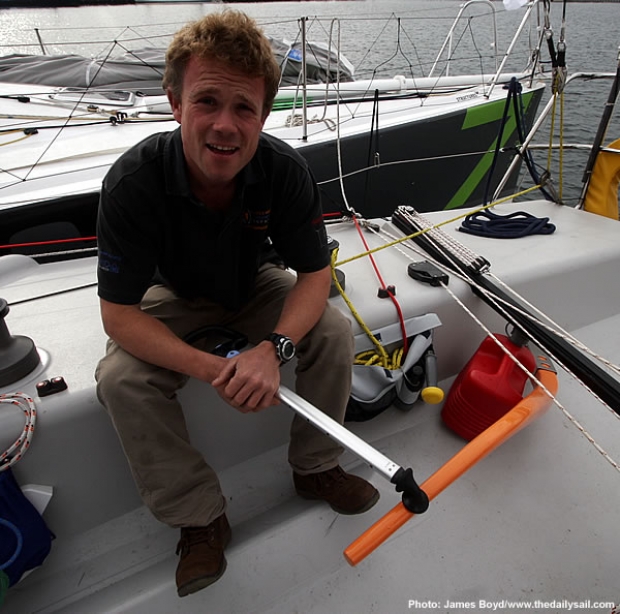
After years of hard graft racing without sponsorship in the Mini class or working as a perpetual shore crew/boat builder, Britain's other singlehanded sailor from Derbyshire, Ian Munslow, finally this year managed to secure backing from an Irish property development company allowing him to mount a Class 40 campaign in the recent Route du Rhum. In this Munslow finished a creditable third behind Phil Sharp and Frenchman Gildas Morvan.
"There happens to be a big development going on in Ireland, Bollands Mill, and it is at an embryonic stage. The site has been bought and I came along at the right time," says Munslow of how he came by his sponsorship.
The all-important meeting between Munslow and Bollands Mill took place in January this year. At the time Munslow says had no specific plans to campaign a Class 40, he just wanted something he could graduate up to from the Mini. "Richard [his sponsor] wanted a competitive boat. You can get any old donkey, but he didn’t want a donkey," as Munslow puts it is his unique vernacular.
Once the Class 40 had been decided upon the plan originally was to find an existing boat to charter, but when the scarcity of boats became rapdily apparent, the Class 40 being so new still, designer Merfyn Owen pointed out there was a build slot available at Jaz Marine in Cape Town for one of his Owen Clarke designs. While the first of these, belonging to Jonathan Crinion, didn't make the start of the Route du Rhum (and is now up for sale), Munslow's new Bollands Mill was the second to be launched, and the result tied up in the dock in St Malo appeared to be one of the most sophisticated Class 40s in the Route du Rhum. Whereas a majority of Class 40s are production boats, Bollands Mill is a semi-custom built boat and is also an out-and-out racer with the minimum of fit-out to meet the rules and no semblance of being a cruiser racer.
With a price tag all up of 320,000 Euros (according to Munslow), the difference between this boat and a standard Pogo is the build quality and the standard of fit-out. As designer Alan Clark puts it: "What you get coming out of that yard is a full-on ready to race yacht. All the deck gear is speced to go across the Atlantic or go around on the Global Ocean Challenge (Josh Hall's race aroud the world for these boats)." You also get almost a custom-built boat. For example while Jonathan Crinion's yacht has windows in the cabin top, Bollands Mill has none (a la Mini). The former aso has a deeper narrower cockpit.
Depending upon who you speak to few of the Class 40s are at present near the minimum weight of 4.65 tonnes, however Bollands Mill's builder Uwe Jaspersen maintains that Munslow's boat was just 7kg over when she was built. As only basic glass construction is allowed it is hard to par weight from the structure in the extreme way as can be done with carbon fibre. The construction of her hull is in standard multi-axial glass cloth with a foam core and epoxy. Uni-directionals are used in the structure. As a result in the Route du Rhum Bollands Mill was believed to have the largest bulb among the Class 40s.
On first glance Bollands Mill appears to be narrow, but this is only at deck level. The published figures indicate a beam of 4.3m, compared to 4.4 for the Finot-Conq designed Pogos and 4.5 for the Lombard and Rolland designs. Alan Clarke explains why they went down this route: "There is no great mystery to it. We did a systematic series of hull testing and we went to 4.5m hull and we found there was no benefit. Every time we did the number crunching it pointed to a boat of that beam [4.3m] and in the light I think we are probably slightly quicker. There are different parameters to a 60 and we are limited by the water ballast. Also you are keeping the boat fairly light and you need to if you are using these materials. You don’t want a huge boat because it is going to be heavy."
It should also be pointed out that the remit for Class 40s is slightly different to Open 60s in that they are expected to go around the cans. Saying this prior to the Route du Rhum Bollands Mill competed in the Little Britain Cup and was nailed on the water upwind by the Farr 40s but downwind was up with the old Whitbread 60s.
Bollands Mill's cockpit arrangement is very Mini-like with twin tillers each attached directly to the top of a rudder. There is a central winch for the main sheet. "The boat is quite physical, but it is simpler to sail than a Mini," says Munslow, comparing his new steed to his old steed he raced twice previously solo across the Atlantic. "The cockpit is quite wide. They’re bigger, heavier loads. There’s no shelter at all. Nearly all the other boats they can hide away. Some have got something like a patio on the back!" Saying this the boat does have a slight cabin top overhang into the cockpit.
Builder Uwe Jaspersen is also a friend of ABN AMRO One and now Alinghi bowman Jan Dekker, who's input went into some of the Bollands Mill deck gear. For example like ABN AMRO One, she has no jib sheet tracks, instead using a system of barber haulers to set the clew position. There is a also a 2:1 purchase system for the headsail downhauls, running back from the foredeck as also featured on the black boat. All lines running aft from the mast go around the side of the cabin top rather than through it as is reguarly being done with the Open 60s these days.
Above decks Bollands Mill was the only boat in the Route du Rhum with a triple spreader rig. The mast was made by Southern Spars and is a Farr 40 section but with a different laminate. Spreaders are swept back and the shroud base is the maximum allowed by the beam on deck. Sails are by North South Africa. While some of the boats have a movable bowsprit on Bollands Mill it is fixed.
Down below as we have mentioned it is sparce in the extreme. There is a central island housing the engine compartment and with the basic Mini-style one burner camping gas stove on top. Forward of this is the chart table, slung off the aft side of main bulkhead. In practise this is little more than a table large enough for a computer keyboard. To port and staboard are pipecots and stowage.
While the saloon floor is divided up with substantial frames, the boat features three watertight bulkheads (although two are required under the class rules) and there is the facility to add a fourth easily.
Running beneath the forward end of the cockpit is the plumbing for the water ballast. Class 40s are allowed 750lt of water each side and canting keels are banned. "Is 750kg enough water ballast?" we put it to Alan Clarke. "It is enough actually. The boats have turned out to be quite awesome beasts in comparison with the more cruiser-orientated end of the Class 40s. We are using pumps that can fill the ballast in two minutes and transfer in 45 seconds. To be honest any more and it is just taking more time."
The Route du Rhum
Speaking to us from Guadeloupe Munslow says he is pleased with his third place and the boat. "The boat is a glamour. It is probably the best boat here at the moment, maybe not next year, but at the moment. I won the prize for the fastest boat around Guadeloupe as well - and that was upwind. The last bit coming in with genniker we were doing 10 knots and at the start I was second at Cap Frehel, I just motored straight through the fleet. With the Zero up it just goes like a beast. I was lucky in the light stuff. Once you get the apparent going it doesn’t take a lot of wind to keep the boat sniffing along." He feels this may be due to the displacement and trim - Bollands Mill's transom was higher out of the water when examined on the dock in St Malo and Munslow would chuck everything below forward when sailing in the light to further reduce transom drag.
During the race Munslow worked with weather routers Eduardo Valderas and Roger Nilson, who were also consulting Team New Zealand met guru Roger Badham. In fact they were handling all the navigation. "The way they did it, they didn’t send me any GRIBs, they just sent me waypoints and predicted wind angles and speeds. So I didn’t know the weather anywhere else on the course. So in your mind you are not looking at something and thinking ‘I should be over there’. You’ve got the one option and you live with it. So I left the nav completely in their hands." He spoke to Valderas every day and says that Nilson joined the party after Steve Ravussin (who'd been routing) capsized. "Their weather was absolutely spot on. The only thing was the approach to Guadeloupe and they admitted they didn’t know whether to go inshore or offshore and they left it with me. They were getting wind shifts accurate to 10-15 minutes. It was pretty good. I’ll definitely use them again."
While race winner Phil Sharp reported his top speed as being 20 knots during the Route du Rhum, Munslow says that he managed 25! That was in 45-50 knot winds under four reefs and staysail. "It feels like you are tearing the sea apart. The noise is like…. And it was under pilot as well. I was inside the boat."
Munslow says he was regularly surfing at 20 knots. As to his most hairy moment...? "I didn’t hit anything. I didn’t do any really dirty crash gybes which are always horrible. The hairiest moment was just the speed and when I lost the fractional kite, and I was trying to wrestle it out of the water around the back of the rudders. And it is always in the dark. That was unpleasant.
"Roger woke me up. He asked me what the wind was. '22-23 knots'. And he said, 'okay, you need to put more sail up'. So I did that only we didn’t account for the sea state. I put the kite up and the boat just lit up, like whaaaa! Two reefs and the fractional kite and it was just too much. It just tore the head off the kite and then it was dragging in the sea. And I was pissed off, because you’ve only got eight sails and when you take out the storm sails that’s only two kites and your Code Zero to play with, so you have to look after them with kid gloves.
"After that I only had the big kite, so whenever I had that up I stayed on deck, I’d kip in the cockpit. I just couldn’t afford to do a broach and I put a hard ceiling of 20 knots on that because without a big spi and you’d really be going slow. The fractional was 20-30 knot sail."
Worse was to come. "So I was under genoa after 20 knots downwind and because I was using that downwind, it was flogging behind the main and so the leech started to disintegrate. Because the jib’s permanently lashed on I had to go up the rig and do a sail repair in mid-air. I haven’t been up a rig solo before because I never had to in the Mini. I had to do it four times in this race. The first time I was really nervous. The third or four time it was no problem. It was just a case of getting used to those ascenders. Your asshole is in your mouth. You are sat at the top of the rig and you are going ‘no one can help me now’. Some people they don’t like being solo, but solo and up your rig - that is not happy. Imagine if you got stuck up there...."
In retrospect Munslow says he should have taken a furling Code 5 rather than the fractional kite in a sock. "I couldn’t get it down because of the windage on the sock and I didn’t have the snuffer line long enough and I ended up losing it, because you are carrying it in 35 knots. By the time you need to get it down it is already a bit late in the day whereas on a furler you just blow the sheet and furl it up."
These problems would have come to light he feels had he managed to sail more prior to the start of the Route du Rhum. But the 2,500 miles he put on the clock did include an encounter with the tail end of a hurricane with sustained 40+ knot winds for two days that allowed him to use the fourth reef in anger. However he admits he hadn't tried the boat in anger hard running.
Because of his lack of pre-race miles in the boat there were a number of problems that came to light during the Route du Rhum. "In the first downwind stuff I had this problem with the rudders where they were loaded up because I had the toe-in angle wrong and that loaded up the pilot ram so heavily it bust it," recounts Munslow. "I played around with the rudder angles and got to a compromise where it wasn’t as bad as it was. It is a common problem throughout the fleet. Once you put twin rudders on the boat, it gets quite hard to get the angle right so they don’t load up too much, because they are fighting each other."
Both Phil Sharp and Gildas Morvan reported having rudder issues during their race. "You can see why the 60s have the kick-up rudders because it instantly gets rid of the problem. If you can kick on out the way they are not fighting each other. It’s just easier," says Munslow. Because of his rudder troubles after his fast start he backed off a little in the running conditions for fear of breaking his only other autopilot drive unit.
Unlike some of the other Class 40s in the Route du Rhum Bollands Mill experienced no problems with her structure. Munslow admits that the breakages that did occur were down to him. "The main sheet set up is like an Open 60 so you get that slack loop of mainsail if you inadvertently gybe, and that nearly ripped a tiller out when I got it looped around one of them in the dark. I did rip off the top of one of the runner winches by doing that. I also broke a batten but that was because I had a fractional kite halyard round the back of the roach of the main and I thought it had popped through on a gybe and it hadn’t and that broke the batten." He is also going to beef up the halyard/jammer arrangement.
From here
Munslow is currently still in Guadeloupe waiting for Bollands Mill to be shipped back to Europe, where it will spend the winter between Plymouth and Dublin. Although it hasn't been formally confirmed Munslow expects to continue campaigning her next year. The official Class 40 program will be announced at the Salon Nautique in early December and is expected to include Pen Duick's Lorient-Bermuda-Lorient (or a shortened version of it to the Azores and back), the Rolex Fastnet Race, some sort of Solitaire du Figaro-style triangle course to from Brittany to Ireland, etc and also the Route de l'Equator down to the Congo or "AK-47 city," as Munslow puts it. "That is just not appealing to me at all." The 2007 season will round off with the two handed Transat Jacques Vabre. The TJV will be an essential race as there could very easily be forty Class 40s on the start line.
While there is nothing formally happening at the moment to divide the Class 40 into Series and Proto classes like the Mini as has been rumoured, more restrictions are expected in the class. This may include the addition of a maximum righting moment figure (as present there is a minimum figure for when the boat is heeled by 90°).
Whle it seems certain that Munslow will be campaigning the Bollands Mill Class 40 again in 2007, he is also looking for rides on bigger faster boats. "My envelope has opened up a bit more after a good result. Hopefully I can keep out of boat sheds a bit. Less grinding and laminating.,,,"

Most Read
Most Commented
Comments
Businesses
Pro businesses
-
-
France
-
France
-
United Kingdom
Editor's choice
Member blogs
-
 Ned Collier Wakefield: MOD70 round BarbadosWell that was intense. 12 hard fought for seconds for the win. In idyllic conditions, Tony Lawsons MOD ...
 -
 Mini Transat leg 2 reportThe second leg of the Mini Transat started on 31st October, just over a month after ...
 -
Leg 1 reportI’ve been working towards the Mini Transat now for three years. In 2013 I was part ...
Business blogs
-
 The Island Sailing Club in Cowes, Isle of Wight, is delighted that Prince Michael of Kent ...
 -
Peta Stuart-Hunt chats with the 25 year-old British solo sailor Lizzy Foreman before she sets sail ...
-
The 2015 Student Yachting World Cup (SYWoC), an ISAF-recognised event hosted and run by students for ...
Editor's Choice
All time favourites...
-
 Three legs down into Ian Walker’s
 -
 Winning all but two races at
 -
 For the first time in its
Latest Comments
Add a comment - Members log in