
Mastman of Rhode Island
Tuesday May 13th 2003, Author: James Boyd, Location: United States
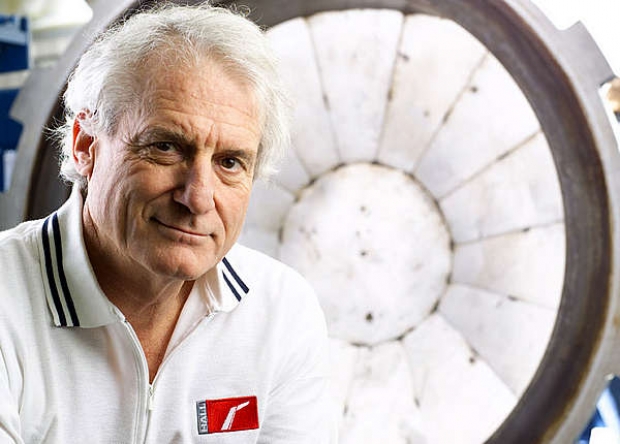
Hall Spars' recent claim to fame was that they were the purveyors of finest mast-wear to Alinghi, while all the other America's Cup campaigns went to Southern Spars. I am impressed that it is more than 10 minutes into our interview with Eric Hall before he mentions this supreme marketing coup almost in passing.
Hall Spars have their headquarters in Bristol, Rhode Island in the same marine square mile as Carroll Marine and Eric Goetz. Just over two years ago they merged with Proctors in Holland and then moved that company into a new building in Breskens. While the marine industry in the States is falling on hard times (several companies nearby are laying off staff) Hall Spars in contrast are soon to expand into a new premises next door such is the demand for their work.
Hall Spars began primarily as an OEM manufacturer for the likes of J/Boats, Carroll Marine and Sabre Yachts (who make cruiser racers). But for more than two decade they have also been well known for their racing yacht spars.
"As racing masts got bigger we went along with it," remembers Hall. "We did a lot of stuff originally in the 40-45ft range in aluminium and when the 50 footer craze was going on we did our fair share of those, and we’ve done a bunch of maxis masts in aluminium."
They started making carbon fibre spars such as spinnaker poles in 1984 and in 1989 went from using a wet lay-up to pre-preg in a vaccum oven. The major development came in 1991 when they acquired their sizable autoclave.
"We knew all along that an autoclave oven was required to really do the job right," says Hall. "We decided to make the splash prior to the 1992 America’s Cup. We got heavy support from the America3 group to kick it off."
Hall adds that they thought it would take some time for carbon masts to take off, but in a matter of 2-3 years income from their carbon fibre work was outstripping that of their alloy spars. Aside from the America's Cup work, this was no doubt helped by several forward-looking production builders offering carbon fibre spars for their boats. J/Boats for example were offering these when they introduced the J/120 and J/130 in the mid-1990s.
So what makes Hall Spars different from the others? Eric Hall believes it is attention to detail. However compared to many other spar manufacturers their techniques for building carbon fibre spars is very different.
Their spars are laid up using uni-direction pre-preg carbon fibre over a mandril, like a male mould. Lamination is carried out by hand rather than by a filament winding machine. "There is no join along the sides or the front and back, that just about everyone has," explains Hall. "Our tooled surface is on the inside, so the inside is baby arse smooth, and there is nothing for the halyards to catch on. When you make a mast in two pieces, you are invariably inserting little pieces inside with wet lay-up or glue, so you get little roughnesses inside. And the fact that there is no join just makes the mast that much less complex structurally."
He admits that the hand lay-up process is labour intensive. "It may not lend itself to getting out of the door quickly, but what does go out of the door is just fantastic and autoclave curing allows a very nice exterior surface." Hall says that thanks to their autoclave crushing the laminate down at six atmospheres pressure they can get away with just a light sanding before their spars are clear-coated. "Not even someone with a tooled outside surfaces that glues them together can get that. They still have to fill the join part and maybe even cover it up before they can clearcoat it. Whereas we just sand it and coat it, we put 2-3 coats on and there is no filler. You can see everything."
Filament winding, Hall says, limits you to laying up fibres at certain angles. "It is very difficult to filament wind axial in zero direction [ie along the length of the spar] and we put a lot of zeros in and that makes the masts much stiffer than a filament wound mast could be. It is labour intensive but our guys are good at it."
Aside from crushing the laminate down the autoclave also ensures the optimum wet-out of the carbon fibre. Ironically while Hall Spars' autoclave can operate at up to six atmospheres pressure, the limit allowed for America's Cup spars is only three. All the carbon fibre spars, even ones for production builders pass through the autoclave, "so a J/130 mast has got a higher tech laminate than an AC mast has!" says Hall.
Laminates are cooked at the industry standard 120degC. Hall says you can get resins that work at higher temperatures still, but these are only suitable for use in the aerospace industry.
In the use of high modulus carbon fibre, Hall is vociferous. The use of this was widely accepted in France as being the cause behind the plague of rig failures that has beset the Open 60 and 60ft trimaran classes over the last two years. In the Route du Rhum 80 knot winds certainly were a contributing factor but this does not explain the numerous dismasting that occurred in much more benign conditions. Hall says that at Hall Spars they regularly use high modulus M40J carbon fibre as a matter of course in high tech racing spars where class rules allow it and that they have done so without problems.
"All I can say is that we haven't seen this problem. As the modulus goes up so the breaking strain goes down and there may be a case to be made for that, but that is not what principally is the problem with mast design." The only theory he comes up with is that because high modulus carbon requires less fibre to be used the wall thicknesses of the spars that failed may have been too thin. "As much as we think mandril moulding is the best way to go, I think someone making high modulus masts in female moulds should be able to succeed. Who knows what their problems were, but I think their problems weren't the use of high modulus."
Projects
The Alinghi deal came about partly because Southern Spars - who built the masts for all the other America's Cup campaigns - had too much on and partly because Dirk Kramers, Chief Engineer in the Swiss design team used to work at Hall Spars as did one of the other Alinghi design engineers. While Hall is unable to give anyway anything specifically about what made the Alinghi rigs so good, he says that the main feedback they got from the Swiss was that they were impressed by the dimensional accuracy of their work.
"We also gave them probably the ability to help them realise some very ambitious design details that may not have been possible elsewhere," says Hall. "They pushed a lot of envelopes and for the most part we succeeded for them."
Aside from Alinghi, Hall Spars have built the masts for Hasso Plattner's new 147ft out of Baltic Yachts in Finland as well as the maxZ86s Zephyrus and Roy Disney's new Pyewacket and the new Morning Glory. At the time of our interview they were about to ship the rig for the new Andrews 61 Transpac boat Medicine Man.
Hall says they have also done well in the Mediterranean IMS market. "We’ve just finished Cristabella and we’ve done Bribon which the King of Spain sails on."
Looking ahead Hall has his boat Blackwing which he uses as a test bed for new spars. It currently has a freestanding cat rig and Hall says that the benchmark is that it must beat a conventionally rigged boat around a race course. They have also been looking at cored structures for their spars.
However he says that it is less likely to be masts making headline developments as composite rigging in the near future. "That is the wild west at the moment. There are a whole lot of ideas out there and who knows which way they’ll end up getting sorted out."
This technology is in its infancy, he maintains, and still has a long way to go. He is impressed by the PBO standing rigging Future Fibres have been coming up with and thinks that carbon fibre rigging as is now being offered by Southern Spars, that uses an encapsulated bundle of 1mm carbon fibre pultrusions, also will be a strong player.
To see images of what goes on at Hall Spars check out the next few pages


Most Read
Most Commented
Comments
Businesses

Pro businesses
-
-
Italy
-
United Kingdom
-
Editor's choice
Member blogs
-
 Ned Collier Wakefield: MOD70 round BarbadosWell that was intense. 12 hard fought for seconds for the win. In idyllic conditions, Tony Lawsons MOD ...
 -
 Mini Transat leg 2 reportThe second leg of the Mini Transat started on 31st October, just over a month after ...
 -
Leg 1 reportI’ve been working towards the Mini Transat now for three years. In 2013 I was part ...
Business blogs
-
 The Island Sailing Club in Cowes, Isle of Wight, is delighted that Prince Michael of Kent ...
 -
Peta Stuart-Hunt chats with the 25 year-old British solo sailor Lizzy Foreman before she sets sail ...
-
The 2015 Student Yachting World Cup (SYWoC), an ISAF-recognised event hosted and run by students for ...
Editor's Choice
All time favourites...
-
 Three legs down into Ian Walker’s
 -
 Winning all but two races at
 -
 For the first time in its
Latest Comments
Add a comment - Members log in