
Team racing
Friday June 2nd 2006, Author: Toby Heppell, Location: United Kingdom
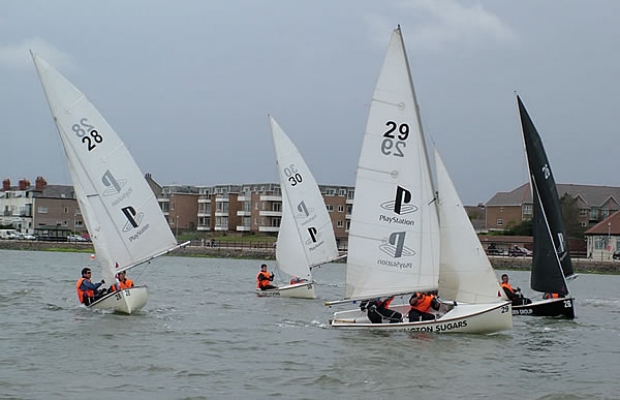
Most dinghy sailors in the UK have had some experience of team racing, predominantly for three years while they are at university. However, following graduation many people stop their team racing and begin fleet racing again on a much more regular basis. This leaves team racing as an odd little wing of the sport that most have done but few do really well.
There are teams who continue to race post-university and although small in number they are regularly seen on the circuit through the season. One such team is Magnum who recently finished as top UK team at the Wilson Trophy, the effective holy grail of UK team racing.
Speaking to Chris Webber and Alistair Morley, both members of Magnum, it is clear that although team racing is a passion it is also a great excuse to meet up and have a bit of a laugh. Having said this they are unquestionably very competitive when it comes down to the actual sailing and their desire to win seems to grow the more they race.
Magnum was originally an Oxford old boys team who got together yearly to compete for the annual Oxford University team race event, the Magnum. However, over the years people have come and gone until there is now an eclectic mix of individuals who attended a variety of different universities who do the whole circuit. It is essentially now about a bunch of friends doing what they love.
Over the years as the people involved have changed, the ethos of the team has also developed. “When I first joined, about three years ago, it was three old Oxford captains helming and we did lots of training for boat speed and things like that," comments Morley. "At the same time there were quite a few other university people who would come." As time has progressed and jobs become more important training has become somewhat limited and now tends to take place on a less regular basis.
The appeal to go racing and the competitive spirit is still very much there and they try to do every event on the team racing calendar, which amounts to about ten competitions over the course of the winter. Webber believes one of the reasons they have stayed competitive as a team is the amount of time they have been a part of the sport. ” It is much more tactical and it is much more mentally difficult than fleet racing. With fleet racing you seem to get these guys that just have this instinct for it and they are just talented. You don’t get that in team racing - it is all about how much time you have put into it,” he says.
The decision for most of the team to continue racing upon graduation was based on three major factors. Immediately after leaving university the cost of buying and running a boat for any fleet racing campaign is immensely high, not to mention the cost of towing the boat to events and maintaining a car. At most team racing events boats are supplied by the organisers so there is no real need to invest in a boat. This makes the preliminary commitment significantly smaller. Additionally Webber says that team racing for most is limited to university - there are some schools around the country that do team race but these are few and far between. The major problem with this is; for the vast majority team racing experience is limited to the length of time they are at university which, Webber believes, is too short to really get to grips with the sport. The final reason, perhaps with the biggest sway, is the famous team racing social scene which always involves lots of nights out with friends drinking more than modest amounts.

Many members of Magnum do not only team race and as the season is through the winter in the UK they find it fits in extremely well with fleet racing. Webber says he believes all forms of racing compliment each other well and he tries to do anything that he can. He also comments that many of those that team race both in and out of university use it as an effective winter filler.
During the season just gone team Magnum have won all but two of the events they have competed in. One of the events they did not win was the Wilson Trophy where, as previously mentioned, they were top UK team but lost out to two US teams at the event. The US team that won the event, WHishbone, are current team racing world champions and we wondered how much better, if at all, the US was compared to the UK. “The States are miles better than any UK team," says Webber. "The two teams that were in the final of the Wilson - WHishbone and Silver Panda - were head and shoulders better than anyone else there. What the Americans do well is they constantly do all the team moves rather than sailing fast. They really, really team race."
"They know all their plays and they know exactly what everyone on their team is going to be doing in a given situation,” Morley adds.
This has not always been the case, according to Webber and Morley there was a time when the UK was the dominant force on the team racing world stage, but the state of team racing in the UK tends to vary quite wildly. “I think it is all relative. It is much better now than it was eight or ten years ago, but it is not as good as it was two or three years ago,” explains Webber. “It was dominated for a couple of years by two GBR teams, Pirates and Spinnaker, and they really set the standard. Now they are doing less as they get a little older and it looks like they will doing much less in the future. Nobody really seems to have stepped up to fill the void that they left.”
Although not dominant on the world stage at this particular moment, Morley thinks the UK is still very good. He says that much of what the US teams do well comes with a lot of training and this is something that is being looked at hard. Additionally he lists a whole host of teams - West Kirby Hawks, West Kirby 1, Tabby Cats and Society - that he believes with a little more experience could give the US a run for their money at the next worlds in 2007.
The issue of national support is always tricky in every wing of the sport. Although there are some that think the RYA could have done more, for the most part team racers think the job has been done well. “I think if anything the powers that be were a little bit complacent," says Webber. "They had two world beating teams for quite a while and they could just keep sending those two to every international competition that came around. I don’t think that they had enough foresight with regards to developing what would happen when those two started to hang up their wetsuits.” This problem is currently being met head on by several groups of people both in and out of the team racing fraternity. Regular racers are sitting on the RYA committee for team racing and are working alongside them to try and build a better coaching system for the sports development. Certainly this feels like a renewed interest and it may be just the push that some of the more experienced teams need.
Although the Americans who were first and second at the Wilson Trophy are far and away better than the UK teams this was far from the case with all the US teams competing there. Both Webber and Morley are unsure as the state of team racing in the US as a whole but think they are in the same situation as the UK was a few years ago with two great teams and a competitive up and coming pack just behind them.
Magnum, it would seem, started out its life as a group of people out of university that did not want to stop team racing nor miss out on the social side of the circuit. Since then as the team and its members have grown older it has become much more established at the top end of the team racing circuit. There are now quite a lot of university leavers making new teams and the ground work for a strong domestic circuit is certainly there. The next World Championship in 2007 is to be held at West Kirby SC and as such should see a number of teams aiming for a good spot. So far as Magnum goes; they are keen to do the event and have agreed to up their training hours in the hope of taking the title. As Webber says if he looks back on his life at 70 and has not given the worlds a proper go he will be very disappointed. They do also mention that despite their renewed training effort they might still find some time for the social side of events.
Most Read
Most Commented
Comments
Businesses

Pro businesses
Editor's choice
Member blogs
-
 Ned Collier Wakefield: MOD70 round BarbadosWell that was intense. 12 hard fought for seconds for the win. In idyllic conditions, Tony Lawsons MOD ...
 -
 Mini Transat leg 2 reportThe second leg of the Mini Transat started on 31st October, just over a month after ...
 -
Leg 1 reportI’ve been working towards the Mini Transat now for three years. In 2013 I was part ...
Business blogs
-
 The Island Sailing Club in Cowes, Isle of Wight, is delighted that Prince Michael of Kent ...
 -
Peta Stuart-Hunt chats with the 25 year-old British solo sailor Lizzy Foreman before she sets sail ...
-
The 2015 Student Yachting World Cup (SYWoC), an ISAF-recognised event hosted and run by students for ...
Editor's Choice
All time favourites...
-
 Three legs down into Ian Walker’s
 -
 Winning all but two races at
 -
 For the first time in its
Latest Comments
Add a comment - Members log in