
Ultimate sailing challenge
Friday July 25th 2003, Author: James Boyd, Location: Transoceanic
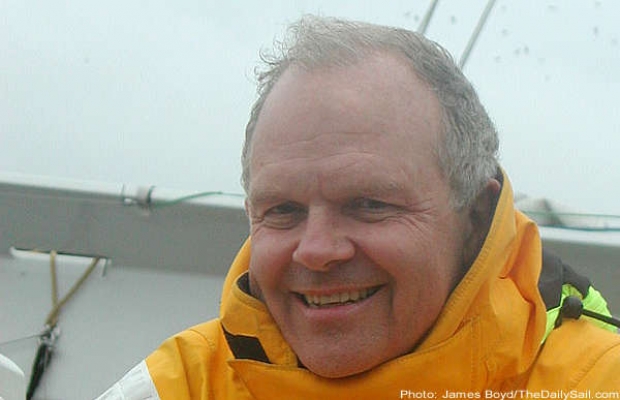
Steve Fossett announced today that next year he will not be competing in The Race, but will instead be making an attempt on the Jules Verne Trophy aboard his maxi-catamaran, now rechristened
Cheyenne.
Speaking from his home in Colorado, Fossett told The Daily Sail that the reasons behind his decision were simple. "We have not found a sponsor. Without a sponsor, the Jules Verne makes more sense to me. The Race is more appealing when you are trying to maximise media coverage."
Fossett is known to have been in serious discussions with Bruno Peyron over the possibility of his participation in The Race, but equally Fossett has always made it clear that his ultimate ambition in sailing and the reason he had his big catamaran built in the first place was to make an attempt on the Jules Verne Trophy. "That was the intent," confirms Fossett, "and to go after other important records. So we’ve done the second part of that - the other important records! We’ve had quite a good run at things. I don’t want to retire from sailing without having one good crack at the round the world record."
So is he going to retire from sailing? "I've no plans to retire - I’m enjoying it but I’m becoming increasingly active in aviation. In the long term I am going to end up being an aviator."
If an attempt on the Jules Verne record in the world's largest racing catamaran is interesting, then what he intends to achieve in the air is nothing short of extraordinary.
"I’m doing a lot in gliders," he says modestly. "I’m attempting records in all three of the aviation categories - further, faster and higher. I’ll be going to New Zealand next week for a four week session trying to take a glider into the stratosphere."
The altitude record for a glider is currently held by Robert Harris and stands at 49,000ft but Fossett says the intention for his 'Perlan Project' is more than just breaking this record. Their aim is to reach 62,000ft - effectively space - and will require him to wear a pressured suit. "For scientific reasons, we want to get substantially higher and fly into the polar vortex. It’s a co-operative project with NASA."
And this is only part one of the project. Part two will see Fossett and his co-pilot Einar Enevoldson attempting to get up to 100,000ft, a mission which will require a fully pressurised glider. To put this into perspective - a Boeing 747 normally flies at around 45,000ft while Concorde in super-sonic mode goes as high as 55,600ft.
"We were in New Zealand last August making attempts and we did some training in California. So far we’ve got to 42,000ft." To get to these altitudes they cannot rely on mere thermals but need a 'mountain wave pattern', "As the winds hit the New Zealand alps, then we fly that up and then there are a number of transitions to do."
So in comparison sailing around the world non-stop will be a walk in the park...
Currently the 125ft Cheyenne (the original name for the boat prior to the three year deal with Sony PlayStation coming along) is in Norfolk, Virginia undergoing a refit, including a complete check-up of the platform and the rig, acquiring some new sails and reinforcing others.
Fossett says that the requirements for undertaking a Jules Verne attempt are different from the records he has carried out in his maxi-cat to date. "There is a lot of preparation. There’s a requirement for spare equipment and very specifically for crew members who can repair things, whether it is electrics or sails. So it is bit different than a shorter event where you just plan on everything holding together and if they don’t you retire. In this case you have got to fix things..."
Having only made the decision to take on the Jules Verne Trophy today, Fossett has not decided upon his crew yet. However it is most likely that his regular captain, Dave Scully will be on board and the likely navigator (what else will he be doing in January-March?) will be Stan Honey.
"We are vulnerable to breakage and also to the weather going to pot," Fossett says of the potential problems they will encounter. "But I think we can learn from the other attempts that have been done recently by de Kersauson and Bruno Peyron. I have great respect for the way they’ve sailed the event."
On the breakage side he says Chayenne is a strong boat built for this type of endurance race. "We have sorted out the high loads. I think we have broken everything you can break on the boat and replaced it with something stronger! We are hoping we have got it strengthened well enough now."
Training in earnest for the Jules Verne will begin on Cheyenne in October probably from a base in the south of Portugal or Spain and will be preceeded by at least one attempt to regain the 24 hour record. If successful this will almost certainly see the 700 mile/day mark finally broken.
From 2 January Cheyenne will go on standby waiting for the right weather pattern to launch them south to the Equator on the Jules Verne record attempt. Fossett says they could be on standby for one month - "one month is no problem. But I might start getting impatient if we don’t leave within a month!"
As to a possible time for a round the world record he believes that the present generation of maxi-multihulls are capable of 60 days. Certainly if Olivier de Kersauson had continued from Cape Horn on his last attempt at the rate he sailed from Brest to the Horn, then he may well have succeeded in this. However Fossett says that 60 days would only be possible if everything came together. "The real goal is to break the existing record of 64 days."
This winter Fossett will not be alone in making an attempt on the Jules Verne Trophy. After it was going so well and then all went so horribly wrong in the Atlantic this spring for the maxi-tri Geronimo, Olivier de Kersauson has also confirmed to The Daily Sail his intention at having another crack at the non-stop round the world record.
Fossett says he is perfectly prepared to line up against Geronimo, but only if their meteorologist says 'go' at the same time as de Kersauson's. "I think Olivier shares my point of view: This is about getting the record. It is not about a sail boat race. So we are going to go on what we believe is the very best day to go."
As to the pros and cons of the two-hulled Cheyenne lining up against the three-hulled Geronimo Fossett thinks they should be evenly matched, even if Geronimo is a little smaller. "I think they’re boats of similar power. On paper they might be sailing similar speeds. We’re not afraid of that kind of a challenge because we have sailed on some of the same courses as our competitors have. For instance the Round Britain and Ireland is the the course that all the maxi-multihulls have sailed on and we have the best time. So we are not afraid of our competition, but we equally know that our competition could beat us."
Fossett and de Kersauson both undertaking Jules Verne Trophy attempts rather than The Race will be a blow for Bruno Peyron. Critics will no doubt already be sharpening their knifes, but should remember that firstly Peyron is a grand master at pulling rabbits out of hats and secondly that he feels no compulsion to show his hand before he's ready. We will be watching with interest over the next seven months to see which boats end up on to the Marseilles start line of The Race on 29 February 2004. At present even without Cheyenne and Geronimo there is no shortage of boats - only sponsors...
Most Read
Most Commented
Comments
Businesses

Pro businesses
-
United Kingdom
-
France
-
United Kingdom
-
Editor's choice
Member blogs
-
 Ned Collier Wakefield: MOD70 round BarbadosWell that was intense. 12 hard fought for seconds for the win. In idyllic conditions, Tony Lawsons MOD ...
 -
 Mini Transat leg 2 reportThe second leg of the Mini Transat started on 31st October, just over a month after ...
 -
Leg 1 reportI’ve been working towards the Mini Transat now for three years. In 2013 I was part ...
Business blogs
-
 The Island Sailing Club in Cowes, Isle of Wight, is delighted that Prince Michael of Kent ...
 -
Peta Stuart-Hunt chats with the 25 year-old British solo sailor Lizzy Foreman before she sets sail ...
-
The 2015 Student Yachting World Cup (SYWoC), an ISAF-recognised event hosted and run by students for ...
Editor's Choice
All time favourites...
-
 Three legs down into Ian Walker’s
 -
 Winning all but two races at
 -
 For the first time in its
Latest Comments
Add a comment - Members log in