
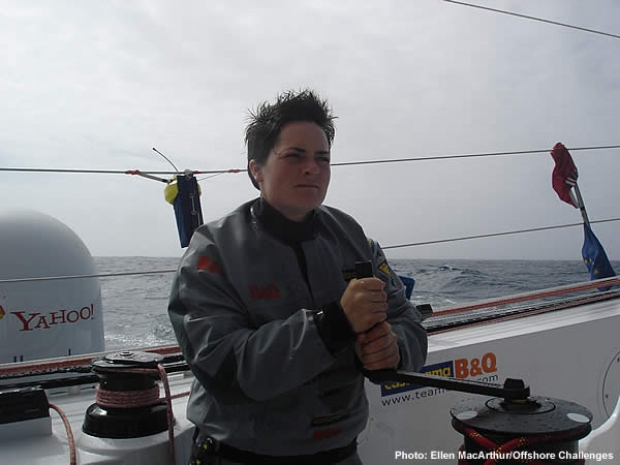
Ellen's magnificent record
Wednesday February 9th 2005, Author: James Boyd, Location: none selected
Having spent the last couple of days in Falmouth witnessing the arrival of Ellen MacArthur from her successful solo non-stop round the world voyage, we are pondering whether we are more stunned by Ellen as an individual, her amazing record or by the extraordinary media frenzy her story has generated. This morning for example Ellen's arrival appeared on the front of almost every national newspaper, while The Daily Telegraph, the UK's highest selling broadsheet, produced a 10 page pull-out section dedicated to Ellen, a scale of coverage one might typically expect from a general election or a royal wedding. Similarly ITV pulled a half hour program out of their normally sacred scheduling to insert a hastily cobbled together program about Ellen's voyage in its place.
Yesterday we were on the water to see Ellen's half Castorama blue half B&Q orange 75ft trimaran - still looking absolutely immaculate - cruise into Falmouth harbour chased by a 200-strong spectator fleet, from kayaks to RIBs to cruising yachts to passenger ferries. Having come straight from the Vendee finish in yachting crazy France, a country more accustomed to sailing celebrity, these numbers appeared to us to be similar in size to the those that accompanied Vincent Riou and Jean le Cam in to Les Sables d'Olonne last week, albeit both those arrivals taking place in the middle of the night.
Ashore, Pendennis Point at the entrance to Falmouth Harbour was teeming with on-lookers, there in the kind of numbers you might expect to see at the start of the Route du Rhum, while it was a case of standing room only in the large area in front of Falmouth's National Maritime Museum, where a stage and giant TV had been erected for Ellen to be presented to the public. Yet this was taking place in the UK, where normally yachting events are lucky to get the attention of one man and his dog...
While Ellen deserves the absolute highest accolade for what she has achieved, as do the team at Offshore Challenges for stage managing such an extraordinary and professionally run spectacle yesterday, there is no question that over the last 48 hours the UK has gripped by Ellen-fever. This has permeated through to the highest level with for example Downing St, the official home of UK Prime Minister Tony Blair announcing that Ellen is to be made a Dame, the female equivalent of a Knight. Instead of this being made in the twice-yearly 'honours list' this announcement was fast-tracked to coincide with her crossing the finish line.
All of this is fantastic news for our sport and as RYA Racing Manager John Derbyshire commented to us, will work wonders for attracting new people into sailing. Whether the message has quite sunk in that it is Ellen, a female singlehanded offshore sailor, who makes it on to the front covers of our national newspapers and not our Olympic gold medallists, worthy as they most certainly are, remains to be seen.
Amid the media deluge we got a strong sense that a number of press were in Falmouth more because of Ellen-fever - boyfriends and what she had for breakfast - rather than having much conception of exactly the kind of water-borne hell that Ellen endured on her massive, powerful craft over her 71 days 14 hours and 18 minutes at sea and the degree of her achievement in terms of human endeavour. Hopefully here we can try and rectify this.
Firstly her time. Prior to Francis Joyon setting his singlehanded non-stop round the world record this time last year, this record was held by Michel Desjoyeaux's 2000-1 Vendee Globe with a time of 93 days 3 hours and 57 minutes. At this point Ellen was the second fastest non-stop solo sailor around the world, having finished second in the Vendee Globe. When Francis Joyon succeeded in lopping more than 20 days off Desjoyeaux's record many thought that it would be a record that would stand for many years to come.
Joyon's record came fairly soon after B&Q Castorama was launched in Sydney last year, causing Ellen and her team to take a momentary gulp as designer Nigel Irens explains: "This all started with a conversation between me and Ellen, in the vein of ‘it’s up for grabs’. 93 days! You’ve never sent a multihull into the Southern Ocean before but you shouldn't have to push that hard. We never dreamed that Joyon would come along... It seemed that beating 93 days was relatively easy, so when Joyon raised the level to that extent, we had to follow."
To put Joyon's time of 72 days 22 hours 54 minutes and 22 seconds into perspective - only 10 years previously Peter Blake and Robin Knox-Johnston had managed to get the 92ft catamaran ENZA New Zealand around the world fully crewed in a time of 74d 22hr 17mins 22 sec. Incredibly Ellen's new record, set singlehanded on a 75ft trimaran, is 3 minutes and 35 seconds faster than Olivier de Kersauson and the crew of the 90ft trimaran Sport Elec achieved on their fully crewed Jules Verne Trophy attempt in 1997. Sport Elec's time round the world was the fastest prior to the introduction of the new generation of 100+ft 'G-Class' maxi-multihulls built for The Race in 2001.
Prior to her setting sail we thought Ellen's chances of breaking Joyon's record on her first attempt stood at about 10:1. Joyon had been fairly lucky with the weather. His boat, IDEC, the former Sport Elec, was older but 15ft longer. We did not get the impression that Ellen had had a chance to push her trimaran really hard other than in her unsuccessful attempt on Laurent Bourgnon's transatlantic record. On the positive side B&Q Castorama was purpose-designed and built for Ellen to sail singlehanded and benefitted from Nigel Irens and Benoit Cabaret's extensive work in the 60ft trimaran class. She also had several unique features such as much greater freeboard relative to a 60ft trimaran that would hopefully enable Ellen to push harder with less risk of pitchpoling or planting the bows. Ellen also had the support of her large and highly competent shore team, whereas Joyon's effort, remarkably, was effectively a one man show.
Neal Graham, Ellen's Technical Manager, says that prior to her departure he was slightly more optimistic of her chances. "I’m not a gambling man, but I would have given her 1 in 4. The problem is that like any yacht racing the weather plays such a big part in it." (Ellen yesterday said that she reckoned it boiled down to one third her, one third the boat and one third the weather.) Graham continued: "Coming up the Atlantic was a perfect demonstration of how much a part the weather can play. And in terms of performance profiles, the one area we weren’t sure about how the boat would perform on a relative basis [to Joyon] was in the Southern Ocean where basically size is king when it comes to bowling along doing high mileage day after day. We knew the boat was potentially quicker than Joyon’s boat in light to moderate stuff especially upwind because it has a lot more horsepower for its displacement. But the boat was fantastic in the Southern Ocean. It is quite interesting - if you look at the stats overall she’s had bigger slow periods in the context of light weather and awkward wind angles than Joyon did. So the boat has performed remarkably well."
Former Vendee Globe winner and trimaran skipper Alain Gautier, with whom Ellen has raced on board Foncia and who was part of her Open 60 design team, said he was not surprised that Ellen had broken the record: "It was perfect. With her team, Benoit Cabaret and Nigel Irens designed her a very nice boat, especially made for her and this record. And Ellen did a fantastic job. When she left Lorient in November I thought it was very possible for her to break the record and now I am not really surprised.
"Ellen is a fantastic sailor. She sails with intelligence. She can go fast but safe and it is a fantastic quality because on a trimaran in the South it was so stressful and she was so tired and I think it was very difficult for her. But she sailed very well between Australia and Cape Horn and when she passed Cape Horn, four days ahead of Francis I think she made a great performance and after that the weather and sea conditions were not perfect for her, but she stayed ahead of Francis. For me it is a big big event."
Aside from her, the boat and the weather, reliability was also key. Fortunately Ellen has repeatedly shown great practical ability in sorting out technical issues on the fly and she had delivered the boat to the northern hemisphere by sea specifically to iron out any bugs in her new boat.
During her round the world voyage Ellen experience two technical problems, one which might have scuppered her chances of making it round, the other which could have prevented her from breaking the record. Neal Graham explains: "The first was the generator problem which started not that long after she crossed the Equator where the primary generator started to use more oil than it should have done."
On board B&Q Castorama there was no propulsion engine for the voyage, but there was a Yanmar 1GM driving a large alternator - her principle generator - with a back-up portable air-cooled generator. Graham continues: "The 1GM was using too much oil and essentially we were going to run out of oil. So she switched to the air-cooled back up generator which ran perfectly well for 30 odd days and then she switched back to the primary generator for a short time before she went around Cape Horn during a storm.Then she went back to the aircooled generator. The only problem with the back-up generator is that if it is really rough and the boat is wave jumping it tends to get air in the fuel lines. It has an integral tank and the fuel sloshes up and down and in those conditions so you can’t take the cap off to fill it."
Initially there had been a problem with the air cooled generator outbound in the Atlantic as she was trying to use it down below in the Tropics. "The ambience air temperature was 34degC and air cooled generators run very hot and it is in a confined space - like most racing boats they don’t have very good ventilation so getting air to them is a big problem. So the ambient temperature in the main cabin was getting up to 50degC. But we got through it," says Graham.
Ellen reverted to the primary generator full time at about the time she was passing Urugary coming back up the South Atlantic. "She has been running on it ever since, but we have been topping it up with rape seed oil and olive oil," says Graham. "We ran a long simulation with the 1GM doing oil analysis. We do now know that you can run a diesel engine for a considerable length of time on 50% olive oil and 50% rape seed oil!"
Aside from the power issue, essential for driving B&Q Castorama's myriad of electronics, not to mention the vital autopilot, the other potentially major technical problem was with her headboard car (no round the world trip is complete without some sort of headboard car issues). "That was when she was short tacking off Brazil, just level with Rio," says Graham. "When it got light she went on deck and the headboard car was no longer attached to the mast. It was hanging on the first batten car. Essentially for whatever reason the slide rods broke down - this is what we deduce - and the car worried itself off the track.
"That could have proved to be disastrous. On a fully crewed boat. It is far easier to check the main and pull the headboard car off and have a look. It is not so easy when you’re by yourself. That could have been terminal in the context of the record attempt. If she had damaged the track more severely she would have had to stop somewhere to repair it. We have a spare length of track on board to repair it but you wouldn’t be able to replace it at sea, so she would have had to park behind one of the islands, like Trinidade, to fix it."
Fortunately two death-defying trips up the 30.6m wingmast and Ellen had been able to fix the problem. Again much of this was down to the team's preparation. Ellen has the normal singlehanded mast climbing gear including jumars with which you can lift yourself up the mast using your legs. But in addition to this B&Q Castorama's mainsail has a series of loops up the luff and there is an addition bolt rope sewn into the sail on either side 100mm back from the luff. "The problem is that the mast is too big to wrap your arms and legs around and you do the biggest damage when you get thrown away from the mast and then you get smack back into it. She had a headsail feeder and she hooks that on to her harness and it stops her from being thrown away from the rig," explains Graham.
And what of the girl wonder herself? This morning when we sat down with Ellen along with news hounds from the Daily Express and the Mirror, she seemed remarkably unphased despite the recent touch down from her voyage, despite yesterday's crowds and the massive media jamboree, despite having carried out four hours of live TV interviews late yesterday afternoon and having spent four hours with ITN this morning in preparation for this evening's 30 minute program. She appeared a little tired, physically a little battered in places but was speaking with the lucidity and speed of someone who understandably wants to sign off their press committments and head for the beach as rapidly as possible. We learn after some Fleet Street probing that she got six hours sleep last night, had eggs and beans on toast for lunch yesterday, fruit for breakfast and, no, her dog isn't here for a photograph. The tabloid shorthand stops when we start talking about rigging screws (metaphorically).
We are keen to get Ellen to compare her experience singlehanded on the Vendee Globe in an Open 60 with sailing the same course singlehanded in her 75ft trimaran.
"The thing which makes what I went through hardest is the fact that it is so relentless," she says. "I am not sitting here saying that to grumble because I chose to do it and I am really glad I did it and there were parts that were unbelievable. The hard parts outweigh the easy parts without a doubt and that wasn’t the case with the Vendee Globe. This was much harder. I can’t communicate that any better - it was very very hard. I am not saying that for sympathy - it was a fact.
"The relentlessness of it was derived from the speed and the fact you are racing against the average speed of another boat. You are not even racing against where he really was on the ocean, because at the end of the day it was his average speed to the end that counts. The fact that in the Vendee when you have no wind, the boat next to you has no wind is great because you can have a fantastic day when you have no wind. You can be on top of the world because you have taken three miles out of the guy next to you. But when the boat that is next to you is averaging a VMG three knots faster than you are doing it is terrible because you know you are losing all the time and you’ve got to deal with that."
Aside from the relentlessness the sheer experience of sailing a fast trimaran rather than a fast monohull was much more taxing. When a monohull is hit by a gust it heels, whereas a trimaran heels only slightly before simply picking up speed. Thus there was a much greater need for Ellen to be attentive and to respond much more rapidly to changes in conditions. The rule on multihulls is normally to reef when the thought first comes into your head rather than hanging around to see what the wind will do.
This means more sail changes although interestingly the size of the sails on B&Q Castorama are similar to those of a modern generation Open 60 - mainsail 160sqm, genoa 106sqm and the largest genniker 213sqm - but the mast at 30.6m is a fraction taller than the biggest Open 60 spar in the current Vendee Globe and some 4m taller than Kingfisher's when Ellen sailed her in the last Vendee.
With the constant acceleration and deceleration combined with the three hulls of the boat negotiating waves at different times, the motion on board could also be horrific: "The motion is violent and really stressful," says Ellen. "If you want to change your socks - you can’t stand on two feet let alone one. It was only around the Equator when it was light airs and flat sea that it allowed me to recover."
She says that she had almost no downtime during her voyage. "One day I couldn’t sleep and I was absolutely exhausted. I remember speaking to Mark and saying “I am really tired and I know I have got to sleep now, but I can’t. I can’t switch my brain off. I can’t disengage”. He said ‘put on a CD’. And I hadn’t even opened up my CD case - and that was a week from the finish." The shorthand starts up again.
However she did read some books including Lance Armstrong's autobiography Not About the Bike and a book on St Kilda. "I am really glad I took some books. When you are really stressed and you can’t sleep you need somehow to take you mind off it. With a book you can read it and you can throw it down and it is gone, it is over. With a DVD the music is still playing. Sometime they were useful if you tried to sleep and you couldn’t sleep. Sometimes the motion of the boat is so violent it would be dangerous to sleep or a weather system is coming and you need to stay awake. I didn’t take the books thinking I would read them. On the Vendee I did listen to some music. On this trip - very very rarely, only in the final period."
Compared to Joyon's passage through the Southern Ocean, Ellen's was very much along a more classic route to the South. This was particularly true to the south of Australia where Joyon was forced north to stay above the Southern Ocean depression track.
Ellen admits that in the Southern Ocean there were three occasions when she had to floor it more than she would have liked. With B&Q Castorama big bows and higher freeboard compared to a 60ft trimaran she says that she never feared for the boat pitchpoling and that she never planted the bows. Her biggest fear was when sailing in cross or quartering seas, that when the waves smashed on to the hull they would break something.
"In big waves it is extremely difficult on the boat and she was just unbelievable. In the Southern Ocean there were three occasions when there were no option but to push really hard. I wouldn’t have pushed that hard, but we had a depression behind us and if we had slipped to the south, which from the sea state was the safest thing to do we would have been in danger later. So we had to push hard and we had to maintain a high speed. Those three depressions where we ended up reaching very very hard. It was very fast. It was very tough on the boat, but she came through with flying colours."
Alain Gautier reckons that Francis Joyon may have had a more pleasant time in the Southern Ocean. "It is not a pleasant experience sailing a multihull around the world. The boat was more dangerous in the south because the boat wasn’t so long. When you compare it with Francis Joyon's his was heavier and when you are in the south it is good to have a heavier boat. It was very difficult for her in the South." IDEC is believed to weigh around 17 tonnes compared to B&Q Castorama's nimble 8.5.
A significant different between this voyage and the Vendee Globe was that she was able to use a shore-based weather router. Ellen used Ken Campbell and Commander's Weather in the States who had additional input from Ellen's German meteorological expert Meeno Schrader. While one can imagine shore based routers in this situation taking on the navigation role fully, telling the skipper when to tack, etc Ellen says that this was not the case on her trip. "You can’t be on a boat in the middle of an ocean and not do part of it yourself. At least I can’t. You listen to their advice. We talked a lot about the situations we were in. Some were easier to get through than others. Some were impossible to get through -we were just going to stuck in them and there was nothing we could have done."
In terms of a challenge we reckon there can be few things physically and mentally more challenging in our sport than sailing singlehanded handed round the world on her own on a multihull. "I would hope to think I will never undertake anything as hard as that again, but unless you have tried everything you don’t know. How do you compare this with an Olympic gold medal - it is a very different section of the sport."
So what now for Ellen? Ellen won't be drawn on what her exact plans are but a fresh attempt on Laurent Bourgnon's elusive singlehanded transatlantic record that she came so close to breaking last year is definitely on the cards for later this year. For this the team are considering adding 60ft trimaran-style retractible foils to B&Q Castorama's floats and/or a canting mechanism for her rig. The necessary additional structure for the addition of foils is already in place in the boat.
Then of course there are Round Britain, Round Ireland and a wealth of other records, but all these have relatively slow singlehanded reference times and are almost formalities.
What we would really like to see is for Ellen and Francis Joyon to line up against one another singlehanded on their respective boats. Maybe kick this off with a race around the Isle of Wight... The two sailors and their boats are very different, but both have similar potential. "They are very different bits of kit," agrees Nigel Irens. "I think everything Ellen has done is quite magnificent, but I don’t think it should detract from what Francis did. That was an extraordinary achievement as well for different reasons - big guy, big boat, old boat, no back-up, versus a younger person, smaller boat, female, lots of back up."
Ultimately at some point in the future, Darwinian theory of yachting evolution suggests there has to be a multihull version of the Vendee Globe. But hopefully this will not be in ORMA 60s, but in a new breed of multihull similar to B&Q Castorama. "You would have to build all the boats for that purpose," muses Nigel Irens. "Whether there is funding for such a thing I don’t know."
Other options for Ellen beyond this are a 60ft trimaran to campaign in the Route du Rhum and The Transat and another Vendee Globe, but at what stage these happen remain to be seen. It should be remembered that Ellen is only 28 (if she had entered this last Vendee Globe she would still have been its youngest competitor) and has plenty of time to fulfil these ambitions.
Ellen has pulled off a magnificent feat, but the last words in tribute to her we leave to Neal Graham, a man who has seen it all when it comes to offshore racing. How does Ellen compare to some of the top names (such as Lawrie Smith) he has worked with?
"She doesn’t drink as much beer as most of the others! There are very few people that that I have sailed with that are capable of driving themselves to the same level that she does. It is not only self-discipline. It is the ability to push yourself and push yourself day after day. Smith would be worse than I. I might make it through the first week. Smith wouldn’t make it through the first day!
"I think the big difference is that I come from a background of crewed racing. I think singlehanded sailing is a different discipline and the mental strength you need for singlehanded sailing is enormous. Fully crewed it is all very well being scared provided you are scared with your mates. With this it is a totally different principle. So there's her ability to push herself, but also her judgement is pretty spot in terms of when it comes to push and when not to push, because make no mistake that this boat would be very easy to break if you made a few wrong decisions. Any race boat is and I think she has got good judgement and it is getting better all the time. She has done a hell of a lot of miles. She is certainly one of the best people I have worked with in that respect.
"All bullshit aside, she is pretty extraordinary and I don’t think there are many people in the sailing world who could compete with her - not just the singlehanded world, but the sailing world in general - at this kind of racing. Imagine what it would be like if she was 95kg of muscle. It is a fantastic effort by anyone’s standards. I think in terms of achievement it is way up there.
"People will look at the clichés - it is an amazing thing for a woman’s to have done. I think it is just an amazing thing to have done full stop. I thought Joyon’s achievement was amazing and I wasn’t overly confident that she could match it when she set off."
Bravo Ellen.
Most Read
Most Commented
Comments
Businesses

Pro businesses
-
United Kingdom
-
France
-
United Kingdom
-
Editor's choice
Member blogs
-
 Ned Collier Wakefield: MOD70 round BarbadosWell that was intense. 12 hard fought for seconds for the win. In idyllic conditions, Tony Lawsons MOD ...
 -
 Mini Transat leg 2 reportThe second leg of the Mini Transat started on 31st October, just over a month after ...
 -
Leg 1 reportI’ve been working towards the Mini Transat now for three years. In 2013 I was part ...
Business blogs
-
 The Island Sailing Club in Cowes, Isle of Wight, is delighted that Prince Michael of Kent ...
 -
Peta Stuart-Hunt chats with the 25 year-old British solo sailor Lizzy Foreman before she sets sail ...
-
The 2015 Student Yachting World Cup (SYWoC), an ISAF-recognised event hosted and run by students for ...
Editor's Choice
All time favourites...
-
 Three legs down into Ian Walker’s
 -
 Winning all but two races at
 -
 For the first time in its
Latest Comments
Add a comment - Members log in