
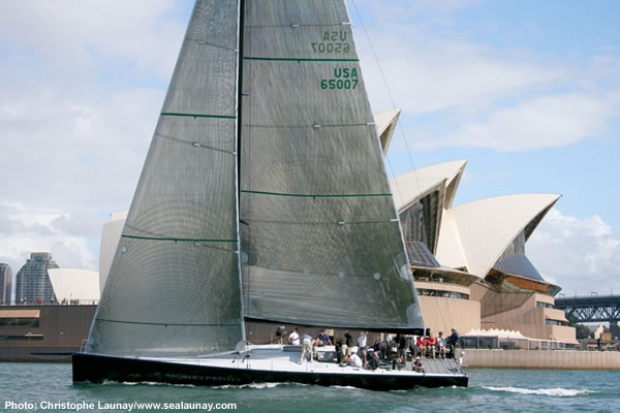
Second STP65
Friday April 11th 2008, Author: James Boyd, Location: United Kingdom
Busy times at the Reichel Pugh office in San Diego at the moment where recently they have designed the new Irish Volvo Open 70, two TP52s - one the new
Artemis for 2007 MedCup winner Torbjorn Tornqvist, the other the Oracle boat Larry Ellison is said to be driving in this year's Audi MedCup. In addition to this they have a new fixed keel 69ft
Alfa Romeo known as
Alfa Junior for perennial owner and client of theirs, Neville Crichton, plus another 69 footer, the new
Bella Mente for Hap Fauth (replacing Fauth's Judel Vrolijk 66 of the same name). While the new Alfetta (surely a better name?) is currently in build at McConaghys, the new
Bella Mente is under construction at New England Boatworks where Reichel Pugh also have a new 75 footer under way... Then there is a new 63ft
Loki under construction at Mal Hart's in Melbourne for owner Stephen Ainsworth (following the loss of his previous
Loki in the Rolex Middle Sea Race). Are any other design houses getting any work at the moment???
It seems that the new 60-70ft pocket maxi class, where the boats race each other under IRC, is currently the place to be, particularly among US owners. So why is this apparent deluge happening now? Perhaps it is just coincidence that a number of US owner have all wanted to move on at the same time? We suspect that it may be due to the advent of IRC taking hold in the US.
Interestingly none of the new generation R-P boats are CBTF. According Reichel-Pugh's Mike Roberts this is because at this size range they feel there is equal benefit (in terms of rating under IRC) of going either way - CBTF or fixed keel. This is not the case for 100 footers says Roberts.
However the latest R-P boat to be launched is the new Moneypenny for American venture capitalist Jim Swartz. This boat has been built by McConaghys in Sydney and replaces Swartz's Swan 601 of this same name, which was campaigned hard both in the US and Europe. The new boat is expected to follow a similar busy schedule with her first outing being in the New York YC's Onion Patch series followed by the Newport-Bermuda, starting on 20 June (alongside Bella Mente). She will then be one of several leading US race boats heading for the Med and the Maxi Yacht Rolex Cup, via, interestingly, Cork Week. She may well then head to Malta for the Rolex Middle Sea Race where Swartz previously raced his Swan. Names one can expect to see on board this year are expected to include Paul Cayard and Gavin Brady.
The new Moneypenny is the second STP65 to be built and in addition to having all the normal attributes one would expect also has a lifting keel. At present Reichel Pugh are playing their cards closely to their chest over the design and technical aspect of this - obviously if design houses such as R-P ever get to do an AC90 (the rule requiring from the outset that boats have a lifting keel) this information will be highly valuable.
At present it is unclear whether or not the STP65 is going to take off as a class. Another, due for launch imminently, is the Judel Vrolijk-designed Container for German owner Udo Schutz, bringing the tally up to three with Roger Sturgeon's Farr-designed Rosebudthe first to be launched. As Reichel-Pugh's Mike Roberts puts it: "It depends on whether a couple of guys decide to go with it or not. There is a J-V in construction - so that will be three. Then if two or three more guys did it, then yes, it could take off. I don’t think there will be 20+ like the TP52s because this is at a whole different level. They are quite sophisticated in construction and all their systems."
Typically the STP65 rule produces a boat that is more offshore orientated, although according to Jim Pugh the new Moneypenny is optimised for the 8-11 knot range.
According to the official blurb from Reichel-Pugh:
Reichel/Pugh Yacht Design was contracted by Jim Swartz in February of 2007 to design a Storm Trysail Transpac 65 (STT 65) racing yacht. The new class is a box rule with specified maximum length, maximum sail area, allowable displacement range, and an allowable range for maximum beam. The class has a deep draft lifting keel, and after the first three boats are measured, an allowable range for VCG will be established.
To insure that the new Moneypenny would not become obsolete as the class grows and designers gain more experience with the rule, a significant R&D program was completed to optimize the hull and appendage designs. This program consisted of the following specific tasks:
1. Large-model tank test at the Institute for Ocean Technology in St John’s, Newfoundland;
2. Evaluation of twenty (20) alternate hull designs using the CFD code SPLASH, anchored to the tank test results;
3. Evaluation of five (5) alternate keel/bulb designs using RANS analyses;
4. Prediction of rig-specific sail forces for a complete range of upwind and downwind sails using North Sails computer codes Flow and Membrane, and the RANS code CFX;
5. Velocity Predictions and comparisons for candidate hulls and appendages using all of the information listed above; and
6. Race Modeling to predict statistical win/loss percentages for a series of distance races specified by the owner using historical wind speed and direction probabilities.
The key tasks in the hull development effort were the high-quality tank test and the SPLASH analyses. Reichel/Pugh has successfully used these tools on a number of previous projects including America’s Cup designs. The tank test data provides very accurate hydrodynamic force data for the Baseline design, and SPLASH is used to predict differences between the Baseline design and candidate hull variations. This approach insures that hydrodynamic force predictions used in the VPP analyses for all candidates are accurate, without the excessive cost and time required to tank test a large number of candidates.
Similarly, development of accurate sail force predictions for the specific rig dimensions and planned inventory were critical to the VPP and race modeling efforts. These high-quality sail forces combined with the high-quality hydrodynamic forces insured that the actual sailing performance for the candidate designs was accurate in terms of absolute and relative speed versus wind speed and angle.
The ability to quickly evaluate design candidates using SPLASH combined with the initial tank test permitted an iterative design development program where results for several candidates were evaluated prior to designing the next group of candidates. This resulted in a focused effort that converged to the final boat. The project was highly successful in that performance gains of approximately 10 seconds-per-mile over a wide range of wind speeds and sailing angles were achieved between the baseline design and the final candidate configuration.
Vital statistics:
LOA: 20.00m (65.61ft)
LWL: 18.70m (61.34ft)
Beam: 4.85m (15.90ft)
Draft: 3.3-4.8m (15.75ft)
Disp: 13,000kg (28,660lb)
IM: 25.55m (83.83ft)
J: 7.60m (24.93ft)
LP: 7.83m (25.69ft)
ISP: 28.80m (94.52ft)
SPL: 10.30m (33.79ft)
P: 26.40m (86.61ft)
E: 9.55m (31.33ft)
BAS: 2.20m (7.22ft)
UWSA: 256.0m 2 (2756ft 2)
DWSA: 560.0m 2 (6,028ft 2)
More photos of the new Moneypenny on the following pages...

Most Read
Most Commented
Comments
Businesses
Pro businesses
-
Netherlands
-
-
United Kingdom
-
Editor's choice
Member blogs
-
 Ned Collier Wakefield: MOD70 round BarbadosWell that was intense. 12 hard fought for seconds for the win. In idyllic conditions, Tony Lawsons MOD ...
 -
 Mini Transat leg 2 reportThe second leg of the Mini Transat started on 31st October, just over a month after ...
 -
Leg 1 reportI’ve been working towards the Mini Transat now for three years. In 2013 I was part ...
Business blogs
-
 The Island Sailing Club in Cowes, Isle of Wight, is delighted that Prince Michael of Kent ...
 -
Peta Stuart-Hunt chats with the 25 year-old British solo sailor Lizzy Foreman before she sets sail ...
-
The 2015 Student Yachting World Cup (SYWoC), an ISAF-recognised event hosted and run by students for ...
Editor's Choice
All time favourites...
-
 Three legs down into Ian Walker’s
 -
 Winning all but two races at
 -
 For the first time in its
Latest Comments
Add a comment - Members log in