
New territory
Thursday November 13th 2008, Author: James Boyd, Location: United Kingdom
The next four legs of the Volvo Ocean Race take competitors distinctly into the unknown with the legs from Cape Town up to Cochin, India, then on to Singapore, Qingdao and the big one back into the Southern Ocean, round Cape Horn and up to Rio.
In much the same way as America’s Cup design teams have enjoyed looking at large multihulls and faster monohulls after the drudgery of V5 boats, so this new course has provided some new research work for the navigators, meteorologists and routers attached to the Volvo Ocean Race teams.
“I like the idea of a new route because it opens up the game and it is not all the same corners and traditional stuff,” says Team Russia navigator and meteorologist Wouter Verbraak. “The weather study has been really exciting to do and trying to get your head around the sail design for that and setting your sail priorities - I like that part.”
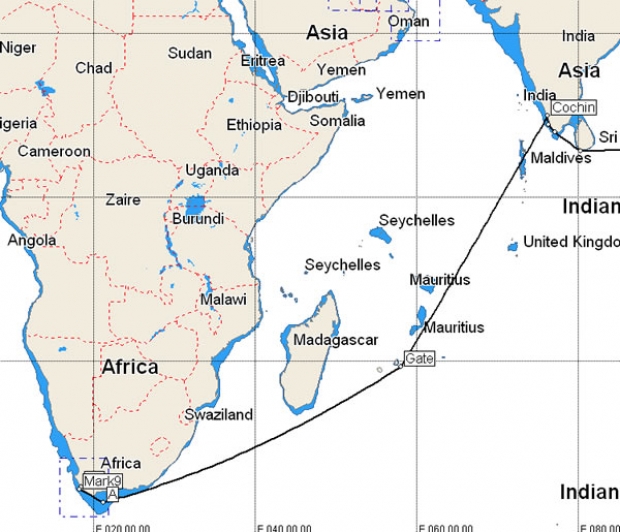
Leg 2 from Cape Town to Cochin in southwest India is around 4370 miles. In terms of the meteorology and route, this leg is a highly complex one and could well be a ball breaker to start with.
Like the South Atlantic there is typically a high pressure parked at the same latitude as Cape Town (35degS) out in the middle of the Indian Ocean and so in theory the boats will head along the south coast of South Africa, turn the corner and into the teeth of a northeasterly… And that’s only after they’ve passed the south coast of South Africa. For here is notorious for its rough seas partly due to the Agulhas Bank, part of the continental shelf that extends out 160 miles from the mainland, and then the southerly flowing Alguhas Current where it meets the easterly flowing West Wind Drift Current to the southeast of South Africa.
While the course naturally sees the boats shaving the south side of Madagascar, in fact with the scoring gate along the line of latitude 58degE south of 20degS it takes them to the south of Mauritius (further up the race track).
And how best to get there? Since the late-1980s the Volvo Ocean Race course has included marks off Brazil on leg one to prevent boats going the wrong way around the St Helena high to get to Cape Town. In theory the boats on leg 2 on this occasion could be doing just this as they attempt to beat up towards Mauritius. However there is another alternative which is the long route – what if boats do a big loop of the Indian Ocean as they do in the South Atlantic on leg one?
“It is interesting because you could get a big split in the fleet because there is a choice of going up the really direct route but upwind to Mauritius on the west side of the high or you go down into the Southern Ocean, all the way around the high and then have a much better angle up, which is quite a big detour,” says Verbraak, pondering this problem. “That depends upon the position of the high. Typically it is not stationary or it can look like it is open and it closes. So that is going to be really exciting.”
But we’ve only just started… Then there are the Doldrums and in the Indian Ocean these are very different to the Doldrums we are familiar with in the Atlantic. “They are much more chaotic,” says Verbraak of their Indian Ocean cousins. “In the Atlantic there is this narrow band and everyone knows where to cross it - where it is narrowest. Here it is like small systems travelling along it and hot spots popping up and bands expanding again. It is a much more random Doldrums than the Atlantic.”
Typically the Atlantic Doldrums are between 0-10degN and usually between 5-10degN and wider on the African side than on the Caribbean/South American side, but this can vary hugely depending upon what is happening with the weather to the north and south and over Africa. But in the Indian Ocean it is even less clear cut. “You can’t really tell,” says Verbraak. “In the studies it can shift north-south by 600 miles in two days. How do you deal with that in the long term strategy?”
Quite often there can also be two Doldrums belts spanning the Indian Ocean. Ericsson 4 navigator Jules Salter explains: “There seems to be two bands which are wider. It is a different set-up to the Atlantic because we are more towards Africa, there is no big land mass directly upwind of where the Doldrums belt is, so it is quite different and no one knows what the route through is, so it is quite exciting. Also the whole thing is shifted - it is further south, because we are in that season. It is summer in the southern hemisphere, so the Doldrums band in the southern hemisphere tends to be a bit more active, but it is a bit less active because there is no big landmass spitting it out over the race track. It doesn’t disappear like it does in the Atlantic. So it is different. We will learn as we go.” According to Salter between the twin Doldrums bands there is typically a band of westerly winds.
“So a double Doldrum transition and it is always very light by India. So even though you might be a long way ahead it might be a park up for the last 500-800 miles. So it might pay to be last into that!” concludes Salter. Light upwind conditions for the end, will be a time when the masthead code zeros get to play a major role, but generally leg two is likely to be one where the rich decidedly get poorer.
In terms of the forecast for the start - the south Atlantic high is making its presence felt off Cape Town come Saturday and so the boats will be in for a short beat once they are past the Cape of Good Hope. A front is forecast to pass over them on their first night at sea. They then have the choice of diving south into the strong westerlies that could propel them east or stick by the coast on the more direct route where it is upwind.
Into early next week the high pressure from the south Atlantic starts squeezing through into the Indian Ocean between South Africa and Mauritius, so it does look as through there might be a downwind, but light, path through vaguely close to the great circle to Mauritius. However some scary stuff is expected on Wednesday when a very intense depression (960mb) rolls through the Southern Ocean to their south and on the front preceeding this the boats could see 30-40 knots NNWerlies. So in fact the weather is not looking as painfully slow as the typical scenario might be - at least for the opening phase of this leg.
See the weather charts for the first days of leg 2 on page 2...
Most Read
Most Commented
Comments
Businesses
Pro businesses
-
United Kingdom
-
United Kingdom
-
United Kingdom
-
Editor's choice
Member blogs
-
 Ned Collier Wakefield: MOD70 round BarbadosWell that was intense. 12 hard fought for seconds for the win. In idyllic conditions, Tony Lawsons MOD ...
 -
 Mini Transat leg 2 reportThe second leg of the Mini Transat started on 31st October, just over a month after ...
 -
Leg 1 reportI’ve been working towards the Mini Transat now for three years. In 2013 I was part ...
Business blogs
-
 The Island Sailing Club in Cowes, Isle of Wight, is delighted that Prince Michael of Kent ...
 -
Peta Stuart-Hunt chats with the 25 year-old British solo sailor Lizzy Foreman before she sets sail ...
-
The 2015 Student Yachting World Cup (SYWoC), an ISAF-recognised event hosted and run by students for ...
Editor's Choice
All time favourites...
-
 Three legs down into Ian Walker’s
 -
 Winning all but two races at
 -
 For the first time in its
Latest Comments
Add a comment - Members log in