
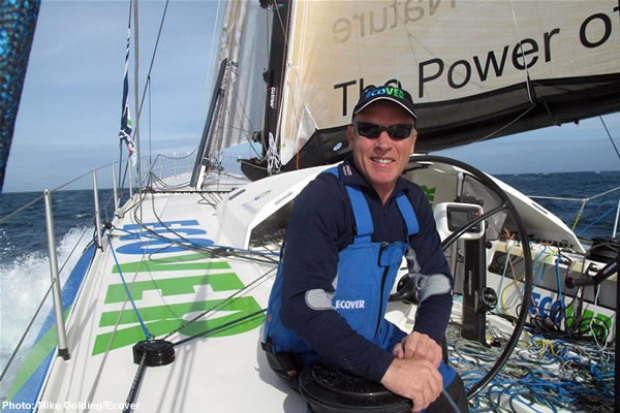
Man on fire
Friday December 12th 2008, Author: James Boyd, Location: United Kingdom
Mike Golding is on fire at the moment, having moved up to second place via his southerly option as the boats pass the Kerguelen islands midway through the Indian Ocean section of the Southern Ocean.
On the satellite phone earlier in the week Golding didn’t seem tired (although he assured us he was) and sounded calm and collected, as if he’s enjoying the experience.
“Today’s all right. I haven’t had much sleep because we’ve been gybing all night. The thing I am enjoying is that I am where I wanted to be at this stage of the race. I feel like when everything is okay on board and I am on the pace. My decision-making hasn’t been bad - I have made some mistakes of course, but my hit rate is not too bad. Generally I feel I can be on the up when I want to be on the up.”
Obviously the significant phenomenon among the front runners is how Michel Desjoyeaux and Foncia were forced to return to port, restarting 36 hours later and four weeks into the race are now back jockeying for the lead.
“I think he is pushing hard and obviously the boat is very quick,” says Golding of the race favourite. “Hopefully now that he has joined this group he will match this pace. All of us know that we have got to get across and if you go ballistic the chances are you are going to break. If one boat starts really forcing the point, then we are all forced to push along and the risk of breakage goes up exponentially. That makes me sound like I am backed off, but I am really not backed off, we are full on, but there’s always more you can do that.”


For much of this Indian Ocean section, Golding has been steering Ecover 3 down a mid-south course (at present he is the furthest south of the frontrunners), along similar lines, but less extreme to race leader Jean-Pierre Dick and Paprec-Virbac 2. “He has taken a southerly route because that is where his routing is taking him. But there is a reason why you shouldn’t be on the right hand side all the time, because with these gates you find yourself banging a corner when you go out to the very right of the fleet and here is risk attached to that that you have to fight your way [back north] to the mark. The boats on the left have more options because they are less constrained by the marks - boats like Generali are probably just sitting it out waiting for their opportunity to come steaming in from the left."
Since the boats entered the South Atlantic and have since passed into the Southern Ocean, a regular feature has been how unusual the weather has been with the St Helena high a long way to the southwest of its typical position, while the depressions, which circle the bottom of the globe eastwards through the Southern Ocean, have been up until the last few days, considerably further south than they typically are.
“It has not been as we would have liked,” agrees Golding. “It certainly hasn’t been as quick as we would have liked. Being forced down into the bottom left hand corner of the Atlantic was quite painful, having to sail all those extra miles and it was painfully slow too having to get around the St Helena High. I thought I played alright - I didn’t make any gains off it, but I thought where I was was looking pretty good and at one point I thought I’d moved up a long way, but it didn’t pay out in the end.”
Golding moves on to the Southern Ocean: “Yes, it is quite benign. The wind we had the other day was pretty serious. Looking back and looking forwards, it is not quite the southern Ocean as we know it. People were saying that we are held further north, but the reality is we’re not. We passed well south of Marion Island and I recall passing by Marion Island before, so we are not much further north than we would be. And also the movement of the last gate has actually made us go further south on this leg so we are down to 49 on our way to 50.
As to the gear on board (touch wood) everything seems to be reasonably fine. Golding says there have been no majors, but when we spoke to him he had just finished rebuilding the pedestal winches as a piece had fallen off inside the tube containing their shafts and gears.
“I have got all that going again, so it is little things like that. The big things are hanging together. I am being very careful with the boat as far as I can be. I am really mindful of things like the engine, so I am quite careful about how I use it and the batteries, etc – all the things that can really let you down. So far that is working and the boat seems to be okay.”
So having sailed around the world umpeen times singlehanded has his approach changed this time? “Possibly I am a little more careful. I am very aware of how a simple situation can turn into a catastrophe really easily and how tenuous your position in the fleet really is if you have major problems. I am trying to gently work my way forwards without doing any damage and my real agenda is to stay in the frame until Cape Horn. It is a long agenda, but I don’t feel a great desire to lead the race. It will be quite hard at times as the front guy pushes, everyone behind will push just as hard and sooner or later you’ll get overtaken, as we’ve seen with all the place changes. It must be quite hard to lead. There must be a lot of pressure attached to that. The only possible benefit of leading right now is if you can see a window to make a break away. And there don’t seem to be any yet. There is a lot of bungee action going on, a lot of extension and compression.”
One gets the impression from several skippers that the Southern Ocean will be a case of keeping in touch with the frontrunner and the real race will only start once the boats have rounded Cape Horn and are back into the Atlantic.
“I could imagine the race being very tight in the Atlantic coming back,” states Golding. “I can really see that happening. You have so many good boats here, so many good sailors. I think there are a few guys backed off, boats like Generali that are being well sailed and you think they have fallen away, but they haven’t, they are still there. PRB is another notable one. You know the boat is being well sailed and you know the guy knows what he is doing and you know he probably could be further forward in the fleet if he so chose. But the reality is that the game here now is to consolidate and not lose touch and be in a good position to make your move in the latter stages of the race. It makes me sound like it is going to be a bit tame in the Southern Ocean but I don’t think it will be. Naturally people are going to push forward and naturally that will drive others to do the same. You have periods of time when you are in the groove and it seems like everything you do turns to gold and then you have periods of time when everything turns to poo. Sometimes you can do no wrong and sometimes you can do no right. When you are in the groove you are best to use it and push yourself forward and keep it going. But inevitably you get tired and then you make a mistake.”

Obviously a number of boats have spotted ice over the last 48 hours and Golding says that this doesn’t come as much surprise. “Sea temperature is a 4degC and during the night it has been 3deg. And if you are less than 5 you are well in the zone. You can see ice in 8deg. So 3-4, you’re in cold enough water to see ice. So far I haven’t been paranoid about it with the radar running all the time. When I am around to look I will flash it up and have a quick scan and when I am up on deck I look around.”
With this year’s Vendee Globe there have been developments to help steer boats away from the worst of the ice. In addition to the race scheds that allow the positions of the boats to be displayed over their electronic charts, and GRIB weather files, this time the skippers can also upload the positions of the biggest bergs in their vicinity, again superimposed on a chart.
“We can see on our MaxSea ice position and movement. It leads you to think that you know where the ice is, but that is only the satellite derived ones [bergs spotted from space] so these are big icebergs. So I am not sure it is lending anything. On the one hand it makes you more fearful and on the other it doesn’t do anything to prevent you from hitting the [smaller] bits that aren’t picked up by the satellite. Obviously it is better to have it than not have it, but I don’t think it has added as much as people intended. It is certainly good to know where the really big bergs are and because you can see along the course it does give the impression that they are along a line of latitude around 100-200 miles to the south of us right now. But I am not sure that it is covering off the bits that you can’t see, that would cause you the damage. It is a good innovation, but not the panacea.”
An unusual comment Golding made before the start of this Vendee Globe and has made since, is that he doesn’t like Ecover 3 as much as his previous boats. By this he means that it has caused him considerably more grief – particularly, once again, in the keel foil department (read more about this here).
“It has just been a bitch of a boat to get working. Now that it is, it is on a stay of remission! It is on probation, after everything we had to put up with. I am still dealing with little things, that I have never had problems with before. So I am not expressing any love for this boat until it does what it is supposed to do. When it gets home I might be quite happy with it…!”
A third of the way into the Vendee Globe and the next few weeks of this absurdly close round the world race will be fascinating to see unfold.
Most Read
Most Commented
Comments
Businesses
Pro businesses
-
France
-
-
Italy
-
United Kingdom
Editor's choice
Member blogs
-
 Ned Collier Wakefield: MOD70 round BarbadosWell that was intense. 12 hard fought for seconds for the win. In idyllic conditions, Tony Lawsons MOD ...
 -
 Mini Transat leg 2 reportThe second leg of the Mini Transat started on 31st October, just over a month after ...
 -
Leg 1 reportI’ve been working towards the Mini Transat now for three years. In 2013 I was part ...
Business blogs
-
 The Island Sailing Club in Cowes, Isle of Wight, is delighted that Prince Michael of Kent ...
 -
Peta Stuart-Hunt chats with the 25 year-old British solo sailor Lizzy Foreman before she sets sail ...
-
The 2015 Student Yachting World Cup (SYWoC), an ISAF-recognised event hosted and run by students for ...
Editor's Choice
All time favourites...
-
 Three legs down into Ian Walker’s
 -
 Winning all but two races at
 -
 For the first time in its
Latest Comments
Add a comment - Members log in