
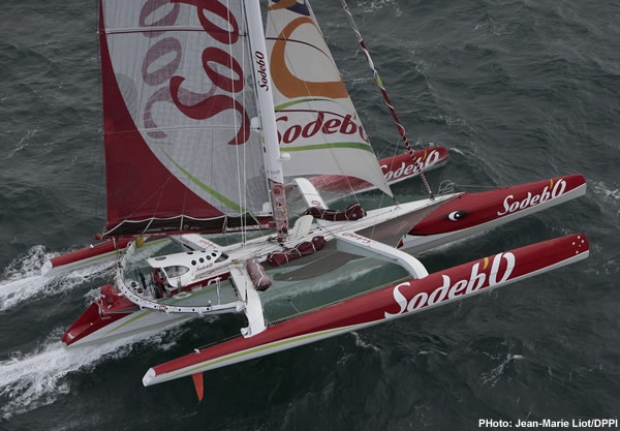
Coville out of time
Tuesday January 13th 2009, Author: James Boyd, Location: United Kingdom
While his
Sodebo maxi-trimaran is set to pass the Azores with 1400 miles to go, a deficit of 880 miles over Francis Joyon's
IDEC from her record attempt last year, has left skipper Thomas Coville resigned to the fact that he has run out of runway to better the record time for sailing non-stop around the world singlehanded. Joyon's time of 57 days 13 hours looks set to stand for another year at least with Coville set to reach Brest two days outside it.
Coville is due into Brest this Friday in the evening or overnight and will do so in the knowledge that he is the second fastest singlehanded around the world with the fourth fastest time outright behind Joyon, and the fully crewed Orange 2 and Cheyenne.

While there has always been the hope that he might overtake Joyon's virtual, Coville has in fact not been ahead of IDEC 2's virtual pace since the fifth day out from Brest on 22 November, by which time, incredibly, he was already at the Cape Verdes.
A very slow patch coming into the Doldrums, saw Sodebo drop back 250 miles astern of IDEC, ut heading down the South Atlantic she was able to claw her way back to within 27 miles of IDEC's equivalent position by day nine as Sodebo was passing the latitude of Rio. However this is the closest he would get for the remainder of his voyage.
Coville lost out hugely to Joyon skirting the St Helena high having to sail all the way down to around 35°S before being able to turn east (in comparison Joyon had been fortunate enough to be able to sail straight across the South Atlantic, cutting a huge number of miles from his voyage).
Entering the Southern Ocean, Coville crossed 40°S at 35°W on day 13 after a series of gybes, whereas Joyon had managed to sail pretty much a direct path from Rio only crossing 40°S when he had reached 5°W. By this time he was 450 miles behind.
Sodebo passed the Cape of Good Hope after 16 days, 12 hours and 23 minutes, while Joyon had made it to the same line of longitude in just 15 days, 7 hours and 16 minutes. However through being unable to cut the corner on the South Atlantic high, Sodebo had sailed more miles and had a faster average speed through the water than IDEC up to this point - 20.51 knots compared to IDEC's 20.24.
At around this point Coville had the satisfying time of overtaking the entire Vendee Globe fleet, despite having given them a nine day head start.
After passing the Cape of Good Hope there followed two days of stark contrast. On 6 December, Sodebo was stuck in an area of high pressure below South Africa and her average speed for one 24 hour period dropped to below 10 knots (stand-still virtually for a 100ft trimaran) covering just 236 miles - his worst run of the entire voyage. This saw his deficit on Joyon double overnight to more than 1000 miles.
And yet Coville followed his up the following day with a new singlehanded world record for the most number of miles covered in 24 hours by a singlehanded boat. In the day leading up to 21:45 on 7 December, Sodebo covered 628.5 miles or an average speed over this period of 26.19 knots. This broke the previous record Coville had set on his aborted attempt on the solo round the world record last year of 619 miles in 24 hours. Unfortunately despite this record Coville was still at this point 1180 miles astern of Joyon...
Once again Coville didn't seem to be getting the luck Joyon had had with the weather, spending most of the crossing of the Indian Ocean in northeasterlies, whereas Joyon had been powered on in more typical northwesterlies. He reached Cape Leeuwin, southwest Australia, after 25 days and 9 hours at sea, but by this time was 2 days and 18 hours behind Joyon. He was promptly slowed by the weather again before this time the wind filled in from the south! At this point Coville was also sailing east along 48°S whereas Joyon had been on a shorter course down at 52°S.
Passing New Zealand Coville as again nailed and was forced to negotate a localised but intense depression over New Zealand that forced him to sail north. In having to deal with this Coville found his deficit on Joyon increasing to more than 2000 miles. On 20 December his deficit reached what would be its worst of the entire voyage - 2157 miles.

For the first two thirds of the Pacific Coville was finally into the rhythm he'd failed to find consistently in the Indian Ocean and was able to eat up the miles in strong northwesterlies. However due to severe ice warnings he did so between 45 and 48°S, whereas in this same zone Joyon had once again been much further south, down into the mid-50s, sailing less miles. Nonetheless over this period the Pacific was for the most part good and Coville was able to make up miles so that when he rounded Cape Horn at 19:42 GMT on 28 December, it may have been four and a half days later Joyon but he had reduced his decifit to 1315 miles with Joyon now into the South Atlantic and starting to slow.
While this deficit was bad, it was not terminal - Joyon was thought to have lost at least four days returning north up the Atlantic and there was plenty of opportunity to play catch up given the vagaries of the weather here. And this Coville resolutely did.
Up the South Atlantic, Joyon had taken an obtuse course out into the middle of the ocean - generally banking easting here is felt to be a better tactic to be able to lay Recife (the easterly bulge in the Brazilian coastline) later on, while Coville sailed closed to the great circle and the South American coast. At the point when Joyon had slowed on the perifery of the South Atlantic high at around the latitude of Uruguay, so Coville was steaming north and had once again closed to within 1,000 miles of his virtual rival. Prospects were looking up... Sodebo remained at full tilt all the way up to the mouth of the River Plate and Uruguay by which time she had reduced her deficit to just 750 miles and was still closing. At this point he was some just over 200 miles off the south American coast compared to Joyon who had been 1200 miles offshore.
For the next three days, Coville continued to wind in the elastic. We was very fortunate with the conditions and did not get sucked into the giant bay around San Paolo although it did go light off Rio where Coville was forced to tack into the beach. By this stage, after comparitively slow days for Joyon mid-South Atlantic, Coville was back in the game, just 300 miles behind with almost 5000 miles of race track ahead of him.
Annoyingly just as the pendulum was swinging back in his direction, so Coville experienced two slow days as finally the South Atlantic bit him and he was forced to take a long unfavourable tack to the east in order to be able to lay Recife subsequently on the opposite tack. At the end of this Coville was back to being more than 1,000 miles behind Virtual Francis, who at this stage was crossing the Equator and forging north at speed.

As Joyon slowed in the Doldrums, so Coville was back up to speed, shaving Recife more finely and lining up for a possibly faster Doldrums crossing further to the west than Joyon had been. By the time Sodebo crossed the Equator on 7 January at 1933 GMT, after 50 days 5 hours and 39 minutes at sea, he was 2 days, 3 hours and 18 minutes behind Joyon having recovered two and a half days in the South Atlantic.
Unfortunately for Coville at around this point the prospect of his beating Joyon's record was evaporating rapidly. 574 miles astern when he passed back into the North Atlantic his brilliant rival had tackled the North Atlantic at lightning pace. And yet while the elastic extended marginally to 590 as Coville was slowed in the Doldrums, Coville over the next few days was able to close once again as he took a very similar parabolic course up the North Atlantic as Joyon had done in order to cross the northeasterly trade wind belt and then negotiate the Azores high.
Unfortunately for Coville, Joyon had had another stroke of luck here, the high positioning itself so that from around 30°N, about the latitude of the Canary Islands, he was able to hang a right to the northeast and sail a direct course to the Brest finish line. Sadly for Coville the high did not allow this fortunate course for him and it was only yesterday at arouid 38°N that Coville was able to make the turn.
Annoyingly there is a beautiful depression to his north right now bringing with it 40 knot southwesterlies/northwesterlies that could power him towards Brest at record speed. Unfortunately he has run out of race track and won't be home before Francis. However it is close and having sailed a longer course it is possible that Coville will arrive in Brest ironically having sailed faster around the world albeit in a slower time.
The conclusion of this is that Sodebo, as many suspected, is a faster boat being slightly longer and having more go-faster features than Joyon's very simple belt and braces IDEC 2. On his round the world lap last winter, Joyon had substantially better fortune with the weather particularly in the South Atlantic, Indian Ocean and on the return up the North Atlantic, whereas Coville had a better run than he did returning up the South Atlantic. There is the old saying "it is better to be lucky than good". Joyon in his recent record attempts has regularly proved himself to be both lucky AND good.We have not doubt that Coville and his red trimaran are just as good, only on this occasion they have been less lucky.
Our commiserations to Thomas.
Most Read
Most Commented
Comments
Businesses
Pro businesses
Editor's choice
Member blogs
-
 Ned Collier Wakefield: MOD70 round BarbadosWell that was intense. 12 hard fought for seconds for the win. In idyllic conditions, Tony Lawsons MOD ...
 -
 Mini Transat leg 2 reportThe second leg of the Mini Transat started on 31st October, just over a month after ...
 -
Leg 1 reportI’ve been working towards the Mini Transat now for three years. In 2013 I was part ...
Business blogs
-
 The Island Sailing Club in Cowes, Isle of Wight, is delighted that Prince Michael of Kent ...
 -
Peta Stuart-Hunt chats with the 25 year-old British solo sailor Lizzy Foreman before she sets sail ...
-
The 2015 Student Yachting World Cup (SYWoC), an ISAF-recognised event hosted and run by students for ...
Editor's Choice
All time favourites...
-
 Three legs down into Ian Walker’s
 -
 Winning all but two races at
 -
 For the first time in its
Latest Comments
Add a comment - Members log in