
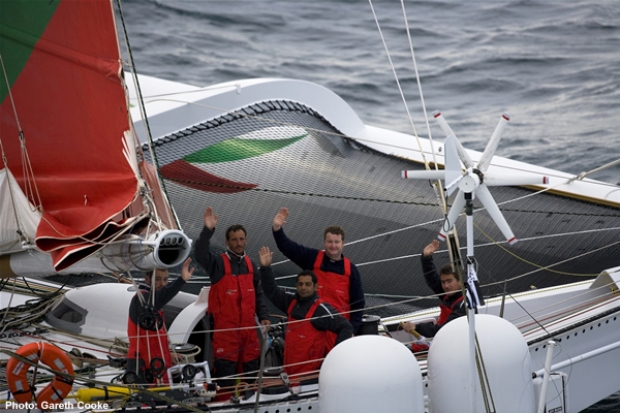
Omani tri at Cape Horn
Wednesday February 18th 2009, Author: James Boyd, Location: United Kingdom
After 40 days at sea, non-stop, the Omani maxi-trimaran Musandam and its crew, including Omani sailor Mohsin Al Busaidi, has passed Cape Horn.
As the crew drew close to Cape Horn the sea state changed dramatically and the light winds and waves of the Pacific began to change into the huge rolling waves of the Atlantic. Strong conditions with gusts of up to 40 knots mean that Musandam, Ellen MacArthur's former B&Q Castorama trimaran, is now surfing on the waves from the west and over the swell from the east.
"This is the second time I have seen land since I left Muscat," said a jubilant Mohsin this morning. "As we passed Cape Horn the overcast sky cleared somewhat to give a partly sunny sky and gave us an unreal chance to see the rocky outcrop of South America in its full glory - I never imagined I would be so lucky. I hope I can now inspire a new generation of Omanis to also become 'Cape Horners' ."


Plagued by choppy seas, the trimaran's progress has remained good, but tiredness and lack of sunlight is starting to take a toll on the crew says Charles Derbyshire: "We are moving along in petty rough seas, not the giant rolling swells that we were expecting but some life onboard is reduced a fair bit to eating and sleeping and sailing, much less reading or writing anything."
On Day 37, under gloomy gray skies and with Cape Horn lying some 2,000 km ahead of them, the crew wouldn't have liked some calmer conditions, but it wasn't to be as another gale rocked the boat. Requiring all seamanship available, the crew spent 48 hours - both day and night - in extremely uncomfortable conditions as the boat was tossed around as if it was an item of clothing stuck inside a washing machine set on the spin cycle. As Mohsin described it: "It was hard to tell if I was soaked from the waves or the torrential rain - I have never been this cold and wet before in my life. Eating had become almost impossible with the motion making life onboard just really difficult. The spectacle of passing Cape Horn is keeping me going, I just hope we pass in daylight hours".
The next morning was to bring some respite, lovely surfing conditions with no spray on deck and beautiful well-oriented waves, and after some 40 days and 40 nights at sea it was time for Mohsin to reflect on the way sleep patterns affect the perception of daily routine, if there is such a thing in an environment of perpetual motion. "Three hours on - three hours off watch means that I sleep when I need to, day or night. The interesting thing for me is in Muscat we don't have much difference in the length of day light and darkness (12 hours each). Out here it changes all the time with the shortest night so far being six hours. The countdown has started to Muscat and my own bed. I wonder if i will have the watch system sleeping pattern when I get back on land."
Over the next week the Atlantic Ocean could prove to be the most difficult test for Mohsin and the crew on board Oman Sail's 75ft trimaran as they now sail towards the African continent. The crew will have to keep an extra visual, especially at night, for drift ice. The sea temperature has now dropped to below 8 degrees C - without a survival suit, a human would not survive for more than an hour in water this cold and it is going to get much colder.
Most Read
Most Commented
Comments
Businesses
Pro businesses
-
United Kingdom
-
France
-
-
Editor's choice
Member blogs
-
 Ned Collier Wakefield: MOD70 round BarbadosWell that was intense. 12 hard fought for seconds for the win. In idyllic conditions, Tony Lawsons MOD ...
 -
 Mini Transat leg 2 reportThe second leg of the Mini Transat started on 31st October, just over a month after ...
 -
Leg 1 reportI’ve been working towards the Mini Transat now for three years. In 2013 I was part ...
Business blogs
-
 The Island Sailing Club in Cowes, Isle of Wight, is delighted that Prince Michael of Kent ...
 -
Peta Stuart-Hunt chats with the 25 year-old British solo sailor Lizzy Foreman before she sets sail ...
-
The 2015 Student Yachting World Cup (SYWoC), an ISAF-recognised event hosted and run by students for ...
Editor's Choice
All time favourites...
-
 Three legs down into Ian Walker’s
 -
 Winning all but two races at
 -
 For the first time in its
Latest Comments
Add a comment - Members log in