
Preparing for party time
Friday May 22nd 2009, Author: James Boyd, Location: United Kingdom
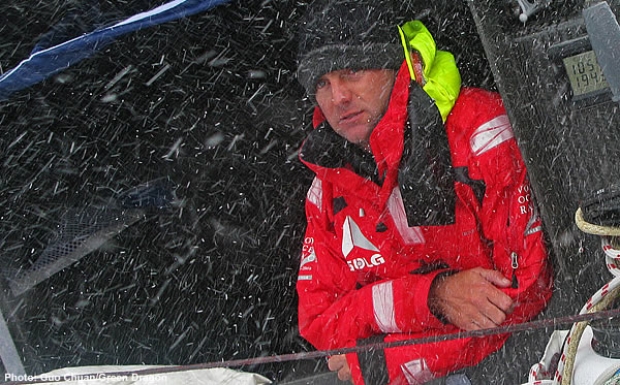
The crew of the moment this weekend when their VO70 arrives in Galway is certain to be that of the Volvo Ocean Race’s Irish-Chinese entry Green Dragon. For in the previous fun and games of the last months it has probably been forgotten that the Irish entry in this year’s fully crewed round the world race came about from trying to get the event to come to Galway, rather than boat resulting in the stopover.
Equally certain to be ignored in the blur of black beer is that of the seven remaining boats in the Volvo Ocean Race, Green Dragon is the team probably most on the back foot at present, as skipper Ian Walker and the lads, including Ireland’s Damian Foxall and Justin Slattery pay the price for the speed at which their boat was put together prior to the start of the race.
“We are on a bad run - we were last in the in port in Rio, we were last into here and last in the in port here,” admitted Walker, when we caught up with him in Boston last week. “So either we are getting worse or everyone else is getting better or both, so it is up to us to try and turn that around obviously with Galway coming up. Whether it is a surprise or not is a different question. We may have been out-performing early on, but anyone who follows the race will see we are not on the pace in the majority of conditions. It is frustrating because I know what would get us on the pace and if we had 2-3 months and the budget we could do that. But we haven’t.”
As Walker points out in putting their campaign together they fell foul of the designer exclusivity agreements and with Farr signed to Telefonica and Juan K to Ericsson, they ended up going to Reichel Pugh, who despite being the world’s most well capped design house for boats of this size, had never previously penned a Volvo Open 70 and were given just three months to conjure up the Green Dragon.
“For a design office which doesn’t have all the data from the last race, in a short period of time, no matter how good you are - and Reichel Pugh are good designers - it is very hard without the R&D and the time to match these guys who have been doing it for five years with very big budgets.”
Specifically Walker bemoans their lack of R&D time prior to the start. While the big teams had prior knowledge of VO70s and most importantly specific data surrounding the complex load case of the boats, and Puma had ABN AMRO Two as a test bench while the defunct Mean Machine and Team Russia campaigns used Pirates of the Caribbean, they lacked this advantage. While they purchased some of the R&D Judel Vrolijk had carried out on behalf of Peter de Ridder’s campaign this still left Reichel Pugh and their engineers having in many cases to make their best estimations of the load case and as a result they were unable to exploit rule as much as the other teams.
As Walker says, he knows exactly what the problems are with Green Dragon and they would not be that hard to put right. At the end of the day it boils down to bulb weight –while most teams are approaching the 7400kg maximum permissible under the rule, as Green Dragon’s certificate from the start shows, they were some 460kg light. “We’d need to build a lighter fin,” confirms Walker. “We’d need to get more weight out of the boat to increase our stability. And I think we’d probably make some modifications to our daggerboards, which would probably help us in the light. There are a number of small things, but those are the big things.” Their overweight keel fin is the biggest area where weight could be pared down.
“If we had a maximum weight keel I think in medium and strong winds the boat would be really quick. If we have a problem it is that we have one of the biggest, widest and most powerful hulls which therefore struggles in the light without the keel weight to make you fast in the breeze and I honestly believe we could address both of those if we just had some time and money. And we will know - someone will buy the boat and put a maximum weight keel on it and do a regatta and we’ll see - hopefully it will be me!”
Their performance is also probably not helped by part of their design and engineering brief being that the boat should not fall apart. Walker is proud that they are one of four boats in this race to have made it all the way around so far on their own bottom (despite a structural issue, since rectified, on the leg to China).
“If you look at this race, a lot of the boats have had major structural failures and some of them have come close to sinking,” states Walker. “So it could have been a very good choice, in fact arguably it is better choice than sinking on leg three or four! But that isn’t the extent of the problem – it is not like we have a completely brick shithouse boat, but it is a small part of it.”
As they have a fuller bow, Walker states that they haven’t suffered the same issues as some of the other 2008 crop of Reichel Pugh designs such as Belle Mente, Alfa Junior and Moneypenny. On these, thanks to their powerful chines and narrow bow, we understand they were developing a tendency to nosedive and unload their foils creating at times alarming lee helm.
The problem for Walker and the Green Dragon team is what to do now? There seems to be no prospect of increasing bulb weight before the end of the race and they have spent their sail budget. “I do think we are better downwind and I do think we have a boat we can push pretty hard in a breeze - it’s just we haven’t had much running. On the first leg which was VMG running, okay we went a different way to everyone, but we got to Fernando first and we were third into Cape Town and we were pretty good in the heavy running section and leaving Cape Town when we had five day of heavy air we got to the scoring gate third - so clearly we are pretty competitive, maybe we can’t match Ericsson 4, but we seem to deal with the other boats in that stuff.”
Do they start banging corners Brunel-stylee? “Banging corners is a difficult one,” continues Walker. “We started this race with the policy of whatever happens, try and do the right thing. Our philosophy hasn’t changed all race - and that is just ignore all the other boats and just do what we feel will get us to the next stopover as fast as possible. So if we think there is a really good reason to go a different way to the rest of the fleet, we’d be brave enough to do it, but our policy is not to go off on a 20% whim that is might pay. Saying that - maybe we should change that policy, maybe we have to increase the risk on this leg. But equally if you go hitting the wrong corners you can make things worse and worse.”

Walker says his frustrations are that while they are clearly lacking pace much of the time, this is hiding how well they are doing in others - he particularly cites the work by the shore crew, the ability of the sailing team and the decisions made on board by navigator Ian Moore. “We are doing a lot of stuff right, but unfortunately this event, like most sailing events, it is as much about the technical aspects as the human elements.”
An additional problem is that the team remain up against the wall money-wise. This has been the case from the outset – as Walker puts it when Eamon Coneely gave the go-ahead on the design work, they didn’t have the funds to build the boat, and even when they started out from Alicante, they weren’t certain they had enough to complete the remainder of the race. Even now being able to find the funds to get Green Dragon to the finish in St Petersberg is in the balance.
And yet throughout all this it is testament to the ability of Walker and his charismatic business partner Jamie Boag that their team, comprising many seasoned race veterans both on and off the boat, they have managed to not only keep together, but also keep motivated. “The guys who have done the race three or four times before, I don’t know how they do it. Generally speaking it is very easy to have a happy crew when you are doing well and it is very hard to keep it together when you’re not - that is true whether you are sailing a 470 or a Star or an America’s Cup boat or a VO70. If you can have not so good results and still everyone is smiling and trying their hardest and the shore crew are still getting up at 7am to prepare the boat the best they can, you are still doing something right. I think they do it because they bought into the concept of the thing and when we sail into Galway I think we’ll remember exactly why we are doing it. We haven’t had one complaint, no one’s walked off the boat, but it is tough.”
While they may not be getting the results they had hoped for on the water, Walker points out that they have definitely succeeded in other areas. For example the campaign is proving to have massive pay-back for their sponsors both in Ireland and China. “The perception in Ireland is incredibly positive and the stopover in Galway is going to be one of the biggest things to happen in Ireland this year in what is a pretty depressing state of world affairs. I think our team and the stopover in Galway will put a lot of smiles on a lot of people’s faces outside of this environment.”

And thanks to their Chinese media crewman Guo Chuan, Green Dragon might as well be winning the race for the exposure they are getting in China. “Up until leg four – I haven’t seen the recent figures - Green Dragon had the highest media return of any team in the race. If you look at the TV audience – 50% of the TV audience is in China which is precisely because CCTV 1 is following our boat.”
As to the other boats Walker observes that they all have their strengths and weaknesses: “The key thing is what is the course. Telefonica have got a very fast upwind boat and a very fast light air boat. It has won the two upwind legs and it is very fast inshore on the windward-leewards. But that is probably the boat you’d least like to take offshore. And then you have to say the Ericsson boats... Funnily enough I often think Ericsson 3 is the fastest boat out there. I don’t know why, but very often they do great mileage.
“Puma are the anathema – they have moments of brilliance, they have two weeks of going nip and tuck with Ericsson 4, but for some reason they never seem to win a leg. Maybe they don’t have a condition they excel in, they are good all round. On Ericsson 4, if they get two days of reaching in heavy air they can get a jump on everyone and if Telefonica get three days of light air… this is conjecture. Puma are clearly not that far off. They have done a great effort with what is effectively a one boat program, although they had the old ABN 2.”
On a personal note, Walker does seem to be enjoying the offshore lifestyle. “There are a lot things that are harder than I thought and some that are easier. The biggest thing I was worried about was the boredom - you don’t get a lot of that, with the exception of the last leg when there really was 10 days without a lot happening, we’ve hardly had a moment. You get position reports every three hours, weather every six hours, steering, trying to get some sleep in and actually the days go pretty fast.”
And the bits he hasn’t liked? “There are times when you think ‘this is insane – what are we doing?’ We’d be having a dilemma about whether we fly the big or small spinnaker and it is 30 knots and the middle of the night, pitch black – you take a minute and think any normal person would be heading for the harbour and we are arguing about which spinnaker we should have up. So it is pretty insane some of that stuff, although having said that we have had remarkably little of it in this race. Most of the time we have been going upwind.
“I still can’t believe we have sailed around the world and been to all those places. When you arrive in a different country by boat you don’t feel you have gone anywhere, because all you have done is get on a boat and got off a boat and sudden you have different coloured faces or a totally different culture and that’s what its been like – we were in Africa, then in India, and the next minute in China and that is pretty cool and you realise the world is actually pretty small, these places aren’t that far away.”
The scariest part he remembers was the collision with the submerged object on the first leg that in the middle of the night bought them from 20 knots to a virtual standstill. Down below at the time, the boat 1000s of miles from land, Walker says he was convinced the rig had come down.
The hardest part was certainly the leg up to Qingdao “after breaking and then repairing the boat in the Philippines, trying to battle our way up to China in a deteriorating seastate and just wanting so desperately to get to China – we HAD to get to China, I didn’t care if it took us all month! – and trying to nurse the boat through that and not knowing whether we were going too fast or whether we could go faster and certainly as a skipper feeling a lot of pressure to make the right decision – should we pull back, should we go faster? So the least fun was probably off the top of Taiwan.”
With still a lot of this Volvo Ocean Race to go, it is perhaps a little premature to be thinking of the next round the world race, but it is all the talk dockside with Volvo firstly having committed to the 2011-12 event back at the start in Alicante and major work going on into how to reduce costs next time around given the present shaky economic climate. Walker says he would definitely go again although it remains to be seen where the funding will come from. “You need to secure your funding early, plan properly. The time line is quite short for the next race. Really you need your funding by the end of the year, designing beginning of 2010, building the following winter.”
He fully embraces the modifications that Volvo Ocean Race CEO Knut Frostad is planning for next time, which is more than can be said of some of the other teams. “ I think because I have been more involved in the money raising and the campaigning running side, I have a vested interested in keeping the budgets down whereas some of the other designers, sailors and teams, have a big interest in keeping the budgets up, right up to the point where if they aren't careful there will be no teams and no race. I am continually amazed by some opinions on the changes to the next race, and the reality is that the sailors, designers everyone involved will need to be more open minded if this event is going to continue. All the sailors and designers who are successful in the race currently, their value is in keeping things very much as they are – the last thing they want is easing the barrier to entry or reducing campaign costs. It is the turkeys at Christmas thing. But fortunately there is also a group, the smaller team, that have a much more open mind to the thing. Puma are one. I think what will happen is that if people are too resistant to change then it will be forced on them and the change will just happen.”
Anyway enough of the serious stuff. The Green Dragon team will have their work cut out just trying to keep their livers intact over the next fortnight.
Most Read
Most Commented
Comments
Businesses

Pro businesses
Editor's choice
Member blogs
-
 Ned Collier Wakefield: MOD70 round BarbadosWell that was intense. 12 hard fought for seconds for the win. In idyllic conditions, Tony Lawsons MOD ...
 -
 Mini Transat leg 2 reportThe second leg of the Mini Transat started on 31st October, just over a month after ...
 -
Leg 1 reportI’ve been working towards the Mini Transat now for three years. In 2013 I was part ...
Business blogs
-
 The Island Sailing Club in Cowes, Isle of Wight, is delighted that Prince Michael of Kent ...
 -
Peta Stuart-Hunt chats with the 25 year-old British solo sailor Lizzy Foreman before she sets sail ...
-
The 2015 Student Yachting World Cup (SYWoC), an ISAF-recognised event hosted and run by students for ...
Editor's Choice
All time favourites...
-
 Three legs down into Ian Walker’s
 -
 Winning all but two races at
 -
 For the first time in its
Latest Comments
Add a comment - Members log in