
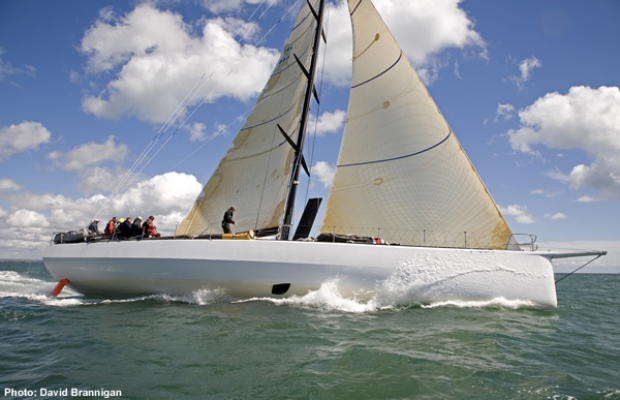
The new Irish belle
Wednesday July 23rd 2008, Author: James Boyd, Location: United Kingdom
If us Brits wish to do some flag waving during the next Volvo Ocean Race then we should prepare ourselves for some Anglo-Irish d’entente, for in addition to top Irish offshore sailors like Damian Foxall and Justin Slattery and Northern Ireland’s Ian Moore, some of the south coast’s finest will be sailing on board the Green Dragon Team Volvo Open 70 from race veteran Neal McDonald, to bowman Freddie Shanks and of course skipper, Ian Walker.
While the likes of Ericsson, Telefonica and Puma have had the benefit of considerable time to spend on their programs, for the Walker-Jamie Boag-Eamon Conneely conceived Irish Volvo Ocean Race team it has been more of a struggle with the campaign only pressing the 'go' button at the last minute, giving Reichel Pugh just three months to complete the design work before it got passed over to McConaghys in China to build.
However the team were able to get a jump start their campaign when they bought the R&D work designers Judel Vrolijk had carried out on behalf of Peter de Ridder’s Mean Machine Volvo Ocean Race team before the plug was pulled on it. “They had carried out two tank testing sessions,” describes Ian Walker of the R&D they acquired. “They had run a number of models which were testing certain characteristics of the boat, waterline beam and prismatic being two of the things. We didn’t have any time for any of our own tank testing work”
“Mean Machine had also done some work in the wind tunnel, because one of the things you have to work out is the drive force to the rig,” he continues.
Importantly the package also came with some weather analysis. With the new course for the Volvo Ocean Race taking in the Indian Ocean, India and the Far East - effectively uncharted water in ocean racing terms, with the exception of the Oryx Quest - and substantially less Southern Ocean emphasis, so the meteorological complexion of the race has dramatically changed and this has affected every aspect of the design, but especially the hull form, appendages and sails. As Walker puts it: “the key thing you need to know is miles or time spent in which wind speeds and angles.”
In addition to the weather data that came with the Mean Machine research so navigator Ian Moore has been studying the climatology for the race course. Aside from leg two heading back up through the Doldrums to India and leg three where the boats look likely to be sailing due east along the Doldrums, Walker reckons the headbanger is going to be leg four, 2,500 miles from Singapore up to Qingdao which appears to be upwind most of the way in 10-30 knot winds with potential horrors such as much flotsam, poorly charted islands and underwater obstacles, etc.
Reliability will certainly be name of the game. This is expected to have improved since the last race, with the new VO70s being second generation and free of the hazardous ‘bomb doors’ for their canting keels. Walker believes the most likely boat breakage this time will be due to collisions. “We are already seeing that in the Open 60s. The places in the world we’re going to and the speeds these boats travel at, I can see the biggest issue will be hitting things and breaking daggerboards. And there’s not much you can do about that.”
However there are contingencies. It is possible, although it comes with a weight penalty, of engineering daggerboards so that they can be reversed. Alternatively a spare board can be carried - although this is not as attractive as it was in the last race when the board could be ‘stacked’. This time round a spare board must be secured in place. Equally while kick-up rudders and mechanisms for replacing damaged rudders at sea is now commonplace in the IMOCA Open 60 fleet, this message it seems has yet to get through to the Volvo teams, although admittedly they don't have to survive a 'non-stop' round the world race.
Another crucial aspect of the campaign Walker says was the structural engineering and especially the interaction between engineers, designers, builders and the team. Rather than go to the big guns, SP or High Modulus, Walker chose to go with the two year old Hamble-based company Applied Structural Analysis (AStA), formed from ex-High Modulus Europe personnel including Julian Smith, Phil Lawrence and Richard Oliver who he worked with Walker at +39 in the last America’s Cup.
In terms of the build, the team once again turned to McConaghys in China. While some might see this as a brave move for a boat entered in giant race where build quality is so vital, they had had a good experience with building Patches 2 in China and Walker says that in the intervening year McConaghys have built many more boats and moved to a new a facility. To streamline the build they brought in Tom Braidwood, who not only is an experienced hand having competed in the Volvo Ocean Race previously on Ericsson and SEB, but had previously project managed the build of Neville Crichton’s Alfa Romeo supermaxi at McConaghys, although that was in Australia. James Carroll, the former boat captain on Patches, joined Braidwood in China for the fit-out.
In terms of building and developing VO70s it is generally felt that in fixing a maximum weight for keel bulb and foil, while a good idea, the rule makers set this weight too high and have failed to achieve the desired result of teams not having to contemplate ‘sawing their toothbrushes in half’. Simply put - with the Code 0s, the stiffer heavier masts, the ‘bigger’ hull shapes compared to last time, teams have been struggling to reach the maximum permitted bulb and foil weight while remaining inside the maximum displacement limit.
“It is just as critical as it ever was,” agrees Walker of the weight saving regime. “Because it is a reaching race, it is all about righting moment, so bulb weight is super important. Trying to get maximum righting moment is key, which is why Ericsson have been trying to get down this hollow keel fin route. Trying to get maximum keel and fin weight, but at the same time trying to get maximum bulb weight with minimum foil weight.”
With furling masthead Code 0s now permitted, this has been a key development, its influence almost as significant as the race’s new route on the design of the second generation boats. The powerful sails have affected mast design, requiring rigs to be stiffer. The Irish team followed Ericsson and Telefonica in getting their spars from Southern in New Zealand. The Code 0s have also affected hull design. “I think it has enabled everybody to go to maximum beam much more confidently because the period you are going to be underpowered is much reduced,” says Walker. To give some indication, they will be looking to change down from the Code 0 in around 8 knots. So fully powered up in 6 knots maybe?
While Code 0 development is important, another area of variation we are likely to see between the boats is the size of their main square tops. With their sail development, Green Dragon Team has benefited greatly from the present hiatus in the America’s Cup. While their sails are finished at the North UK loft, they have managed to secure the design talents of Henrik Soederlund and Mickey Ickert of North Sails Design Group, who previously worked with Mike Sanderson on the well developed ABN AMRO wardrobe last time around.
“Most teams would take a sail designer full time on board in their team,” says Walker. “We weren’t in a position to do that, but in a funny kind of way this has worked out well because Mickey and Henrik’s time is freed up because their AC commitments have been reduced. They probably wouldn’t have been available if the AC had not stopped. You can’t underestimate the difference that has had for is in terms of personnel as well.” The likes of Justin Slattery and Neal McDonald would also have been tied up with TeamOrigin had the Cup been in full swing.

Neal McDonald and Ian Moore
In terms of crew selection, Walker says he was looking for a combination of youth and Volvo experience and big guys (as well as bright people, with the correct combination of skill sets, who he wants to hang out with for the next year). When it comes to Volvo experience it is sensible to get people from a range of past teams and they have past crewmen from Ericsson, ABN AMRO and Pirates of the Caribbean. There was a requirement to include Irish sailors and in addition to those already named, most of the shore support is from the Emerald Isle including old hands such as Johnnies Smullen and Mordaunt. With their title sponsorship coming from China, they will also be taking a Chinese crew with them and Walker is specifically looking for one of the China Team sailors from the last America’s Cup or an Olympic sailor.
This time round Volvo Ocean Race crews are obliged to include two under 30 year olds and Green Dragon Team in fact have five in their squad. “What I didn’t want was to have just two under 30s and find that one gets ill or injured and not having trained up someone else,” says Walker. “I wanted some flexibility particularly with the under 30s.” These include ex-Emirates Team New Zealander Andrew Mclean, ex-ABN AMRO man Phil Harmer, Scott Miller from the RYA Keelboat program and ex- Patches bowman Freddie Shanks.
As to sailing a Volvo Open 70, this is the first time Walker has been unleashed on a boat so brutal. As was proved in the last race - and a point made repeatedly at the time by ABN AMRO skipper Mike Sanderson - Volvo Open 70s are more than capable of revving into the red and are getting into multihull territory in terms of their being capable of blowing themselves apart if pushed to the limit constantly. Is this something our man is comfortable with? “I think that is my style,” says Walker. “I think that is something I have proved in the past. We have been very clear: The design brief for the boat was to try and make it simple and reliable. We have some very short stopovers in some places that aren’t used to having high tech race boats turn up. Ideally you need not to have to fix the boat.”
Another aspect of the ABN AMRO campaign which we imagine more teams have paid attention to this time is sail handling, many of the ideas taken from the Open 60 and ORMA 60 multihull classes where they have been used in part to ease life for shorthanded crews, but particularly to prevent breakage. Spinnaker poles are now fully a thing of the past. More and more sails are hoisted on furlers - obviously furling Code 0s are permitted this time, but some of the smaller triangular sails will also be rolled. The Irish boat for example has a furling no4 and they are contemplating being able to roll up their no5. There are times when boats will be deliberately slowed down prior to manoeuvres or sail changes will be made bare headed 0 ideas previously abhorrent in fully crewed ocean racing circles, but at times vital in the name of looking after the gear.


Another disadvantage of being late into the game is that there was never the opportunity for the Irish to be a two boat team. While Walker says that two boating benefits you greatly in terms of being able to develop gear, and in particular sails, this would have been impossible given their tight time fact and in fact this has proved not to be as crucial when dealing with VO70s as it is in other classes. “The testing we have done in the last two weeks I have learned more from that than the testing I’ve ever done in any other boats. That might be because when you are say testing reaching sails, one can be a knot faster than the other, so it is pretty obvious, whereas in Olympic or America’s Cup sailing, the differences between the boats are also immeasurable until you line the two boats up and it might be half a length here or there, which you might not even be able to record in the data.” The testing is run by Ian Moore who performed this role for Emirates Team New Zealand during the last America’s Cup.
While they are a one boat campaign, they has been talk of their getting together with paranoid Puma or the Russians for some two boating, but this does look like it will come to pass.
With VO70s one gets the impression there is a much broader brush approach to development. But for the Irish this is also a function of their lateness. Walker provides the example of their sails: “We wouldn’t have time for two generations for sails before the race. With a one month lead time on 3DL sails if we ordered sails now, we wouldn’t have time to get them, look at them and re-order them and have
them for the start of the race.”
In terms of their finances, Green Dragon Team are getting there. The boat is owned by a syndicate of mainly Irish businessmen while the Irish tourist board, Failte Ireland are a sub-sponsor and their recently announced title sponsor is a Chinese syndicate. Walker says that at present they are 75% of the way to reaching their full budget, but they “still have considerable branding and corporate sponsorship to sell which will make up the budget shortfall.”
Despite the shortfall they are not really wanting for anything. They could always get more sails and have more people. “If you had unlimited time and budget you can always build a better boat. You can always spend more time weighing stuff and taking more care. But for the time and budget we’ve had I couldn’t be more pleased with our boat. We’ve only had the bowsprit [which broke on their first sail] and a few minor things that have kept us off the water. So at least we are getting the hours up.” Since launching they have also been blessed with an excellent range of conditions to test gear both out of Gosport initially and out of their new home in Cork.
Green Dragon Team will be based in Cork for one and a half months during which time they will be carrying out their qualifier, along with a few other long stints offshore. They will also go on a mini tour of Ireland visiting Dublin, Belfast and Galway, before they have to head off to Alicante ready for the start.
But sadly it doesn't look like it will be until the Volvo Ocean Race has started that we will get an indication of whether or not they are indeed in the ball park with the likes of Ericsson and Telefonica.
See video of life on board in 30 knots here .
More photos on the following pages...

Most Read
Most Commented
Comments
Businesses


Pro businesses
Editor's choice
Member blogs
-
 Ned Collier Wakefield: MOD70 round BarbadosWell that was intense. 12 hard fought for seconds for the win. In idyllic conditions, Tony Lawsons MOD ...
-
 Mini Transat leg 2 reportThe second leg of the Mini Transat started on 31st October, just over a month after ...
-
Leg 1 reportI’ve been working towards the Mini Transat now for three years. In 2013 I was part ...
Business blogs
-
 The Island Sailing Club in Cowes, Isle of Wight, is delighted that Prince Michael of Kent ...
-
Peta Stuart-Hunt chats with the 25 year-old British solo sailor Lizzy Foreman before she sets sail ...
-
The 2015 Student Yachting World Cup (SYWoC), an ISAF-recognised event hosted and run by students for ...
Editor's Choice
All time favourites...
-
 Three legs down into Ian Walker’s
-
 Winning all but two races at
-
 For the first time in its
Latest Comments
Add a comment - Members log in