
How to do it
Monday March 17th 2008, Author: Paul O'Riain, Location: United Kingdom
Funding
The main barrier to a project like this is funding. There are three ways to fund it, either from sponsors, from personal funding and or through fund raising. My project involved all of the above. Friends, family and even people I hardly knew rowed in and I was truly humbled by the amount of support. Funding is an area where most competitors struggle and the stories of how people have got to the line and with what are pretty amazing. The budgets I have heard of range from 10s of thousands to ¼ million euros. Like many I decided to embark on my project even though I didn’t have a sponsor up front, but I have always believed that unless you are actually doing it, or have a track record, no one will really take you seriously and at the end of the day where there is a will there is a way.
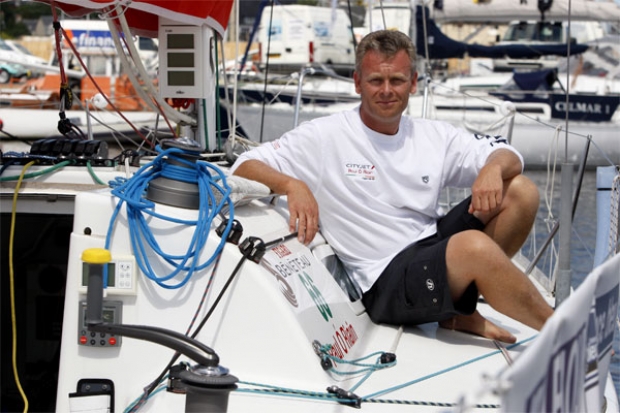
My sponsor CityJet, an Irish Airline owned by Air France, came on board in June and was a perfect fit. CityJet’s support of my project came at just the right time and I was delighted to receive it. The day the CityJet graphics went onto the side of the boat was a real thrill, she looked absolutely fantastic.
The budget to do a Figaro varies and will depend on whether buying or chartering a boat, how much training is involved and the number of events entered on the circuit besides the main Figaro event. I got my boat mid-March, trained and prepared in April, did three races in May, spent a further six weeks in La Rochelle, for training in June and July, competed in the Figaro from the end of July and the whole of August, did the Tour de Bretagne (doublehanded) in September and the Route de Ponant (solo) in October. I chartered my boat and my budget for the season worked out around €130,000 and that was not lavish. Most people agree, a full budget to do the whole circuit of events, including an early season transatlantic race, would be €170,000 minimum.
Sleep Deprivation
A big part of solo sailing is dealing with sleep deprivation. It is necessary to keep watch as much as possible and keep the boat going as fast as possible, but at some point sleep is necessary. Sleeping is done in the form of cat naps of between 10 and 20 minutes and if lucky you may stretch it to 30 minutes if there are absolutely no hazards around. It is done this way because in general visibility stretches to 4-5 miles all round, about the distance the boat or other boats are likely to travel in the time it takes to nap.
After checking the horizon and with no threats to worry about down for a nap. The idea is to get a load of 20 minute cat naps over the course of any 24hr period and keep putting some sleep “in the bank” - so that at night when the urge to sleep occurs it can be fought off. This whole area is very interesting because scientifically it is known that the first 20 minutes of deep sleep accounts for something like 20% of what is necessary. By getting a bunch of 20 minute deep sleeps it makes up for the daily requirement but without spending as much time actually asleep.
Another very interesting part of the sleep game revolves around what are called 'sleep gates' which links into a pre-historic biorythmn. Millions of years ago in caveman times when there were predators around people didn’t sleep for eight hours for fear of attack and would sleep for short periods. Everyone still has these sleep gates which are times during the day when the urge to sleep happens - its perfectly natural, but most people ignore them. I know, for example, that I definitely have one a 2.30pm each day when I yawn and feel sleepy. This is a good time, for me, to get a 20 minute cat nap of quality sleep, because theoretically it is easier to get into a deep sleep then. Interestingly some of the worlds most famous leaders including Winston Churchill and Margaret Thatcher would have a short nap during the day and were reputed to only sleep for four or five hours each night.
While it is easy to understand how to do the sleeping thing in theory - in practice it is very difficult. Typically the fear of something happening while asleep makes it difficult to get into a deep sleep, also the boat can be very noisy below, because every noise above decks gets amplified below, which is unnerving. Around the sleep gate time it might be necessary to do something on deck or the boat maybe near land/rocks/another boat therefore that sleep gate and opportunity to sleep is lost.
In my first qualifier race, the Solo Ports de France Concarneau, I only slept in the end because I got to the point where I was so exhausted and didn’t care if I got run over and sank to the bottom as long as it was quite and I could sleep. I really wanted to crack the sleep thing, but every time I went down to do it I just couldn’t settle and feel comfortable. This came, from years of being on boats where you always made sure someone was keeping watch at all times. I couldn’t get this out of my mind. This was made more difficult because my special sleep alarm didn’t work properly and only allowed me ten minutes max at a time before if went off and my autopilot was malfunctioning every thirty minutes and going into a man overboard routine, which ended up being a problem with the remote control and its sensor.

Preparateur
When competing in the Figaro it is a very good idea to have some help and this comes in the form of what the French call a preparateur (shore crew). The preparateur is there to help take all the small stuff away from you, get your vehicle and gear to each stopover, ensure the boat is cleaned, repaired, prepared between stages and generally there to ensure you can put your head into the race because the skipper is exhausted and needs to rest. This preparateur and their performance doing what can be a menial role is very important. If you get the wrong person it can really be upsetting and make your life very difficult.
France
Living in France is something I have wanted to do since I was very young. This comes from family holidays in France camping and crusing. Luckily for me, three years spent in a French school in Dublin from the age of 4-7 means the language while still not easy was still there hidden in some recess of my brain and not a huge barrier. Many would say that it was easier for me cos I do “parlez vous” and yes that would be partly true. However, there were other English speaking people doing the Figaro who did not have any grasp of the language and they got by absolutely fine. The class and event organisers had interpreters to ensure we didn’t miss anything important and the class publishes the rules in English as well. However if anyone is thinking of going to France to take on a challenge like this - remember many of the French speak English very well and will do so, but you must make an effort to speak French first otherwise they will not speak English to you. They rightly can be very stubborn that way. I always say if you murder a couple of sentences in French first, the French will speak English to you because they can’t stand to hear their language being abused so badly.
The Boat
The boat used for the event, a Figaro Beneteau 2, is specially designed and constructed for the Figaro. There is a separate class association which regulates the class and it is quite strict. The interesting thing about the boats is the class changes the boat design every 13 years. They only allow 100 boats to be built which is to ensure new boats can’t be built many years into the cycle to gain an advantage and also protects the investment made by skippers and sponsors when they buy a boat.
Effectively the boat has 13 years to depreciate. At this stage as far as I am aware all 100 have been built in this cycle which started in 2003. This also creates a ready charter market where owners can get a return on their investment if they are not competing in the boat themselves.
Getting to grips with the boat was not as big a problem as I had imagined – but getting to make it go as fast as guys who have been sailing them for a few years has been a huge challenge. The more I race the boats the more little tricks I hear about like stacking your spinnakers in heavy weather on the windward rail beside the ballast tank overflow and then turning on the ballast so it overflows into your spinnakers, soaking them and effectively adding huge weight to the windward rail.
A funny thing about the rules is the requirement to seal a lot of the gear in place. This is done using wire seals to ensure things like fire extinguishers, bunks, house batteries, engine batteries and lots more can’t be moved about the boat. This has all come about because that’s exactly what someone has done in the past and it was deemed unsafe or unfair.
Racing the boat was a pure joy. The boat is stable, fast and very well behaved. This is not to say that it was easy. Far from it. Normally you would sail a boat like this with approximately seven people, so it is necessary to adapt and learn to do everything by yourself. The main thing is to anticipate and learn the various tricks of a solo sailor. Physically it is very tough both because you are tired from lack of sleep and because you are doing everything on your own.
The boat uses a very robust autopilot made by NKE and is specified for boats up to 45ft and really worked well, but there were a few idiosyncracies which became apparent over time. On board we carried a remote control as part of the auto pilot, which we generally hung around our neck, from which we could steer the boat, which was necessary especially if on the foredeck gybing the spinnaker pole or other manoeuvres. Apparently if the skipper fell off the boat and travelled more the 50 metres away from the boat with the remote control, the helm would immediately crash tack the boat, so it would stop and the skipper could potentially swim back to it. At the same time the pilot would send out a distress signal over the VHF to draw attention to the situation. I never saw this in action and hope never to.
The boat is water ballasted and has two tanks either side into which you can pump 270 litres of sea water using an onboard electrical pump. This is to replace the normal situation where crew would sit on the rail.
The boat has two rudders which made the boat extremely stable, reducing any tendency to wipe out and meant there was a back up in case of hitting something and serious damage to one.
Navigation was mainly done on a PC using Maxsea navigational software which overlaid tidal information and weather forecast files (gribs) on the chart to enable the skipper formulate the right racing strategy. Naturally all competitors had to have paper charts on board as a back up.
Conclusion
At the end of the event my overall result stood at 43rd. I have mixed feelings about my Figaro experience. The racer in me is a bit disappointed with the result, however the sailor and adventurer is absolutely thrilled - I have learned so much, sailed an incredible amout, nearly 4000 miles in one year 90% of it single handed, lived in France, met many people and had a massive adventure.
I started the project with the specific goal to do it once and see how I got on before I made decisions about whether to continue. I was apprehensive about the solo sailing and my ability to do it and more importantly whether I would like it. This was answered very emphatically immediately I stepped on the dock at the end of my first qualifier in Concarneau in May, even though I was exhausted beyond anything I had ever experienced - I loved it.
However, at times in the third and fourth legs of the main event I really questioned what the hell I was doing there, conditions were that bad and it was scary. Now that I have finished and can reflect on everything I feel to not try and continue on for another year would be stop too soon. I was told by many people who have done the Figaro not to expect to much in the first year and to take it on as a two year project as the first year is all about getting to grips with the Figaro - I didn’t want to believe that at the time, but now understand exactly what they were talking about.
The Figaro is the undisputed hotbed of solo sailing talent as evidenced by the fact that Michel Desjoyeux, a sailing legend, returned to compete and to sharpen himself up and won it again for the third time, but only won one stage. They say if you want to compete long term in short handed sailing - the Figaro is where you learn - certainly if you look at some of the big names winning big races you find a lot of them have come from the Figaro. Many of the competitors are fulltime Figaro sailors, many are ex olympic and world champions from other classes, it’s all they do all year round which means they are good - damn good - believe me!
Paul is still looking for funding to compete in the Figaro this year. Read more about him at his website here
Most Read
Most Commented
Comments
Businesses

Pro businesses
-
Italy
-
-
United Kingdom
-
Editor's choice
Member blogs
-
 Ned Collier Wakefield: MOD70 round BarbadosWell that was intense. 12 hard fought for seconds for the win. In idyllic conditions, Tony Lawsons MOD ...
-
 Mini Transat leg 2 reportThe second leg of the Mini Transat started on 31st October, just over a month after ...
-
Leg 1 reportI’ve been working towards the Mini Transat now for three years. In 2013 I was part ...
Business blogs
-
 The Island Sailing Club in Cowes, Isle of Wight, is delighted that Prince Michael of Kent ...
-
Peta Stuart-Hunt chats with the 25 year-old British solo sailor Lizzy Foreman before she sets sail ...
-
The 2015 Student Yachting World Cup (SYWoC), an ISAF-recognised event hosted and run by students for ...
Editor's Choice
All time favourites...
-
 Three legs down into Ian Walker’s
-
 Winning all but two races at
-
 For the first time in its
Latest Comments
Add a comment - Members log in