
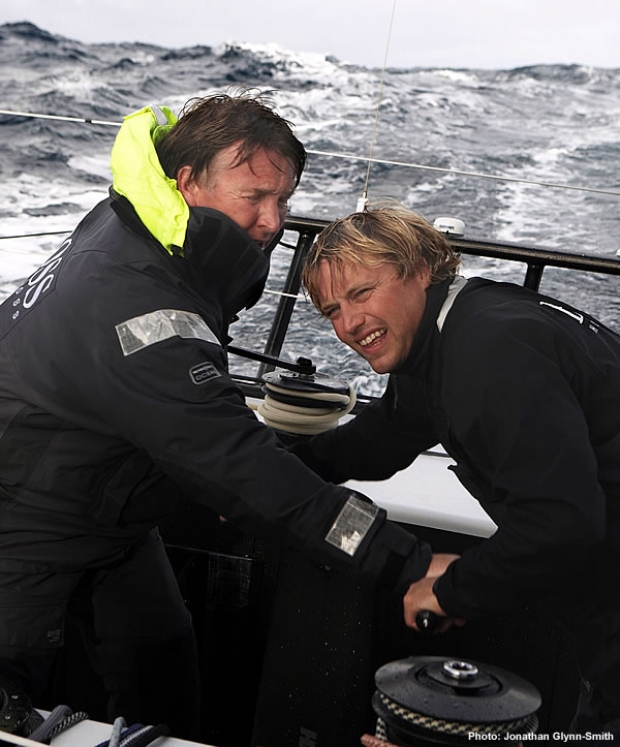
Best dressed man in Barcelona
Saturday November 10th 2007, Author: James Boyd, Location: none selected
With the Barcelona World Race kicking off tomorrow so Alex Thomson, skipper of the Open 60
Hugo Boss, Britain's only entry in the race gave us his views on the doublehanded round the world race and the latest news about his program. To read our technical article about
Hugo Boss -
click here.
thedailysail: So what have you been up to since the Fastnet?
Alex Thomson: Trip to Hamburg for the naming ceremony, we've done - as you should do with a new boat - take it out break it, take it back in fix it, take it out break it, take it back in fix it, etc.
TDS: What has this thrown up?
AT: We’ve taken the mainsheet track off and we’ve had various ballast leaks. That is always going to be hard thing firstly because there is so much ballast, and because the boat flexs so much and because its just the way you build the tanks: You put the sides in and on the top you have a blind flange and then you have a blind bond on top. You stick the lid on and laminate over the sides. So you can’t get in to laminate the inside. Then there's the pipes - it is a lot of water and a lot of pressure in it, so the water was going into the glue bond and going down the glue bond and coming out wherever it was easiest sorting out leaks has been a big thing.
Apart from that – we’ve done a small modification to the rudders. Otherwise it has been pretty good really .
TDS: How does the new Hugo Boss feel different compared to the old one? Obviously it is a load more powerful...
AT: It is so light really. I just feels like a skiff more than a keel boat. It feels very different. Upwind not so much - she is incredibly stiff - but downwind she is just like a skiff. She is a real pleasure to sail. Speed-wise the big difference is that you don’t need as much sail to go just as fast. It does mean you end up with the same amount of sail, but going faster. It is easier to sail faster. The old boat was two tonnes heavier, so you were dragging that around and when you were doing 20 knots it felt like you were doing 20 knots. When you are doing 20 knots on this boat it doesn’t feel like it at all.
TDS: ...the old multihull thing where you don’t recognise the speed?
AT: Yes. It is a really nice boat to drive. We are very pleased with the concept of the deck at the beginning and now we think it is awesome, really really nice.
TDS: What’s the most breeze you’ve seen in the boat?
AT: We came back from Hamburg on a dead beat for three days in 40 knots which was nice!
TDS: What happens to the water in the cockpit, have you found much come down the tunnel? (A unique feature of Hugo Boss is her twin cabin tops with all the lines running back from the mast directly to the cockpit, which is what are referring to here)
AT: Upwind you get some coming down, but it always goes right down the leeward side. Downwind in a blow you do get some down there. The Fastnet was the worst because the sea was so confused between Land’s End and the Lizard. There was quite a lot of water coming down then. That would have been horrible for everyone because there was water coming from everywhere.But you don’t need to go down there to be honest, so it has been alright.
The nicest thing about the system is that you never leave the cockpit by the sides, you always go up the middle and you can’t fall off the boat. You feel really safe on the boat and the cockpit floor is so low, the side is here [Alex indicates to his waist], normally your side is there {he indicates to knee height] so it feels like you can’t really fall out .
TDS: Have you rationalised all the sheeting in the cockpit?
AT: We don’t really cross sheet very much. You just have the ability to do it. It is nice to have a primary winch nearly in the middle of the boat, so that when something goes wrong or the breeze gets up and you really start charging and you have to ease the sheet, you don’t have to go underwater to ease it. You just go half way down, ease it and come back up again.

TDS: In the Barcelona World Race how will it work on board with Capey [his co-skipper Andrew Cape]?
AT: We’ll just try and look after each other. We’ll share everything. Capey will do more navigating than I will. I’ll be the one going up the mast for sure….
TDS: Will you run some sort of watch system?
AT: I don’t think you can really. It is more a case of if you are feeling strong you’ll do some driving and if you feel tired you’ll go to bed, whether that is for an hour, two, three or four hours - whatever. I think it is really important to keep rested because even when you are in the Trades and you think you know what is going to happen, it only needs a squall to come through to change everything and then you are losing sleep and you can make a mistake…
TDS: So how do you feel about the Barcelona World Race compared to the other events you've competed in?
AT: It is a real marathon. It feels more like a marathon than anything I’ve done. Maybe that is the mindset for me. I’ve always felt like this - it is a series of sprints, whereas this really is a marathon, particularly coming out of the Med….
TDS: It looks like it is going to take forever….[the forecast for the first few days shows very very little wind between Barcelona and Gibraltar]
AT: We are sticky in the light for sure, being the widest.
TDS: Is Hugo Boss the widest here?
AT: Yes, for sure.We certainly have the most righting moment. I’d be quite happy if it was a nice upwind first leg in 20 knots… It may be more like two… [ Hugo Boss has 40% more righting moment than the previous boat and yet is 25% lighter....]
TDS: How do you rate the rest of the competition?
AT: I think they are all going to be there maybe apart from the old Kingfisher with Servane [ Escoffier]. They might be pretty good in the first bit! If you look at their boat compared to everyone else’s it is SO narrow! I think it is only about 5.2m. We are over 6m and most people are approaching 6m.
If you look at the rest of them - PRB stands out from the crowd, Bilou [Roland Jourdain, Veolia Environnement] is going to be quick, Delta Dore is going to be quick. And Virbac…. Everyone is. It is going to be really hard. And the first bit being light and the second bit being average downwind, it is unlikely we are going to see one boat that is going to fly off just from a boat speed point of view. I just hope that the first four or five days getting out of the Med isn’t a complete and utter lottery.
TDS: You've seen a bit of Vendee Globe - how do you think the pace will be different in the Barcelona World Race?
AT: It would be nice to think that it won’t be too mad. We’ve got a pretty extensive sail wardrobe on board. I know some other people have and some people haven’t. If you are suddenly into the range of another sail, you’ll change it and off you go. People are not going to slow down. What happens is we will obviously push at the pace of the first guy and you’ll push at that pace and then he pushes more and then we push more, etc etc. But it is just really important to make sure that you push at the right times. Sometimes you can push and there is no gain at the end of it because you are going to fall off a system and you are going to fall off it anyway, so it doesn’t make any difference if you are five miles on or not. That will be a really important thing. If you push too hard in those situations it will be very easy to break.
TDS: Do you feel you are getting a better handle on when the boat is going to break?
AT: I don’t think you ever know. I couldn’t have predicted that my keel was going to break [in the Velex 5 Oceans] and I couldn’t have predicted my gooseneck was going to go [in the last Vendee Globe]. You just have to do what you feel is right. It would be nice to think you can have a 500 mile cushion and you are in the lead and you can take it easy. But Nick Moloney when he did the Vendee Globe, took it easy, didn’t push too hard and his keel fell off!
I do think the attrition is going to be high.
TDS: On the basis that there is going to be a high attrition rate, are you going to be quite conservative with the spares you take?
AT: Yes, we are taking a lot of spares - as we always do. We could build a boat probably! And we have got a lot of sails. We are taking 14 sails.
TDS: How many sails did you take on the Vendee?
AT: 14 - but that was a mistake. On the Vendee there was one spinnaker I never used. We used it for corporate and that was it. It was a 1oz VMG chute and just never really used it. And I took a spinnaker staysail as well which is a nice sail to have but it is not really necessary when you can run a normal staysail which does nearly as good a job. On this race there is much more opportunity to make the sail changes efficiently. You feel like you would have more if you could.
TDS: What is it like sailing with [living legend and veteran of countless Whitbreads, Volvos and America's Cup campaign and the Mini Transat] Andrew Cape? He’s obviously got this massive sailing CV? Does he have a similar temperament to you?
AT: It feels like he is someone who is really at home on the water. He is a very level person and he is always positive. He is as hard as nails. There’s no doubt about it. It is no trouble for him to stay up. If we work out how much sleep the two of us get around the world, I’m sure I’ll have more than him.
TDS: Yes, he is a bit older. You don't need so much sleep when you are older!
AT: Yes, he has to get up after two hours anyway to go for a wee! So he is hard, he is positive. He is a good driver.
TDS: He won’t be restraining you?
AT: I think we’ll be restraining each other. I think he might find I’ll be the more conservative one. It’s my boat!
TDS: You’ve had these incidents in these last races - have they affected how you sail?
AT: Not really, no. I don’t feel the pressure. I know I have to finish this, but you don’t worry about it because you don’t know what is going to happen. Anything could happen. I am very conscious that the boat is brand new and I’m conscious of how powerful it is. The one thing I bring to this party that you can’t buy is the Open 60 and shorthanded experience. I’ve got myself into all sorts of bother lots of times and it is really good because you know that something say is going to happen in an hour, so let’s do something about it now because it takes 40 minutes to get to the point where we’re ready to change. And the techniques for things when you do get into trouble - how to deal with it.
TDS: I presume you’ll both be on deck for manoeuvres and you can do those a lot faster with two than one?
AT: Much faster. You can gybe the boat without snuffing the chute in under 12 knots of wind. Tacking is much quicker. Everything is much quicker. The boat is much more physical than the old one. So having two people makes a big big difference. Even moving the sails around. Some of our sails are nearly 100kg. Say 88kg dry and stick some water in it. Just moving that around… Imagine you try moving me or you around in the boat – it is really hard.
[There is some banter about how it would be a little harder moving thedailysail's editor around than a trained athlete of an Open 60 skipper]
TDS: You will be steering most of the time ?
AT: Yes, we’ll be steering all of the time. We’re not taking enough diesel to use the autopilot all the time! I think upwind you have to [steer]. Downwind you definitely have to. Power reaching if you are properly tuned up sometime you can just stick it on [the pilot under] compass or TWA.
TDS: What’s the most breeze your pilot can handle?
AT: Anything. It wouldn’t be handling more than 25 knots upwind with the mast chute up, but by then we would have taken the masthead chute down, whereas on the old boat I’d run it to 30 knots. You wouldn’t want it to drive in more than 18 knots of true wind with the chute up. Apart from that it’ll do anything .
TDS: So you don't just use the pilot in medium conditions when it is stable?
AT: We’ve used it 35 knots power reaching. That night off the Fastnet when it freed up and we were off it was a black black night and water everywhere and you couldn’t see anything for the dark or the amount of water that was in your face. So the pilot was doing a better job then.
There is no moon now. It was a full moon when we came in.
TDS: Thanks and good luck in the race.
More photos on page 2...
Most Read
Most Commented
Comments
Businesses

Pro businesses
-
United Kingdom
-
France
-
United Kingdom
-
United Kingdom
Editor's choice
Member blogs
-
 Ned Collier Wakefield: MOD70 round BarbadosWell that was intense. 12 hard fought for seconds for the win. In idyllic conditions, Tony Lawsons MOD ...
 -
 Mini Transat leg 2 reportThe second leg of the Mini Transat started on 31st October, just over a month after ...
 -
Leg 1 reportI’ve been working towards the Mini Transat now for three years. In 2013 I was part ...
Business blogs
-
 The Island Sailing Club in Cowes, Isle of Wight, is delighted that Prince Michael of Kent ...
 -
Peta Stuart-Hunt chats with the 25 year-old British solo sailor Lizzy Foreman before she sets sail ...
-
The 2015 Student Yachting World Cup (SYWoC), an ISAF-recognised event hosted and run by students for ...
Editor's Choice
All time favourites...
-
 Three legs down into Ian Walker’s
 -
 Winning all but two races at
 -
 For the first time in its
Latest Comments
Add a comment - Members log in