
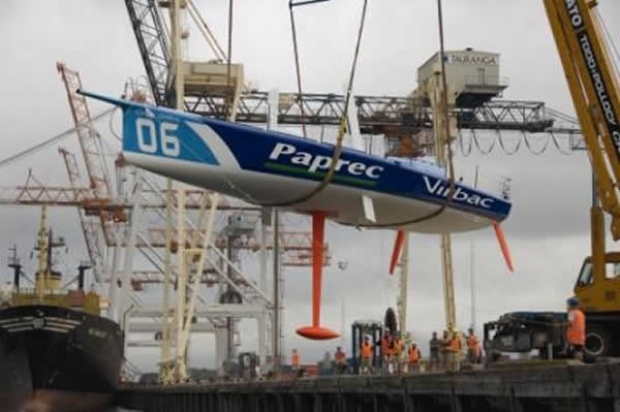
New Virbac-Paprec launched
Friday February 2nd 2007, Author: James Boyd, Location: France
Jean-Pierre Dick’s new Open 60
Paprec-Virbac has just been launched at its builder, Southern Ocean Marina in Tauranga in New Zealand.
Once again the Paprec-Virbac design team has been particularly innovative, as they were for Dick's first monohull. The most important item is the addition of a trim tab under the boat's. This trim tab has been used for a long time on powerboats, and a similar system featured on the Hugh Welbourn-designed maxi, Bols , but has never featured before on an Open 60.
Once again, Dick and his team have made a great innovation in the world of IMOCA Open 60s. For their first boat, the Virbac-Paprec team set the tone when they commissioned the first Open 60 designed by the well-known Farr Yacht Design office in Annaplis. Today, there has been a dramatic increase in the number of Farr designs prominent Open 60 skipper have commissioned - Vincent Riou, Jérémie Beyou, Michel Desjoyeaux, etc
.
With ther new Open 60, the Paprec-Virbac design team, comprising Luc Bartissol, Loïck Peyron, Nicolas Abiven and Jean-Pierre Dick has innovated again. The trim tab on the transom articulates along one metre of transom. When sailing, Dick will use the trim tab to adjust the fore and aft trim of the boat.
Another exterior innovation on the new Virbac-Paprec is a sliding roof to protect her crew from spray. Paprec-Virbac also has an innovative interior, but due to competition, these innovations must remain secret for a while yet.
Q: What is the philosophy of your new boat as opposed to the old one?
Jean-Pierre Dick: Q"Like the new generation, it is more powerful, beamier, offers enhanced heeling, with canting keel and central ballasts. You need to control all these and protect yourself from the water. The general philosophy is therefore to sail fast in a protected environment.”
Q: What are the major innovations to Paprec-Virbac?
J-PD: "First there’s the very visible sliding roof to protecting her crew from the water. There are sides, like a car hard-top, which allow you to trim the sails even if you're not in wet gear. Of course, the major innovation is obviously the trim tab at the rear of the boat."
Q: What is the purpose of the trim tab under the hull?
J-PD.: "In gentle breeze conditions, it is lifted to reduce the wet surface and limit drag. Downwind, it is lowered to make her steadier and easier to adjust the boat’s trim. This results in excess weight and requires a perfect engineering system. However, we feel that this will bring greater speed, which will be beneficial during the Vendée Globe.”
Q: Who had this idea? Did you immediately support this principle?
J-PD: “The initial idea came from Farr, however, its completion and deployment was carried out together with our technical team. As with any innovative idea, there is an appealing side to it as well as a risk-taking element. We can only say, after testing it, that it was a successful gamble. The decision was difficult to take, since you don’t get that many chances to build this kind of boat. However, it’s interesting to make progress. Perhaps she is a foreshadow of the racing yachts to come in the third millennium."
Q: After two years of design and construction, you must be glad to see the boat
completed.
J-PD: "Yes, of course. It represents so much work. It is also of great satisfaction to the whole team to see the birth of a baby like that. The project of building a new boat is always very exciting. It’s the start of a new story.”
Technical specifications :
Architect : Bruce Farr (USA)
Boatyard : Southern Ocean Marine / New Zealand
LOA 18.28 m (60 foot)
Beam 5.80 m
Draft 4.50 m
Displacement +/-9 t
Mast height 28.50 m
Upwind sail area : 270 m²
Downwind sail area : 560 m²
Builder's team : 20 persons
Time to build : 22 000 hours
Most Read
Most Commented
Comments
Businesses

Pro businesses
-
United Kingdom
-
United Kingdom
-
Italy
-
Italy
Editor's choice
Member blogs
-
 Ned Collier Wakefield: MOD70 round BarbadosWell that was intense. 12 hard fought for seconds for the win. In idyllic conditions, Tony Lawsons MOD ...
 -
 Mini Transat leg 2 reportThe second leg of the Mini Transat started on 31st October, just over a month after ...
 -
Leg 1 reportI’ve been working towards the Mini Transat now for three years. In 2013 I was part ...
Business blogs
-
 The Island Sailing Club in Cowes, Isle of Wight, is delighted that Prince Michael of Kent ...
 -
Peta Stuart-Hunt chats with the 25 year-old British solo sailor Lizzy Foreman before she sets sail ...
-
The 2015 Student Yachting World Cup (SYWoC), an ISAF-recognised event hosted and run by students for ...
Editor's Choice
All time favourites...
-
 Three legs down into Ian Walker’s
 -
 Winning all but two races at
 -
 For the first time in its
Latest Comments
Add a comment - Members log in