

Sister's challenge
Friday June 8th 2007, Author: James Boyd, Location: United Kingdom
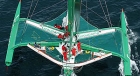
After an intense period campaigning in the Figaro class then skippering the 60ft trimaran
Sergio Tacchini, in which she won the 2004 Quebec St Malo race, France's top female offshore sailor, Karine Fauconnier, has dropped off the radar. She surfaced briefly to compete in the Oryx Quest with Brian Thompson's winning team, but since then has returned to obscurity in Brittany...until now.
"In April 2006 I had Gaia, she is one year old now," explains Fauconnier, 34, of her recent low profile. Her other half is Jacques Guichard, a sailmaker at North France and younger brother of French Olympic Tornado sailor Yann. "I am getting back into business now. It is nice to start again on these boats and tell everyone I’m still sailing. When you are a girl and you have a baby, people think it is ‘Game Over’. I wanted to come back earlier, but sponsors - it’s not an easy business in France now."
Part of the problem is that if you are in Fauconnier's situation and are trying to find money - what do you offer a sponsor? The wheels have all but fallen off the ORMA 60ft trimaran class that is Fauconnier's first passion. "I am waiting to see what is going on with the multihulls," she says. "There is also Russell Coutts’ catamarans [the World Sailing League], there are the IMOCA boats too that are getting bigger now, but I think that is going to get like the ORMA - it is going to cost too much money. So I am waiting for things to settle down so that I can really propose something long term. You can’t sell anything to a sponsor if you’re not sure about it."
In the unregulated world of the ORMA trimarans, budgets have become astronomic (relative to what they were) with highly complex boats, grand prix requiring 11 crew and support crew and always the same boat winning: Franck Cammas' Groupama. Hence this season there are only four boats regularly competing, they do not have their own circuit and one wonders whether or not the class will fully fold by the end of year - unbelievable when you remember there were 18 of this amazing craft on the start line of the 2002 Route du Rhum.
It is not the first time offshore multihull racing has imploded in France. In the mid to late 1980s when it took place in 85ft and then 75ft long multihulls and costs were escalated one boat, Jet Services V, came along that was new and thus head and shoulders faster than all the competition and caused the end of that particular era. Fortunately the phoenix rose from the ashes in the form of the 60ft trimarans. One wonders what will happen this time? The latest rumour is of a one design 60ft trimaran.
"It is too bad because these boats are really great and it could be a huge thing, but I think the people that were in charge of the races and also the skippers - we didn’t do a good job," admits Fauconnier. "We were just thinking of our own projects and not thinking for the community. It is not just a question of money spent on the boat. The America’s Cup costs a lot of money but people talk about it, they’re interested in it. There’s money spent by the organisation on the races, on the media, the way people follow the races. If you go to Valencia you have great parties. It’s lot of money, but it is fun. With ORMA there was a lot of money for the boats and teams but there wasn’t a lot of money for the organisation and it wasn’t fun at all. At the end I was wondering what we were doing there."
Effectively running a large racing class like ORMA is the same as running a business. All the boxes must be ticked in terms of the product, the quality of the organisation/service and the marketing otherwise it will invariably come unstuck. ORMA was decidedly lacking in the latter two.
While the multihull classes get themselves sorted out, Fauconnier has some other projects on the go and of particular interest at the moment is her part in the Decision 35's Julius Baer Challenge on Lake Geneva, where she is skippering a new team led by Ernesto Bertarelli's sister Dona Bertarelli Späth.

Karine Fauconnier with Dona Bertarelli Späth

Fauconnier explains how this came about: "I wanted to sail on these boats, she heard about it and she came and said ‘let’s do an all-female crew’. And I said ‘no, I’m not interested’. And she said ‘Please Karine, try. I’m not a Barbie girl. I understand totally what you think, but can we try and put together this project and we’ll see'. I knew the D35 boats - 80% of the time they sail in less than 8 knots of wind, so with an all-female crew it could be possible. I made them [the class association] change the rules so that we could sail with seven on board. It is normally six. We had a problem of weight because it is 456kg so that is an average of 65kg for girls and an average of 75kg for boys which is okay."
So the Lady Cat project was born. Their new one design 35ft catamaran was built this spring by Decision (who also build the Alinghi Cup boats - read more about D 35 class here) and was launched in April, one of two new boats for this season bringing these exotic all carbon lake racers up to ten in number .
A problem was trying to find suitable all-female crew to sail the boat. "I didn’t know many women sailors," continues Fauconnier. "I’ve never had a female crew, except that I’ve sailed a bit with Sharon Ferris round the world [on the Oryx Quest] and once on my trimaran and a little bit with Sam Davies, but otherwise I’ve never had experience of women’s crew. So I did a big selection. I asked everyone if they knew people. In France we have a good match racing team with Clare LeRoy and her crew and I asked the girls that knew about multihulls, like F18 and Hobie 16, and then we did a crew selection."


To help get the team together Ernesto Bertarelli lent them his Alinghi D35 and Fauconnier put a group of 12 girls through their paces with the help of coach Franck Citeau, himself a highly experienced F18 and Tornado sailor who is also part of the Gitana trimaran crew. "That it was really a good experience. We chose the crew later on and now we have a very good team," says Fauconnier of the crew selection which took place in March.
So why does Dona Bertarelli want to do this? "They are really competitive in the family," explains Fauconnier of the Bertarellis. "She likes to compete. She is really a sportswoman, skiing, etc. But she never sailed competitively so it is a new adventure for her. But we had a good feeling. She had a lot of confidence in me, because the D35 can capsize easily. To start with her husband didn’t want to let her sail because he was afraid for her. But then he saw it was reasonable and I wasn't going to break everything…I am responsible and I know how to steer these boats, it was okay."
While Ernesto Bertarelli is known for his yacht racing from the Cup to Farr 40s, his lake boats, etc the Bertarelli family itself have many other boats - mother in Italy for example has a Swan. "She never did race by herself but she knows how to sail. And she is very good because everything she doesn’t know she asked and she learns very quickly. And she is very fit physically. I have a good crew here," says Fauconnier of Dona Bertarelli.
Sister's involvement also seems to be acting as a motivator for her brother. Both Bertarellis will be competing this weekend in the Geneve-Rolle-Geneve race for the class prior to the Bol d'Or Mirabaud the weekend following, before Ernesto returns to Valencia for that other event...
Fauconnier is not the only other French former trimaran skipper to be involved with the D35s. Alain Gautier campaigns his Foncia team, the present leaders of the Julius Baer Challenge ahead of Bertarelli's Alinghi. Gitana's Loick Peyron regularly steers Nicolas Grange's Okalys. Of course Russell Coutts still takes part occasionally and will be steering Banque Gonet for the Bol d'Or Mirabaud.
This won't be Fauconnier's first Bol d'Or. Two years ago she competed on board one of the old heavily overpowered trimarans that were the precursor to the D35. "It was the slowest Bol d’Or," she recalls. "We spent all the day and the night on the lake trying to find a little wind funnel. It is weird the navigation there. We have a lot of work with the tactician to find out what is going on."
As to the Sebastien Schmidt-designed D35 itself, Fauconnier says it is a really good boat...for the lake. "I wouldn’t sail this boat anywhere else like on the sea or in waves. It is not made for that. For our first Grand Prix we had 15 knots of wind all day and we did four regattas on the same day - they’d never had as much wind in four years. So it wasn’t a good start for us. It was very tough because the boat is quite physical and in 15 knots it is a problem because it is really hard to bear away. Two boats almost capsized and Julius Baers dismasted at the end of the first day. It was like a stormy day and there was only 15 knots of wind! But I wasn't afraid. I’ve seen bigger waves than that on the lake, but the boat is really made for the lake, really clean, a big mainsail, etc. You are flying a hull in 5-6 knots of breeze and with the genniker too. I like the boat."
Fauconnier says she also really likes the 'ambience' of the class. It is not all professional crews. There are a lot of amateur sailors, with pros intermingled. In some ways it is like a less formal multihull version of the Farr 40.
Lady Cat will be competing in all 10 events in the Julius Baer Challenge, the D35's annual championship that culminates in the Beau-Rivage Palace Grand Prix at the end of September. All the races at present take place on the Swiss side of Lake Geneva, but Fauconnier says there is the possibility of holding an event on the French side, probably in Evian (where the water comes from) next year. At present the boats only race on Lake Geneva because they are not demountable and the cost of transporting them to the next lake by helicopter is prohibitive.
Aside from Lady Cat, Fauconnier will also return to transoceanic multihull racing this year and is signed up to sail November's Transat Jacques Vabre not on a 60ft trimaran but on a 50ft trimaran - Franck-Yves Escoffier's smart looking Crepes Whaou! The timing of this works well says Fauconnier as the D35 season finishes in September allowing her and Escoffier enough time to train for the TJV. She may also do other events on the tri this summer when the opportunity arises such as the Trophee SNSM and Defi Petit Navire.
Most Read
Most Commented
Comments
Businesses


Pro businesses
-
Italy
-
-
France
-
United Kingdom
Editor's choice
Member blogs
-
 Ned Collier Wakefield: MOD70 round BarbadosWell that was intense. 12 hard fought for seconds for the win. In idyllic conditions, Tony Lawsons MOD ...
 -
 Mini Transat leg 2 reportThe second leg of the Mini Transat started on 31st October, just over a month after ...
 -
Leg 1 reportI’ve been working towards the Mini Transat now for three years. In 2013 I was part ...
Business blogs
-
 The Island Sailing Club in Cowes, Isle of Wight, is delighted that Prince Michael of Kent ...
 -
Peta Stuart-Hunt chats with the 25 year-old British solo sailor Lizzy Foreman before she sets sail ...
-
The 2015 Student Yachting World Cup (SYWoC), an ISAF-recognised event hosted and run by students for ...
Editor's Choice
All time favourites...
-
 Three legs down into Ian Walker’s
 -
 Winning all but two races at
 -
 For the first time in its
Latest Comments
Add a comment - Members log in