
You don't have to be Ellen MacArthur
Thursday February 22nd 2007, Author: James Boyd, Location: United Kingdom
One of the most stunning aspects of last year's Route du Rhum was the size of the fledging Class 40 fleet. With the class a little over a year old at that point, 25 boats took the start line and many feel that this is set to grown with equal rapidity with as many as 40 or even 50 boats set to swamp this autumn's doublehanded Transat Jacques Vabre. While perhaps 10% of these entries are sailed by 'pros', full timers coming mainly from the Mini and Figaro circuits (a figure most expect to grow), this leaves around 90% of the class comprising part-time sailors, regular people with real jobs (gasp).
While singlehanded offshore racing may have been invented in the UK, with Royal Western Yacht Club-spawned events like the OSTAR and the Mini Transat (originally born out of the 1976 OSTAR) it is of course France which for several decades has been the dominant nation when it comes to this style of sailing. So it comes as some surprise that the UK should once again be leading the charge when it comes to mobilising what for many years has been a dwindling area of the sport.
As events like the OSTAR and Route du Rhum and newcomers like the Transat Jacques Vabre have increasingly become professional events, so few race organisers have been catering for the Corinthian element. And so it was that following the 2000 OSTAR that a group of disgruntled solo sailors with boats in the 30-40ft range (rather like Bob Salmon with the Mini back in '76) got together to form an association initially based around a Yahoo newsgroup called Petit Bateau: 'Small boat' in French, by way of tribute to the leading nation in this sport (and not to be confused with French manufacturer of children's cloths bearing the same name). Emulating the incredible growth of the Class 40, so Petit Bateau today has more than 300 members, dotted all over the globe.
While Class 40 has been encouraged into existence by the endeavours of solo round the world sailor and former Course au Large editor Patrice Carpentier, Petit Bateau has been equally successful thanks to its own enthusiastic nucleus.
Aside from being a forum for likeminded souls, the remit for Petit Bateau has evolved into being a training ground for Corinthian sailors who's ultimate aim is events like the OSTAR or the Royal Cornwall YC's Azores And Back Race (AZAB), being held this June. Confusingly this is for the most part a different group to the 'pros' - the Nick Bubbs and Phil Sharps, etc - who sail for a living and who's ultimate ambition is to compete in the Vendee Globe. This is also not necessarily a comment on sailing ability either: a crossover point for these two groups is the Mini class, where Simon Curwen - who has a full time job not in sailing, thus placing him firmly in the Petit Bateau camp - is the Brit with the most successful result to date in the Mini Transat.
Petit Bateau really began to swing into life in 2004 following the split in the OSTAR, OC Group acquiring the professional side of the event, redubbed as The Transat and only open to 50 and 60 footers. While The Transat stuck to the event's four yearly cycle, that dates all the way back to 1960, the Corinthian race, still known as the OSTAR, was kept by the Royal Western YC but postponed until 2005. This left the Petit Bateau brigade without a race in 2004.
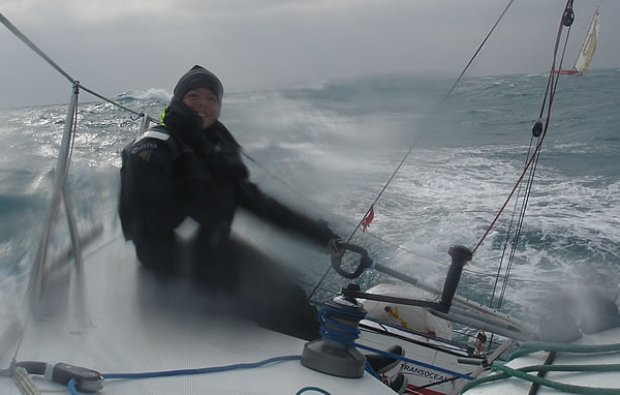
Paul Peggs (above), former Mini sailor and today one of the chief mover and shakers within Petit Bateau, takes up the story: "So a few of us got together to organise our own singlehanded race and the idea was to do a Figaro-type race around Biscay. We went to various yacht clubs, the Royal Cornwall, Royal Western and the Royal Southampton to see if they would run a race for us, and unfortunately we wanted it to be singlehanded and they all declined to run it, because I don’t think they thought that singlehanded racing was safe. So we decided to run it ourselves."
A problem with singlehanded offshore racing is that technically under the International Regulations for the Prevention of Collisions at Sea (the Colregs) - it is illegal, as if one refers to the letter of what is written in this heavyweight International Maritime Organisation tomb, there is no way a solo sailor can maintain a proper look out if they are sleeping for longer than 15 minutes at a time. Expanding on this debate is beyond the remit of this article (those who wish to air their views on this email us here) but it is a fascinating argument, particularly as pretty much all the sailors who have been awarded by the establishment in the UK - be they Sir Francis Chichester, Sir Robin Knox-Johnston, Sir Chay Blyth up to Dame Ellen MacArthur or Emma Richards and Mike Golding with their MBEs - have all been solo offshore sailors.
So Petit Bateau held their first race in 2004 with 15 entries and 11 finishers. With the Faraday Mill OSTAR taking place the following year, the Royal Western YC agreed that it could be qualifier for their event. The course was from the tiny Cornish port of Mylor (near Falmouth) across to Ireland, down to Gijon in northern Spain and finishing in Camaret in northern France.
Prior to the 2004 event, Mary Falk, a retired lawyer and a stalwart Corinthian solo sailor having competed in numerous OSTARs and two handed Round Britain and Ireland races about her 35 footer QII, pointed out that they had to have third party indemnity to protect themselves as race organisers, however for the 2004 race this cost them £3,000. As Peggs puts it "it was ridiculous with an entry of 15 boats." So to make the situation workable for 2005, Peggs, Jerry Freeman and Martin Buckley formed a limited company, through which they would run the race. This company would take on the liability in the event of them being sued (this still preys heavily on the minds of the organisers of these races after the Royal Western YC lost a case in the Italian courts and had to pay substantial damages, following the loss of the two Italian solo sailors Beppe Panada and Roberto Kramar off their 60ft monohull Berlucchi in the 1986 Two Star).

For 2005 Petit Bateau also changed tack with their race. With no OSTAR qualifier needing to be included they came up with a new format. As Peggs puts it: "We needed to try and encourage people to come along and do more singlehanded racing. We couldn’t just go and say 'come out into the middle of the Bay of Biscay and do some singlehanded racing' because there would be a limited number of people who’d come and do it. "
Thus Petit Bateau race week was formed, comprising a number of passages races in the English Channel, starting from Lymington and ending up in Mylor via stopovers in France. "20 entries came along to do that race and it was a real success, because not only was it good fun sailing, but everyone was able to go for a drink in the evening so the social side was really good fun too," recalls Peggs.
Still with the aim of enticing more kindred spirits into solo offshore racing for 2006, Petit Bateau introduced at the beginning of last year's season the RIOW Solo, round the Isle of Wight. With this they had 36 entries but the light conditions didn't make for a particularly exciting race. They held their race week again this time starting from Weymouth and finishing in Mylor.
Both events are to take place again this year with the RIOW Solo on 28 April and the Petit Bateau 2007 race on 14-28 July, this year crossing the Irish Sea and back on a Mylor-Kinsale-Baltimore-Dingle-Mylor course. Again to help build up some OSTAR potentials, the course is longer than it was last year, its duration extended from one to two weeks.
Perhaps the set-up of Petit Bateau (despite its name) is too English, but for some reason French competitors seem to be reluctant to show up, despite the close proximity to Brittany. So a majority of entries are English with a smattering from Holland and Belgium.
Next year is once again pre-OSTAR year so the course for Petit Bateau 2008 will be similar to their first event, including a long, Figaro-style leg from southern Ireland down to Gijon that can be used as a qualifier for the 2009 OSTAR.
Stability
An additional and recent problem for amateur solo offshore sailors is their boats no longer having adequate stability. Many organisers of offshore races are now requiring boats entered in their races to be 'Category 1' with a STIX number of 32 or more and a minimum AVS of 130 degrees as demanded by the latest ORC Special Regs. We'll publish more about this in due course, but the new rules seem to be hitting Petit Bateau-type craft the hardest. Interestingly many boats that have proved themselves time and again in the open ocean, from Figaro 1s - think of the countless Transat AG2Rs these have sailed without incident - to Mary Falk's purpose-built QII to Ronny Nollett's Open 40 La Promesse, all with numerous successful ocean crossings under their belts are failing to meet the requirements.
This is likely to hit the next OSTAR and this year's AZAB hard. The Royal Cornwall YC for example issued a 'Conditions of Entry' amendment to their Notice of Race three week ago (see it here) where they introduced these new stability requirements.
As Peggs explains: "When the entry list was opened up for the AZAB race last year, it got filled up quite quickly, and then they introduced this new rule saying it would be to ISAF Cat 1 and you have to comply with the STIX 32 rule, then all of a sudden, a lot of boats had to withdrawn because they couldn’t meet the stability numbers."
Peggs' own JOD 35 has failed to make the grade: "I got together with two other boats the same as mine - JOD 35s with water ballast - and got RORC to work out the STIX number and under RORC’s STIX number we couldn’t enter the racing. RORC's STIX number is a guestimate so we got the designer of the boat to work the STIX numbers out for us properly, and it worked out that if we don’t use any water ballast then we can do the races. If we put water ballast on the boat then they don’t meet the STIX numbers, but we can’t sail our boats shorthanded without water ballast on them, so it is a vicious circle."
Conference
New for this year is the Petit Bateau Conference being held at the Royal Southampton YC on 17 March, the intention of which is partly to be a get-together of Corinthian solo sailors as well as some training and insight with the likes of Ian Munslow talking about Class 40 sailing and Peter Kay from Quantum Sails preaching about sails for shorthanded racing. Attendance is limited to 60 and it is all but sold out already (find out more here).
"A lot of people in the group are interested in Class 40, but I think we are really looking more at the OSTAR, the Corinthian type of thing," says Peggs of their membership. "There seem to be plenty of people about keen to do it. Most people who come along to our events are the J/105 lot. People who would love to aspire to the Class 40."
Tracking
Another string to Petit Bateau's bow is Martin Buckley, one third of the limited company and owner of the classic Adrian Thompson designed water ballasted Open 30 Alice's Mirror.
Entries in the Petit Bateau race are encouraged to buy into Buckley's system that comprises the satellite tracking device, costing around £400, plus a nominal subscription fee. The bonus of this is that from the outset Petit Bateau races have been tracked through Buckley's website www.oceanracetrack.com. One wonders if in the fairly near future RORC will be encouraging all boats that compete in their races to fit similar gear - this seems likely to happen for this year's Rolex Fastnet Race. It can be no bad thing from a safety perspective and it will also dramatically improve people's ability to follow their races.
The future
At some point it seems likely that the numerous amateur French solo sailors will catch on to Petit Bateau, even though it has yet to gain the glamour and history of major events like the Route du Rhum. Perhaps the catalyst could be the advent of the Class 40, which has seen so many amateur solo sailors come out of the woodwork.
As Peggs puts it: "It has grown and grown without any real effort because there seems to be a need for it. We want to carry on running the races we’re doing and carry on getting people up to the standard where they’re ready to do an OSTAR or other races like that. We have talked about maybe running our own transatlantic race one day, but nothing has been decided upon. So I think we’ll just carry on as it is.
"The people who have come along to do our events generally speaking have never done anything singlehanded before. So we had 15 people turning up the first time who’d never sailed singlehanded before overnight and almost to a man they became absolutely hooked on it. So I’m sure there is an untapped market there. It is a big achievement to do a Channel crossing singlehanded for the first time and then when you get back to the bar you are talking it over with everyone else who has done it for the first time and everyone has throughly enjoyed it and want to do some more."
At every turn Petit Bateau try to promote safety for solo sailing and one advantage of fledgling solo offshore racers joining Petit Bateau is that they can rub shoulders with those with considerably more experience. We hope in the future, and this might form part of the conference or a training day, they might hold a safety seminar relevant to solo sailing - how to deploy and get into a liferaft, how to use an ARGOS/Inmarsat C/D in the event of an emergency, how to let off flares, how to use an EPIRB, etc.
With Petit Bateau, the Class 40 going supernova, 70 entries in this year's Solitaire du Figaro and more than twice the number of entries than will be able to compete currently on the list for this year's Mini Transat, it seems that solo sailing has come of age, even for those with proper jobs.
Most Read
Most Commented
Comments
Businesses

Pro businesses
-
Italy
-
United Kingdom
-
-
United Kingdom
Editor's choice
Member blogs
-
 Ned Collier Wakefield: MOD70 round BarbadosWell that was intense. 12 hard fought for seconds for the win. In idyllic conditions, Tony Lawsons MOD ...
 -
 Mini Transat leg 2 reportThe second leg of the Mini Transat started on 31st October, just over a month after ...
 -
Leg 1 reportI’ve been working towards the Mini Transat now for three years. In 2013 I was part ...
Business blogs
-
 The Island Sailing Club in Cowes, Isle of Wight, is delighted that Prince Michael of Kent ...
 -
Peta Stuart-Hunt chats with the 25 year-old British solo sailor Lizzy Foreman before she sets sail ...
-
The 2015 Student Yachting World Cup (SYWoC), an ISAF-recognised event hosted and run by students for ...
Editor's Choice
All time favourites...
-
 Three legs down into Ian Walker’s
 -
 Winning all but two races at
 -
 For the first time in its
Latest Comments
Add a comment - Members log in