
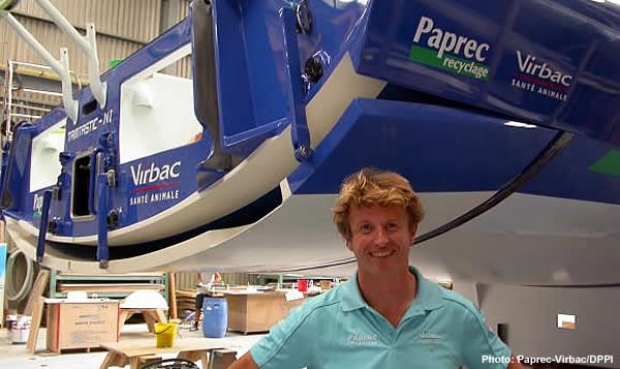
Open 60 with a tab
Thursday February 8th 2007, Author: James Boyd, Location: France
Following on from Vincent Riou's
PRB and Jeremie Beyou's
Delta Dore, so the latest Open 60 offering from Farr Yacht Design has just been launched in New Zealand in the form of Jean-Pierre Dick's new
Virbac-Paprec. Still more Farr Open 60s are to come in the new Offshore Challenges boat and the new
Foncia for former Vendee Globe winner Michel Desjoyeaux and rumour of a second boat from the
Virbac-Paprec moulds.
Jean-Pierre Dick, readers will remember, was once a man with a proper job. Based in the south of France, his family have a successful international company, Virbac, making medicine for pets of which he was part. As a sailor Dick is highly experienced in keelboats and had won the Tour de France a la Voile in 2001 before making the dramatic, life changing leap into the professional, singlehanded Open 60 class (see our original interview with him here). Prior to the Vendee Globe in 2004-5 Dick chartered the 2000-1 winner, Michel Desjoyeaux's PRB (pre-Vincent Riou) as his new Open 60 was being constructed. The first Virbac was unique in the Open 60 fleet at the time for having been designed by Farr and the titans from Annapolis have Dick to thank for opening the flood gates. Farr Yacht Design will have more new Open 60s on the start line of the next Vendee Globe than any other design house, with the winners of the last two races sailing them.
While he has twice won the two handed Transat Jacques Vabre, it has understandably taken time for Dick to make his mark as a solo sailor. He finished a disappointing sixth and last of the new builds of the 13 finishers in the Vendee Globe, after his circumnavigation was dogged by a number of costly technical issues. In the 2006 Route du Rhum he got off to a strong start and led for the first half of the race until he was overhauled by the solo offshore veterans Roland Jourdain and Jean le Cam. Unfortunately for the 2008 Vendee Globe the competition looks stronger than ever with more new, fully tricked up Open 60s than ever before sailed by the strongest ever group of sailors.
For the new Virbac-Paprec, Dick returned to Farr. As we have already seen with the new PRB and Delta Dore , the trend among the new Open 60s is for 'bigger' boats, more powerful in every respect, be it sail plan, beam, movable ballast, etc. In fact JP Dick says that the new boats are not much more powerful than his previous Virbac-Paprec - the sail plan is a little bigger, as is the hull with the new chine extending halfway forward from the stern. "We could have more sail in light winds. So it will be a bit more powerful, but my previous boat was already very powerful. We were the first to have water ballast inside," he says. This last comment puzzles us - he is presumably referring to the central ballast tanks in the middle of the boat, but Open 60s such as Kingfisher were fitted with these in the 2000/1 Vendee. What is certain is that the volume of internal water ballast has gone up dramatically with the new boats, not only in the forward and aft tanks to alter the trim in this plane, but in centre tanks to vary the displacement of the boat as well as 'cheat' the Open 60 rule by sinking the hull during measurement.
But the new Virbac-Paprec has a radical new feature for an Open 60: an enormous trim tab, 1m long fore and aft and extending around the full width of the stern up to the the chine on each side. Open 60s can now not only almost double their displacement if need be, they can also change the shape of their hull, a development we predict we'll be seeing much more of in the future.
While twin trim tabs were fitted beneath the transom on Gordon Kay's Hugh Welbourn-designed maxi Bols for her sadly abbreviated career, the trim tab on Virbac-Paprec is huge in comparison, we reckon about 6sqm in area and judging from the tracks on her transom capable of dropping the tip of the tab by about 150mm.
So how on earth will this work, we put it to Russell Bowler, President of Farr Yacht Design. "We tried to draw it up so that it has a middle position - that actually isn’t a middle position but its near - that represents your typical sailing conditions and then when you move either side of those in terms of speed or sea conditions then you adjust accordingly."
In light airs the tab will be in its 'up' position to reduce transom immersion. We haven't seen photos yet of the boat floating and fully laden but one imagines the tip of the tab will be just above the waterline in its 'up' position. In medium conditions we suspect the tab will come into its own and a little like the stepped hull on Yves Parlier's radical catamaran, if the tab is dropped down it will encourage the hull to plane at lower speeds. Upwind the tab - or the corner of it left in the water on the wide, heeled Open 60 hull - could help to keep the bow down extending waterline length. Quite how it will work the rest of the time, both Dick and Bowler give the impression, remains to be seen.
Most of the time reaching or running Open 60s have a tendency to nose dive and the tab may not help in these conditions. "In more extreme conditions you may adjust it to suit the seaway more than anything else, just to make the boat get around and over seas with less trouble and that may mean down or up," admits Bowler. "If you are nosediving or the seaway is all over the place, you can pull it back up and get the boat to settle down a little bit." One suspects in these conditions the aft water ballast tank will still be put to good use. We await the time someone is brave enough to come up with a tab at the front of the boat to lift the bow out without adding displacement - foiling Open 60s here we come!

While getting to grips with using the trim tab will be a voyage of discovery for Dick, the Farr office and Virbac-Paprec's builders, Southern Ocean Marine in Tauranga, have already faced their own challenges designing and building a one metre long tab that can be deployed across a curve surface. "It was quite exciting to draw and very exciting to build," admits Bowler. "It is full of challenges and of course with the geometries it is only possible these days with 3D [modelling] programs so that you can understand what the intersections are like and how they vary. It looks like a simple tab but to try and execute it and to keep the weight of the actuating devices down to a reasonable level was no mean feat."
A significant different between the Bols and the Virbac-Paprec tabs is their size. Bowler points out that if you made the tab shorter fore and aft the water would travel a less fair path (as well as making the tab even more exciting to engineer and build....) The reason he cites for not going for twin tabs is that when you do this you introduce additional wetted surface down the sides of them.
So why is this system only appearing now? "It is not new and its something we’ve kicked around here for a long time," says Bowler. "The 60s are a program where it looks like it is a good place to deploy this device and JP Dick was adventurous enough to give it a shot."
Trying out the tab will be interesting for Dick and his team. "It is not obvious it will work," admits the French skipper. "We will have to work hard to make it work, but we have two years until the Vendee. It is going to be a little bit more work but it shouldn’t be too difficult. It shouldn’t have too many positions or be something you trim every minute."
A downside of having the tab is that the rudders have had to be transom-hung. A demand of Dick's was that the rudders should be able to flip up and one wonders if this weren't the case if Farr might have fitted them forward of the tab as we imagine the flow over the rudders won't be nearly as clean after it has already been bent out of shape by the tab. Bowler says that the principle reason for skippers wanting to be able to flip the rudders up is to protect them in the event of a collision, although there are additional benefits of lifting the windward rudder to reduce drag. To reduce the ventilation effect of having the rudders hung off the transom, they are fitted with gates.
Forward Virbac-Paprec obviously has twin daggerboards and a canting keel. From the photos, the boards look more toed out than they did on Dick's previous boat, but Bowler refutes this. Obviously Farr have come a long way since their first Open 60, with the additional benefit of a Volvo Ocean Race in between. "Our first Virbac was the first Open 60 we did," says Bowler. "That was on our own and it wasn’t a dedicated program of research. Now we have been able to go through all those decisions and groom them all up a bit. So we have done more work on where they should be and positioning them and sloping them but they are very subtle changes."
Without the weight constraints of the VO70 rule, Open 60s are capable of sailing at speeds approaching those of their big brothers and Bowler says this is one of the vital lessons they learned from the last Volvo race. "These boats are going faster and faster which was one thing which we needed to take into account with the new designs. Particularly with shorthanded crewed races, where there are four or five guys driving one of these, they have the potential to go extremely fast. Up to now the boats rarely did over 20 knots. They can sustain high speeds over a long period of time but they never really went fast, but I think they are going to be driven a lot harder now than they have in the past. I guess the Volvo taught us that high speed boats driven fast through the oceans are subject to some fairly hefty loads..."
The hull shape appears to be of similar proportions to the other new Farr boats, although Bowler says there are subtle differencies due to the trim tab.
Despite the new trim tab, the greatest variation between Open 60s remains aloft. Already with the new Farr boats launched we have seen PRB fitted with a relatively clean wingmast arrangement with deck spreaders and Delta Dore with a wingmast that rotates less but is stayed in what appears to be the conventional way with three sets of spreaders, except that the spreaders hinge at the mast.

A third variation is to be used on the new Virbac-Paprec which Dick says was inspired by the rig on Mike Golding's Ecover - imagine the shrouds and a single set of hinged spreaders being fixed and the wingmast, stayed by two sets of diamonds, able to rotate within the shrouds. Dick won't get too specific about his rig set-up except that it may only have one diamond.
Bowler acknowledges that there are pluses and minuses of each rig set-up and these obviously extend beyond just what turns up in the VPP. "Reliability is a huge issue when the boats have to do non-stop around the world. That is a huge area and it is one which is very personal to each sailor too. Wingmasts can be made more aerodynamically efficient than a conventional mast stuck in front of sail - that is a known, but they come with the fact that they have to turn to be efficient, and when they are turned the rigging comes out at all different angles, and there are some reliability questions that are difficult to answer, so our job in that program is to just try and do a scientific appraisal into the benefits of each rig and blend that with the practicalities of each rig and then each person goes their own way."
Bowler continues: "And deck spreaders give some good sheet advantages and some sailors really enjoy that and tailor their sail wardrobe around that ability. So it is a multiple choice. It is interesting to see them all choose different answers, even the guys who have done the race a few times. I guess they have developed their own style of sailing and they know what they want to see whenever they look at the rig and they know how to operate it. A lot of it comes down to ease of maintenance and operation."
Virbac Paprec's other radical feature is her cockpit protection - something we can expect to see on other new Open 60s being launched from other design houses. Compared to Dick's previous boat the cabintop is wider and its overhang extends further over the forward end of cockpit. However - and Dick has yet to reveal photos of how this will exactly work - the boat does have some sort of sliding panel system providing protection in the cockpit all the way aft to the runner winches. "The idea is to be able to trim without having to put on a dry suit," hints Dick.
Bowler expands on this: "They have realised that one person alone sailing for many days at a time, in a sleep deprived condition - if you can make their life a little more comfortable, the quality of their decisions goes up. I think quite a few are responding to that idea."
And what of her performance? Dick says he is not sure the boat will faster than his old Virbac Paprec (soon to be taken over by Bernard Stamm) on every point of sail. Bowler reckons light weather performance in particular will improve as sail area has increased slightly. But frankly they have bigger boards now (plus the tab), so their upwind performance will be better and the hull shape is more powerful and presumably contains more water ballast than before to up performance when reaching.
Virbac Paprec is due to leave New Zealand mid-March and we will be heading back to Europe on her own bottom via Cape Horn. Dick says he will start off with a crew but sail up the Atlantic on her own with a pitstop in Brazil. He hopes to be back in Europe mid-May ready for Virbac Paprec 2's first competition - the Calais Round Britain Race. Later in the year Dick will sail her in the two handed Barcelona World Race with Damian Foxall.

Most Read
Most Commented
Comments
Businesses

Pro businesses
-
United Kingdom
-
-
Italy
-
Editor's choice
Member blogs
-
 Ned Collier Wakefield: MOD70 round BarbadosWell that was intense. 12 hard fought for seconds for the win. In idyllic conditions, Tony Lawsons MOD ...
 -
 Mini Transat leg 2 reportThe second leg of the Mini Transat started on 31st October, just over a month after ...
 -
Leg 1 reportI’ve been working towards the Mini Transat now for three years. In 2013 I was part ...
Business blogs
-
 The Island Sailing Club in Cowes, Isle of Wight, is delighted that Prince Michael of Kent ...
 -
Peta Stuart-Hunt chats with the 25 year-old British solo sailor Lizzy Foreman before she sets sail ...
-
The 2015 Student Yachting World Cup (SYWoC), an ISAF-recognised event hosted and run by students for ...
Editor's Choice
All time favourites...
-
 Three legs down into Ian Walker’s
 -
 Winning all but two races at
 -
 For the first time in its
Latest Comments
Add a comment - Members log in