
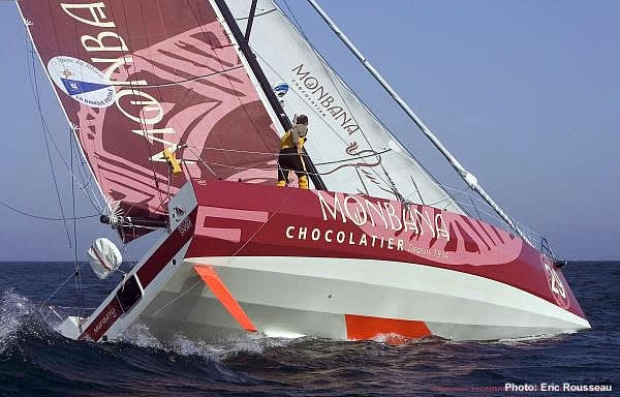
The chined hull of the Julien Marin-designed Chocolats Monbana, sailed by Damien Grimont
Stepping stone
Friday November 3rd 2006, Author: James Boyd, Location: United Kingdom
For time immorial the shorthanded offshore racing world has been crying out for a stepping stone boat to fit, budget-wise, between the Mini/Figaro classes and the substantially more expensive Open 60 and ORMA 60 classes. In the multihull world, Formula 40 briefly attempted to achieve this in the late 1980s, but died after just three seasons with soaring costs as France plunged in recession. However the latest attempt, the Class 40 monohull, looks set to be much more successful, with 25 boats currently competing in the Route du Rhum - the race's biggest class by far..
First championed three years ago by Vendee Globe skipper and former Course Au Large editor Patrice Carpentier, the Class 40 has a box rule the end result being a dumbed-down water ballasted Open 40 that attempts to curb inevitable cost escalation by, for example, banning canting keels, exotic construction or basically anything interesting that you might find on an Open 60 or even a Proto Mini. Saying this, the boat is no slouch and this morning Class 40 leader, Gildas Morvan, is only 332 miles astern of the first Open 60 after almost five days of racing, having averaged 195 miles/day so far compared to the Open 60's 265.
Who's playing?
The class is wooing a wide mix of sailors. The majority are experienced amateurs taking time out from their professions but the class has also attracted many stars of the Mini and Figaro classes. The three British sailors competing in the Route du Rhum - Phil Sharp, Nick Bubb and Ian Munslow - are all well seasoned Mini sailors as are Damien Grimont (winner of the 1991 Mini Transat), David Lefebvre, Yvan Noblet (winner of last year's Transgascoigne), Gwenc'hlan Catherine (a boy BTW) and Cecile Poujol, the Class 40's only female representative so far. From the Figaro are the French stars, former Solitaire du Figaro winner Dominique Vittet and a man who should have won the Solitaire but so far hasn't, Gildas Morvan. Even two former Vendee Globe competitors are competing in Joe Seeten and Benoit Parnaudeau.
The class has also got several older skippers back into singlehanding such as Herve Papin and even Mr Rolex Comoodores' Cup himiself, Gery Trenteseaux and other keel boat sailors such as former Melges 24 World Champion Olivier Rabine.and Mumm 30 World Champion Guillaume Voizard.
What is a Class 40?
The basic Class 40 box rule constraints are:
Max LOA: 12.19m
Max beam: 4.5m
Max draft: 3m
Min average freeboard: 1.10m
Min displacement: 4.65 tonnes
Max water ballast: 750lt each side
Boom length: at least 80cm inside aftermost part of the boat
Max bowsprit length: 2m (simimlarly a conventional spinnaker pole if used can't extend beyond 2m of the bow)
Max upwind sail area (mainsail and genoa): 115sqm. Unlimited sail area downwind.
- single fixed keel and two moveable appendages (ie rudders - daggerboards are forbidden)
- canting masts are banned
- deck spreaders are banned
- sails limited to eight (including storm jib and trisail)
- sails must be made from woven or laminated polyester or nylon in the case of the spinnaker, except two which can be made from any material (typically the main and genoa/jib)
- a chart table must be permanently installed
- a minimum of four berths must be permanently installed
- the boat must be able to right from a 90deg heel test with a 220kg weight slung off its masthead
- 3 m 3 of closed cell foam must be fitted, divided between a minimum of four compartments
- carbon fibre and titanium are banned throughout the boat
- construction using pre-preg materials is banned.
- carbon fibre can be used in the construction of the mast, boom, spinnaker pole/bowsprit provided the carbon has a tensile modulus greater than 245GPa.
Full Class 40 rules can be found here
The first examples of the Class 40 were launched around two years ago in the Pogo 40, designed by Finot/Conq and built by Structures, well known for their series Minis, and Thibault Derville's Pierre Rolland-designed Jumbo 40 Cap VAD, a regular on the RORC circuit. The box rule for the Class 40 was effectively based on these two boats.
Since then numerous Class 40 designs have sprung up, the majority of French origin including Marc Lombard's Akilaria, radical Mini designer Francois Lucas and Axel de Beaufort of NACIRA (who designed Jean-Philippe Chomette's Solune 60 footer). The only non-French design house represented in the Route du Rhum is Owen Clarke which was supposed to have two of their new South African-built boats racing, but in fact are solely represented by Ian Munslow's Bolands Mill. In the Route du Rhum by far the most prolific examples are Pogos and Jumbos, there being 11 of the former and four of the latter. Two of the Lombard Akilarias are also hightailing it to Guadeloupe at present as are two of the wood sandwich multi-chine Julien Marin designs, which may appear clunky but we understand are outstandingly quick - they hold sixth and seventh spots at present.
Route du Rhum Class 40 line-up (in order of the present Route du Rhum position)
| Skipper | Boat |
Nat
|
Designer
|
Built
|
Type
|
Beam
|
SA
|

|
|
|
|
|
|
|
Downwind
|
| Gildas Morvan | Oyster Funds |
FRA
|
Finot-Conq
|
Apr-06
|
Pogo 40
|
4.4
|
275
|
| Dominic Vittet | ATAO Audio System |
FRA
|
Lombard
|
Jul-06
|
|
4.49
|
252
|
| Phil Sharp | philsharpracing.com |
GBR
|
Finot-Conq
|
Jul-06
|
Pogo 40
|
4.4
|
233
|
| Joé Seeten | TMI Technologies |
FRA
|
Finot-Conq
|
Jul-06
|
Pogo 40
|
4.4
|
233
|
| Yvan Noblet | Appart'City |
FRA
|
Julien Marin
|
Jul-06
|
Marin 40
|
4.4
|
253
|
| Damien Grimont | Chocolats Monbana |
FRA
|
Julien Marin
|
Aug-06
|
Marin 40
|
4.4
|
218
|
| Olivier Rabine | IXSEA |
FRA
|
Rolland
|
Jul-06
|
Jumbo 40
|
4.48
|
240
|
| Gwenc'hlan Catherine | Tchuda Popka 2 |
FRA
|
Finot-Conq
|
Mar-06
|
Pogo 40
|
4.1
|
250
|
| Ian Munslow | Bolands Mill |
GBR
|
Owen-Clarke
|
Jul-06
|
|
4.3
|
250
|
| Nick Bubb | Kenmore Homes |
GBR
|
Lucas
|
Jul-06
|
|
4.5
|
250
|
| Guillaume Voizard | Le Comptoir Immobilier |
FRA
|
Finot-Conq
|
Fev 05
|
Pogo 40
|
4.4
|
250
|
| Hervé Papin | Lexibook |
FRA
|
Finot-Conq
|
Jul-06
|
Pogo 40
|
4.4
|
253
|
| Philippe Legros | Côtes d'Armor - Pierres et Mer |
FRA
|
Finot-Conq
|
May-06
|
Pogo 40
|
4.4
|
250
|
| Jean-Edouard Criquioche | Cinémas Cinéfil.com |
FRA
|
Finot-Conq
|
Apr-06
|
Pogo 40
|
4.1
|
320
|
| Lionel Regnier | FNAIM Pays de Loire |
FRA
|
Finot-Conq
|
Mar-06
|
Pogo 40
|
4.4
|
238
|
| Gery Trentesaux | Guyader L'Esprit de la Mer |
FRA
|
Finot-Conq
|
Jul-06
|
Pogo 40
|
4.4
|
255
|
| Thibaut Derville | Cap VAD |
FRA
|
Rolland
|
Aug-04
|
Jumbo 40
|
4.5
|
250
|
| Jacques Fournier | Nous Entreprenons |
FRA
|
Finot-Conq
|
Oct-05
|
Pogo 40
|
4.1
|
260
|
| Pierre-Yves Chatelin | Destination Calais |
FRA
|
Rolland
|
Mar-05
|
Jumbo 40
|
4.5
|
230
|
| David Lefebvre | KNAUF Industries |
FRA
|
Lombard
|
Jul-06
|
|
4.49
|
252
|
| François Angoulvant | Fermiers de Loué - Sarthe |
FRA
|
Gouard
|
Mar-06
|
|
4.2
|
270
|
| Benoît Parnaudeau | Jardin Bio Equitable |
FRA
|
Axel de Beaufort (Nacira)
|
May-06
|
|
4.5
|
230
|
| Cécile Poujol | PACA Entreprendre |
FRA
|
Olivier Philippot
|
Aug-06
|
|
5
|
275
|
| Yves Ecarlat | Nouvelle Calédonie |
FRA
|
Joubert-Nivelt
|
Feb-06
|
A40
|
3.75
|
190
|
| Marc Lepesqueux | Siegenia-Aubi |
FRA
|
Rolland
|
Sep-06
|
Jumbo 40
|
4.5
|
260
|
See photos of the different designs on the following pages....
To give some idea of how popular this class is becoming, Structures who build the Pogo 40 currently have 25 boats on their order books! Despite the Pogo being the oldest Class 40, they appear to have been a good design from the outset by Finot/Conq who's boats it should not be forgotten have won the last four Vendee Globes. At present Pogo 40s hold first, third and fourth places in the Route du Rhum, while Dominique Vittet's Lombard design is second.
At present there is a fairly big variation between designs and even their basic philosophies. Several boats, like Munslow's Bolands Mill or Nick Bubb's Lucas-designed Kenmore Homes are out and out racers, while the majority are cruiser racers some with fitted out interiors. There is even considerable variation between the supposed production boats - the Pogo 40s being the best example. The standard Pogo, such as Phil Sharp's or Gildas Morvan's, has the mainsheet mounted Open 60-style at the back of the cockpit sole above the transom, while on Joe Seeten's TMI Technologies it is raised to seat level and lashed to the cockpit sole with Vectran (see page 6). Similarly the standard Pogo has a prod that retracts along the deck, while Seeten is carrying a conventional spinnaker pole and also has cute little through deck strops along his boat's toerail to accept blocks. While exotics are banned from the build, construction variations include standard monolithic glass to glass/foam sandwich to the unusual wood/foam/wood sandwich of the chined Marin boats.
So where is this all going?
At the moment there seems to be a certain amount of disorganisation in the class. For example the Class Rules specifically prohibit routing but due to an oversight in the class' negotiations with Route du Rhum organisers Pen Duick they missed the part which said that all boats in the Route du Rhum must have routing (a wise move after the disasters of the last race). So just two weeks prior to the start the Class 40s found themselves having to have routing. The rules are also in a state of flux with three sets of changes so far this year, including the requirement for the block foam buoyancy to be distributed evenly around the boat's centre of buoyancy, instead of just packed into the bow.
The minimum weight of the boat is 4.65 tonnes yet oddly we understand no one has managed to make that. The Jumbo 40s for example are in the 5-5.2 tonne range and even Ian Munslow's supposedly state of the art Bolland Mills is 100kg over. Part of the problem with building down to weight is due to exotic materials being banned from the boats' construction.
Another most obvious variation between the boats is in their beam. As the table above indicates the Lombard boats and the Jumbos are pretty much maximum beam while Munslow's Bollands Mill is the narrowest of the 'race' boats. While the Joubert-Nivelt A40 seems to be the narrowest in the table above she doesn't appear to be anything like this narrow in reality.
Even at this early stage of the class, there seems to be a wide range in campaign budgets. Ironically Ian Munslow, who previously has run meagre budget Mini campaigns is now rumoured to have one of the largest. The range, according to Perrine Vangilve, who aside from being Franck Cammas' girlfriend also does PR for the class, is around 160,000 Euros for an off the shelf Pogo 40 to 450,000 Euros for a fully custom-built boat. We understand some budgets for a boat and entry in the Route du Rhum have been as high as 500,000 Euros. One of the best indications of the variation in competitiveness of the boats and skippers, Vangilve points, out is the difference in the amount of food skippers are taking on the Route du Rhum - some 20 days worth, others 35!
Because of the difference between campaign costs and the fundamental styles of the boats, there is presently a strong move in the class at present to go dow the same route as the Minis, where for years the class has been divided into 'Series' and 'Protos' the former being dumbed down production boats with their own specific set of cruiser racer rules to appeal to the amateur sailors, while the latter being full on one-off race boats designed to a more liberal set of parameters. This seems to be finding favour with the skippers the likes of Joe Seeten and Rolex Commodores' Cup winner, Gery Treneseaux, both currently campaigning Pogos and both likely to be in the market for something a little more one-off and optimised in the future.
As to a circuit Vangilve says a decision will be made after the Route du Rhum but talk is of a program similar to the ORMA 60s mixing offshore events and round the cans races, fully crewed and singlehanded. We understand the Rolex Fastnet Race might be under consideration as well as the Lorient-Bermuda-Lorient race next year. It is equally possible that if local fleets such as the UK build up then the Class 40 might develop regional fleets, but as ever with these France-originated classes there tends to only be one regional fleet - and that is in France. One suspects that the existing boats won't be great around the cans and will be hideous under IRC, but we suspect even among owners on this side of the Channel, the prospect of racing fully crewed with perhaps four or five on a boat that goes like smoke downhill might be appealing.
Next week we will look at Ian Munslow's new Class 40 and speak to her designer Alan Clarke

Most Read
Most Commented
Comments
Businesses
Pro businesses
Editor's choice
Member blogs
-
 Ned Collier Wakefield: MOD70 round BarbadosWell that was intense. 12 hard fought for seconds for the win. In idyllic conditions, Tony Lawsons MOD ...
-
 Mini Transat leg 2 reportThe second leg of the Mini Transat started on 31st October, just over a month after ...
-
Leg 1 reportI’ve been working towards the Mini Transat now for three years. In 2013 I was part ...
Business blogs
-
 The Island Sailing Club in Cowes, Isle of Wight, is delighted that Prince Michael of Kent ...
-
Peta Stuart-Hunt chats with the 25 year-old British solo sailor Lizzy Foreman before she sets sail ...
-
The 2015 Student Yachting World Cup (SYWoC), an ISAF-recognised event hosted and run by students for ...
Editor's Choice
All time favourites...
-
 Three legs down into Ian Walker’s
-
 Winning all but two races at
-
 For the first time in its
Latest Comments
Add a comment - Members log in