
Volvo Ocean Race 2008?
Wednesday June 14th 2006, Author: James Boyd, Location: United Kingdom
The 2005-6 Volvo Ocean Race is nearing its conclusion and with it the inevitable conjecture over 'what will happen next time?' Having attended the stopovers in Portsmouth and Rotterdam the mood and dockside chat is very different from how it has been in previous races. Typically at this stage the question is always raised of 'will the race happen again?' This time round the mood is very much more bullish with discussions focussed on 'how' not 'if' the race will happen next time.
Yet ironically it could be argued that this Volvo Ocean Race has been the most catastrophic ever - it has seen its first fatality since 1989/90 in poor Hans Horrevoets, one boat, movistar, appears to have been lost entirely (has that ever happened before?) and a legion of major technical issues relating to the canting keels have consistently dogged the progress of several teams.
So why has all this carnage occurred? The reason is mostly due to the advent of the new Volvo Open 70. Volvo Ocean Race CEO Glenn Bourke, Race Director Andy Hindley and their team should be congratulated for being bold enough to come up a state of the art ocean racing machine when they changed to the new boat. For a 70ft monohull the VO70 offers unprecidented performance and while the 600 mile day hasn't fallen during the race, one can imagine that it will not be too long after the race is over that one of the teams will be out in the Atlantic waiting for a suitable weather window to have a crack at this. If illbruck managed 484 miles in a day in the last race and a Volvo 70 could theoretically do 600 miles then that represents a 23.9% increase in performance. Up until only a few years ago we would not have dreamed that these kind of multihulls speeds would have been possible from a monohull.

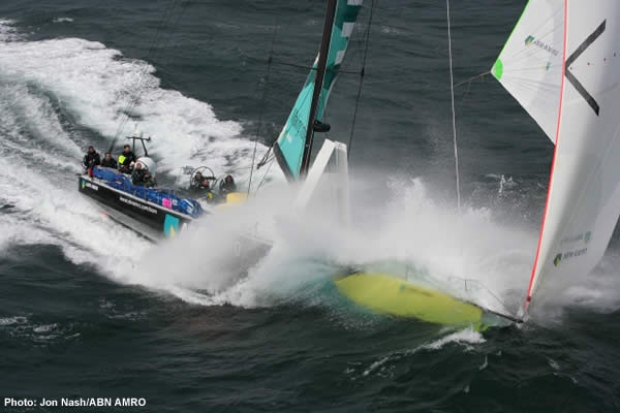
But this high speed is also a curse, raising a wealth of other issues. These have been addressed in other offshore classes such as the Open 60s, 60ft trimarans and G-Class maxi-multihulls and now need to be looked at with the VO70s. The main issue is green water over the deck - thanks to its high speed, on a Volvo Open 70 solid water comes piling down towars the crew with exponentially greater force than it ever did on a Volvo Ocean 60. While some stalwarts might say 'tough it out, this is a fact of life', various alterations can and should be made to the boats to reduce this - they include adding freeboard, increasing the ability to be able to trim boats fore and aft so that the bow will bury a lot less often and adding protection around the cockpit area.
There is also the issue of the stack - putting all sails up on the weather rail is legal in the Volvo Ocean Race and while having the stack to weather does offer some side protection to those sitting inside it, like the cockpit coaming on Orange II for example, those sitting on top of a full stack are only a few centimetres below the top guardrail and this is not good.

As to the canting keel problems, we believe that these are all teething problems and are unlikely to re-occur in the next race. The problems with the 'bomb bay doors', the flaps used to close the aperture in the hull necessary to allow the keel to cant, seem to be an issue solely with the Farr boats. During the race no such problems have occurred with the ABN AMRO boats or Brunel, although ABN AMRO Two (the first ABN AMRO boat to be launched) suffered a major keel issue during a transatlantic delivery prior to the start of the race last year when the head of one of her rams broke off followed by the collapse of the attachment for the ram on the opposite side. Fortunately the crew were able to limp back to the States despite the keel 'doing its own thing'.

The underbelly of the keel canting mechanism on Brasil 1 , with bomb bay doors removed
While more robust engineering solutions can be found to close the aperture in the hull, there is a strong lobby at present for the rule allowing the axis of the keel pin to be up to 125mm inside the boat to be changed. However moving the keel pin axis back down to the hull exit may create a new set of problems next time around as teams attempt to minimise keel pin sizes and the size of external fairings. Maybe it is a case of better the devil you know...
Anyway, enough of our views - what does Mike Sanderson think?
"I am very enthusiastic about the Volvo 70. I think it is a very cool boat," says the ABN AMRO One skipper. "My biggest excitement with the VO70 was having the first go at it. That was really what dragged me away from the America’s Cup, was this excitement of working with a new rule and a new class and trying to do a better job than the other teams at creating a fast Volvo 70. But as I keep saying - we are painting with a very broad brush, putting sails up that go up a knot faster than something else and then trying to fit them in an inventory."
When it comes to changes to the VO70 this will depend very much on the race track they are next sent on. A race across the Pacific has been previously mooted and if the average wind speed of these courses is dramatically less than it is for the round the world race course then it will alter the characteristics of a boat optimised for the new race course. This is obviously of particular concern for the ABN AMRO One team who have optimised their boat for conditions above 12 knots.
"If they change the course dramatically and we end up in lighter area regions like the Far East, how would we deal with taking those same boats into the Southern Ocean and what is the average wind speed of the race going to come down to? Then talking about Cape Horn in the same boat - it might become like taking a Mediterranean TP 52 to the San Francisco Big Boat series," continues Sanderson.
In terms of the rule Sanderson would like to see furlers allowed for the tight luffed masthead sails. ABN AMRO got around this rule by developing custom-built snuffers to dowse these sails. "In the end I saw that as an advantage for us - for the late teams it would have been far easier to just agree on furlers because you can buy them off the shelf and they work."

And the keel pin height issue? "What we think is a keel fairing with our bubble the Farr office think is a hollow and hollows aren’t allowed. But it has been deemed a keel fairing and you are allowed a keel fairing. But they have to get rid of all that stuff and if they want to keep the performance the same, then make the fins 150mm longer and everyone will be happy."
Another solution mooted is for Volvo to supply a standard keel package, or the canting mechanism and foil at least. Cariboni in Italy for example deliver their standard canting keel packages, rams and all in a massive cassette that simply slots into a pre-sized piece of internal structure with the bulb attached at the bottom. However if Volvo were to do this it would open up a whole can of worms in terms of liability. "It is like our media equipment now, as soon as our media equipment doesn’t work you can just point the finger," warns Sanderson. "Now we [the teams] own all the responsibility, so at the moment I have to sign a paper saying I think our boat is safe to go offshore and I am responsible for the crew but if someone is going to supply something which I’ve had no control over…"
Sanderson in a past interview revealed that the price tag for ABN AMRO One was not too far off that of Mari Cha IV, twice as big and with twice as many masts. Aside from a much more vigorous sail development program (which we'll come on to) one of the main drivers for teams has been to get as much weight out of the boat as possible so that this weight can be put in the bulb. With a bulb that is canted up to weather this was even more important than it had been with the previous generation of 60s. Somehow a way must be conjured up of reining in this trend as as it forces weight out of the boats structure and its keel canting mechanism and this cannot be good for safety.
One solution would be simply to specify a maximum bulb weight of say 5 tonnes. "They have achieved it with the Open 60 rule with the 10 degree rule," says Sanderson. "The problem we had this time was the huge expense which everyone went to was to gain every kilo onto the bulb. So maybe maximum bulb weight is the answer, but it will take some research from the designers. Let’s hope you are allowed to still have some diversity in the fleet."
When it comes to numbers of sails in an attempt to reduce costs Volvo dramatically reduced the numbers of sails boats could carry on this race as well as the number they could measure in. Has this actually reduced costs? Not even slightly. ABN AMRO for example simply tested all their sails before the race began as illbruck did in the race before.
In terms of numbers of sails to be carried on board during the race Sanderson thinks they got it about right, however: "The problem with the sail limitation rule overall is that in fact it is an advantage to the big teams because it meant we looked at every option before the start and were very content with our sail inventory. We quite literally haven’t changed anything in design or concept, because we’d built it all beforehand, every possibility we could think of we had the pleasure of testing it! I look at someone like Ericsson who struggled in the earlier legs...in the Volvo of years gone by if you got your sail inventory wrong it took you a little while to catch up because you saw what everyone else was doing and you built one of those. With the sail limitation this time that was almost impossible because it meant you were going to run out of sails and weren’t going to make it all the way round."
Sanderson estimates they tested 70-75 sails before the start of the race, although they cut costs by making many of these sails in cheap fabric solely to examine concepts.
"Everyone tested as much as they had time to test," he continues. "It is not like nowadays you’d put a new mainsail on every leg because you just don’t need to and there is a certain amount of reliability that you gain from keeping using what you had: you know it is okay and it works. Sails are lasting a lot longer now. I think maybe going back to the Whitbread 60 numbers or half as much again would - a few more so that the teams that are struggling early on have an opportunity to speed their boat up."
As to crew numbers, Sanderson, unlike several other skippers we have spoken to, reckons ten is just fine. "I think a lot of people didn’t think seriously enough that the boats are short handed which is something we did right from day one. Also a lot of people compared it too much to a big Whitbread 60 than a big Open 60. That still amazes me. I still hear people commenting that Open 60s are for shorthanded sailors and they don’t push their boats." He quaffed at this point.... "People who haven’t been sailing singlehanded or two handed even I don’t know how they can say that and I can say that because three years ago I was one of those people."
Another issue that is likely to be addressed when Volvo make their announcement is over continuity. Previously the Volvo Ocean Race has been one big gig every four years, but it seems entirely probable that Volvo will follow the example of the America's Cup and attempt to create more of a circuit. This, one hopes, will entice team sponsors to stay on board for the long term as they do with say Formula 1 motor racing teams.
"I would almost say that the race is now as strong as it has ever been," reckons Sanderson. "You have companies like ABN AMRO and Ericsson and even Brunel, every one seems pretty enthusiastic and the Brasil team have enjoyed it a lot. These are the biggest companies that have ever been in the race, so they are definitely going to up the ante and they are going to want to do more. It really is going to a whole new level of sponsorship. The America’s Cup has almost gone out of the realms of sponsorship, it is a billionaires game, especially if you want to compete and win, so now we have to make sure the Volvo stays in the realms of sponsorship and is accessible to companies and makes sense. So I think we have to got to look at doing more between races and maybe even have the race closer like every three years."
Holding the race every three years while possibly great for Volvo would throw a major spanner in the works in terms of the yacht racing calendar which, with the annoying exception of the America's Cup, works on a four yearly cycle.
As far as ABN AMRO is concerned their program is set to continue for at least another 18 months from now and Sanderson says there is a possibility they will roll into the next race. "I doubt they’d do two boats. We did that this time to go two boat testing because we thought it would be an advantage (and it was...). We now own two boats so if they want to keep them and keep development going from there we have a pretty good platform."
The sponsors are also likely to drive any changes Volvo make to the in port races, which aside from representing a significant part of the scoring for the Volvo Ocean Race also give sponsors a new opportunity for hospitality.
"One thing they are good for is the boats," says Sanderson of the in-port races. "They are better boats than the Volvo 60s were because we have had to give the in port races some thought. They provide 20% of the points, so we used to go and practice in port racing and it affected our keel speed and the number of pedestals we had in the boat. I am not anti the in port races, but I think it will come down to the sponsor’s analysis of the race afterwards - did it work for client entertainment, TV, etc? And it gets the boats back in the race village a week early. It is a pretty boring race village without any boats in it. Brazil did a really good job as the boats were on the hard right outside the race village. Like Formula 1 where they have opened up the pits, I think we need to make sure that when the Volvo comes to town people have access to the boats immediately beside where they would have seen them if they had been in the water."
Another point has been raised over whether there should be only one in-port race in each stopover. Given the effort shore crew go to change the boats over to inshore more, surely there should be more? Sanderson is not convinced: "One thing which they have tried to do, and Glenn and his team has done a good job at, is to keep the message clear as to who has won on a day. You can have a three race day and come third in each race or two firsts and a last and you still win. The public want to watch a race that has a winner. It is still only five days before the race starts and two or three starts increases the chance of collision so perhaps the one race is not all bad."
So how and should Volvo be looking to cut campaign costs? "I think they have to be very careful because the Volvo still sits under the America’s Cup as the glamour, fully crewed around the world race and that costs money," believes Sanderson. "A campaign is maybe one tenth of what it costs to win the America’s Cup. In budget terms, from doing the America’s Cup there is a pretty big jump down to the Volvo Ocean Race and then there is a pretty big jump down to an Open 60 campaign. So I don’t think the Volvo 70 needs to dig too deeply into the Open 60 market. So it would be nice to keep it at the cutting edge of Grand Prix ocean racing."
Obviously crew costs are an issue and Volvo this time round attempted to address this by limiting crew numbers. Unfortunately this also hasn't worked as teams have had to pay more to get the most experienced sailors and have had to employ larger shore teams, particularly following the teething problems experienced in the race. One way of cutting costs that has been mooted would be for each team to have to take a number of under 30 year olds.
So what does Sanderson think Volvo will do? "My gut feeling is that it will be made a bit safer and maybe a few more supplied items but apart from that I don’t think it will venture too far away and I don’t think it should."
What are you views on this? Email us here
More on this subject over the next few days....
Most Read
Most Commented
Comments
Businesses

Pro businesses
-
-
Italy
-
United Kingdom
-
Editor's choice
Member blogs
-
 Ned Collier Wakefield: MOD70 round BarbadosWell that was intense. 12 hard fought for seconds for the win. In idyllic conditions, Tony Lawsons MOD ...
 -
 Mini Transat leg 2 reportThe second leg of the Mini Transat started on 31st October, just over a month after ...
 -
Leg 1 reportI’ve been working towards the Mini Transat now for three years. In 2013 I was part ...
Business blogs
-
 The Island Sailing Club in Cowes, Isle of Wight, is delighted that Prince Michael of Kent ...
 -
Peta Stuart-Hunt chats with the 25 year-old British solo sailor Lizzy Foreman before she sets sail ...
-
The 2015 Student Yachting World Cup (SYWoC), an ISAF-recognised event hosted and run by students for ...
Editor's Choice
All time favourites...
-
 Three legs down into Ian Walker’s
 -
 Winning all but two races at
 -
 For the first time in its
Latest Comments
Add a comment - Members log in