
There for the losing
Monday November 6th 2006, Author: James Boyd, Location: Transoceanic
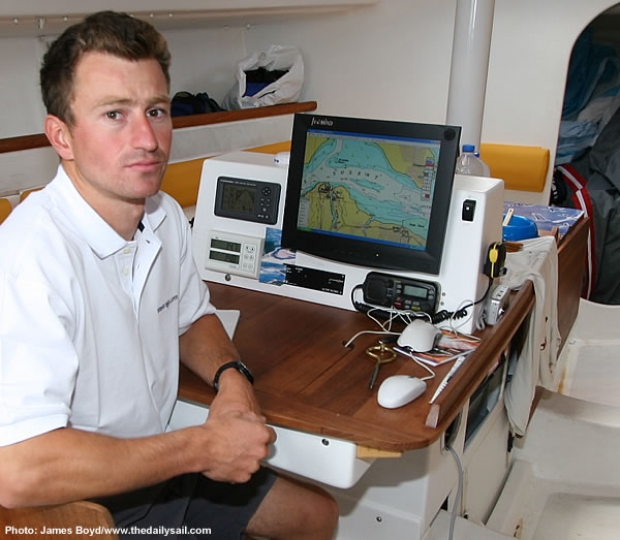
Hat's off to Phil Sharp who's position in the Route du Rhum is looking (fingers and toes crossed at this point) good, even if there is the substantial prospect of 1876 miles left to sail to the Guadeloupe finish line. As we were enthusing about in our race update at lunchtime, Sharp is not only leading the Class 40 in the Route du Rhum at present, in a field of 25 including several titans of the Mini and Figaro circuit, but he is also the only competitor to have made it across to the west side of the warm front closing in on the fleet. The latest sched has him screaming southwest directly at the mark having averaged 11.5 knots over the last four hours whereas the second highest speed over this period throughout the Class 40 fleet has been just 8.4.
"It is pretty good," Sharp told thedailysail earlier, trying to restrain himself. "We’re on the right side of the front so bombing downwind. I just have to make sure I don’t do anything stupid now. I can’t quite believe it myself. It is a good time to be in the lead in the Route du Rhum."
Having broken into the northeasterlies at around 11-12 GMT today, Sharp's Pogo 40, called philsharpracing.com in the absence of a title sponsor, is now enjoying 25-28 knots of breeze under main and genniker and was "bombing along at 12-13 knots" with the wind set to build further.
Weather-wise this has been a highly unconventional Route du Rhum with the normal Azores high pressure system initially not evident and then putting in an appearance well to the north of its usual position. This has allowed competitors to take a route more direct than normal towards Guadeloupe and there's been none of the normal 'going south, til the butter melts' before turning west.
"I got a fairly slow start and worked my way up through the fleet and then it was downwind, so I pushed pretty hard in that - that was pretty mental," recounts Sharp of how his race has panned out so far. "It was the first time I’d sailed the boat downwind with spinnakers. I’m sure that was the same for quite a lot of the [Class 40] fleet."
Phase one of the Route du Rhum was downwind to the Azores to the south of the high at which point the race turned into a three horser with Dominique Vittet chosing the southerly option and Gildas Morvan initially north and then the middle between Vittet and Sharp. Three days ago Sharp says that he and his routing team realised that the northerly option to 'get west of the front' was an option and two days ago they finally made the decision to commit to this.
Following the carnage in the race four years ago routing is now mandatory in the Route du Rhum, for safety if not performance reasons. For Sharp this is a new feature to his racing, coming from the Mini class where the sole source of weather information tends to be a crackly French voice over an SSB radio with no interaction, no advice from the shore and no internet allowed. In fact for other Class 40 races routing will be prohibited.
To get advice during the Routeu du Rhum Sharp has joined forces with Slovenian Mini sailors Andraz Mihelin and Kristian Hajnsek of Team Adria Mobil who have enlisted the services of the head of the Slovenian Met Office, Jure Jerman for the Route du Rhum. Jerman has analysed the historic data for the Atlantic at this time of year as well as the weather experienced by competitors in the last five Route du Rhums.
Three days ago there was the choice of staying north or heading south, the option Vittet has taken, says Sharp. "As we progressed, the northerly option was looking ever better so we stayed the most north in the fleet. Then this northwest option came up with this front coming through so we thought it was a bit of a gamble, but went for it but based on the fact that Morvan was staying relatively far north as well and as he was a lot bigger threat we decided to go for it and it’s actually turned out pretty good. He was further south than us yesterday and that means its going to take longer for him to get to the front. He didn’t have a lot of wind yesterday so we overtook him anyway before the front. And now it is looking really good."
The front is orientated SW-NE and so with the boats heading west the ones to the north have been first to break through.
The Route du Rhum is obviously a singlehanded race with boats being pushed to the max and as this is Phil Sharp we are talking to there have inevitably been hairy moments. "I’ve had quite a few broaches which is quite a bit more spectacular than on the Mini," he recounts. "It is pretty nerve wracking going downwind when you realise there is so much more to go wrong, but if you go down below it is like a different place." Compared to the cramped confines of Sharp's 21ft long Mini, his Pogo 40 is palatial. However with everything stacked this also means further for airborn items to fly when the boat is knocked down.
Sharp recounts one particular incident: "I was down below changing into a dry set of thermals and I pretty much had hardly anything on and then the boat decided to wipe out completely. Everything went flying and I got twatted on the head by a water canister which went flying across the cabin. Then I had to go out in thermal bottoms and get the boat back upright and snuff the kite in the middle of the night."
There was also an exciting incident three days ago when for no apparent reason the autopilot decided to pack up as the boat was screaming along in 25 knots. "I dived for the helm to try and stop it crash gybing and then had to think about getting the kite down, because the autopilot was just not responding - that was quite interesting. The only way I found eventually was to broach the boat and pull the snuffer down as far as I could. When I couldn’t get it down any further, I had to progressively run from the foredeck to the helm and back without losing control of the boat too much, so that was quite a drama, but I managed to get the kite down in one piece."
Compared to the Mini, the Class 40 is still fun, but more sedate and less dinghy-like to sail. "The whole fundamental of the boat once it was up and planing is the same as a Mini. I found the learning about kite snuffing was quite interesting. You have to really plan ahead. You can’t just look at the conditions, throw a sail up and change it when the next conditions come along in the next half an hour. You have to look more long term ahead at the weather for that day and plan your sail changes around that and go over and over it in your mind before you do it, so you don’t make a mistake because mistakes are much more costly."
Obviously all the gear is exponentially bigger, heavier and more loaded and this makes it more physically draining to sail too. "They are not as extreme as the Minis, which are just incredibly fun - you go out and cane them around and know you’re going to be the fastest thing on the water that is 6.5m long. These boats are quick but not that special. If they had a swing keel they would be a hell of a lot quicker."
To date Sharp's top speed has been 20 knots, and he says he has regularly sat on 16-17 knots with kite up in 30 knots. "It feels a lot slower compared to a Mini - that is until you stuff it into a wave!"
During the day Sharp has been steering a lot partly because it is faster but also because he underestimated the amount of diesel he should have taken, the autopilot sucking up more than he anticipated.
This morning he says he had a problem with the swivel bearing part of his furling unit at the masthead, causing the sail to drop to the deck. So at some point he will need to make a trip to the masthead, but in the present conditions this would be a little ambitious even for him and he says he will go aloft when the wind has dropped and he needs to retrieve the halyard. Given that it could well be downwind all the way to Guadeloupe it is possible he may be able to retrieve the halyard once he is tied up alongside at Pointe a Pitre.
With his nice new boat, almost twice as large as his Mini so it seems Sharp is getting a bit soft He admits he's been sleeping more than he ever did on the Mini Transat - with around two to three hours a night on average. "Not an insane amount, but you do progressively get more tired over the passage. I had a lot of sleep night before last and it was only when you get a lot of sleep that you realise how tired you are - the more I slept the more I wanted to sleep. But I am getting a lot more than I did on the Mini Transat, so I’m feeling quite alert. I am playing it as a race of endurance because there is still a long way to go and there is no point in just going hammer and tongs at the start and then folding and not being able to stay with the leaders."
Now into the big conditions his bow is pointed towards the Caribbean and Sharp says he's going to wait for the next 24 hours for the weather to settle before pressed on hard. "I have got to get back a bit south, closer to the rhumb line to cover myself and then I think it is just going to be rhumb line to the finish. It looks really fast the rest of the passage. I don’t want to take it too conservatively because anything could happen, so I want to try and build a gap as much as possible and get to Guadeloupe for a rum!" A very well deserved rum if he arrives there in first place.
If there is a young British solo sailor out there more deserving of a Vendee Globe sponsor than Sharp, then we can't think of them.
Most Read
Most Commented
Comments
Businesses

Pro businesses
Editor's choice
Member blogs
-
 Ned Collier Wakefield: MOD70 round BarbadosWell that was intense. 12 hard fought for seconds for the win. In idyllic conditions, Tony Lawsons MOD ...
 -
 Mini Transat leg 2 reportThe second leg of the Mini Transat started on 31st October, just over a month after ...
 -
Leg 1 reportI’ve been working towards the Mini Transat now for three years. In 2013 I was part ...
Business blogs
-
 The Island Sailing Club in Cowes, Isle of Wight, is delighted that Prince Michael of Kent ...
 -
Peta Stuart-Hunt chats with the 25 year-old British solo sailor Lizzy Foreman before she sets sail ...
-
The 2015 Student Yachting World Cup (SYWoC), an ISAF-recognised event hosted and run by students for ...
Editor's Choice
All time favourites...
-
 Three legs down into Ian Walker’s
 -
 Winning all but two races at
 -
 For the first time in its
Latest Comments
Add a comment - Members log in