
The French view
Monday June 19th 2006, Author: James Boyd, Location: United Kingdom
For the rest of the skippers who competed in this last Volvo Ocean Race, the new change of cycle from four to three years will have little effect. But for
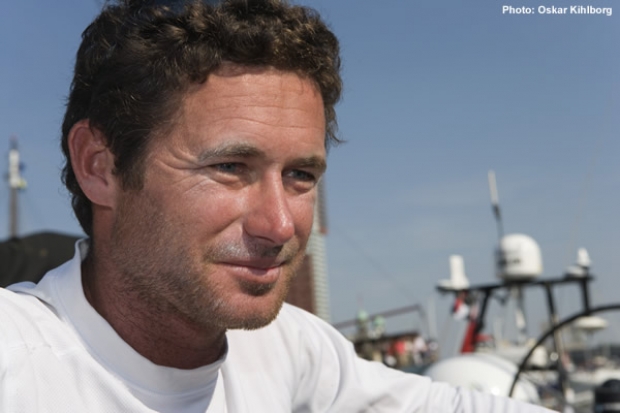
ABN AMRO Two skipper Sebasten Josse, the next Volvo Ocean Race now occurring in 2008-9 means it directly conflicts with another major event he has said he wants to enter: the Vendee Globe. To be fair it is debatable whether or not Josse could have managed to shoehorn in a Vendee Globe finishing the spring before the Volvo Ocean Race under the previous four year cycle - but now it is physically impossible.
In the meantime, we get Josse's viewpoint on the Volvo Ocean Race, unique because it comes from a Frenchman who has previously attempted to sail around the world singlehanded non-stop and who has been part of a record breaking crew sailing around the world non-stop on a G-Class maxi-multihull.
So after sailing thousands of miles in one - what are Josse's thoughts about the VO70? "I think it is a nice compromise between the Open 60s and the multihulls," he says. "It is fast and safe - when the boat doesn’t sink [his words] - and I think it is a good class. You have a 24 hour record in this boat. You need time to fix and update the designs, but for the first time it is really nice. If you saw the Open 60s the first time they were really ugly slow boats and they were narrow and you couldn’t go upwind in them. These boats are really nice for that - sailing around the world safe and fast. I hope for the next campaign the rule doesn’t change too much."
Coming from a background where the amounts of money spent on sailing are considerably smaller, Josse has some fairly blunt opinion when it comes to the cost of competing in the Volvo Ocean Race. Oddly they are not as you would expect. "A cheaper Volvo campaign is not possible - it is fully crewed and there are a lot of stopovers. You can try but you can’t make it half price. The cost is part of this race. It like trying to make the America’s Cup cheaper - it is not possible. Maybe you can make it a little cheaper - but it's never enough."
While ABN AMRO Two suffered a severe breakage of her canting system prior to the race last summer, during the course of the Volvo Ocean Race itself it essentially operated without a major hitch. "I think the system is okay," says Josse. "All the problems we have with the Farr boats or this boat is because no one expected the boats to be so powerful and for there to be so much load in the keel. We changed ours twice and we fixed it and for the other boats is the same. Now all the designers and engineers know what the lowest limit is and that is really important. I think it is good now."
This bring neatly on to one of the significant differences between the Volvo and the class he is used to sailing in France. "It is amazing in the Volvo because you have a lot of money and in six months you can do two or three refits on your boat and if you look in France in the Open 60s if you fix the boat it takes one or two years! In one race the boats have got faster by 10%. The Volvo in one year is what we do in 10 years in France, because there are more people, more money and more intense racing. Each leg is like one big race because you really push your boat and you have to find the limit really quick."
In terms of the sail numbers Josse thinks they are right as they are. "Any less it might be dangerous because you have so much load in the boats that the sails get old really quick. Pirates broke a kite because it was an old sail and you can have more trouble because you have less sails. So you need to find the limit between safety and performance."
Again when it comes to crew numbers Josse, the ex-Vendee and Figaro sailor one might assume would have felt there was an overcrowding problem on board the VO70. Not so: "At the start I felt the crew was not big enough because it is a big boat with big sails but in the end with a lot of training and a lot of time on the boat we have found the techniques. So it is not America’s Cup manoeuvres. We can’t drop the kite in one minute or 30 seconds, we need three minutes, but it is the same for all the other boats and it is part of the race. You could say sail the inshore with 16 people and the offshore just 10. Less than 10 I don’t think would be good."
Even with this number Josse reckons the lessons have been learned this race about the sail handling gear - next time he would go with an even more Open 60-stle set up with more furlers and halyard lock systems. "Having sails furling is no longer bad for the design of the shape of the sails now. We can find a smart system and put a big sail in the forestay and make it easy to change. It would be good interms of saving the sail and as well as saving the crew. And it is faster...."
We push him semi-seriously on whether he would ever try and sail his VO70 singlehanded. After all if Tabarly could sail his Whitbread maxi in the 1976 OSTAR, and win it, surely... "If I can, I do. It would fun! We could fit a small furling reacher. We can try!" His expression suggests this is not top of his list of priorities, although the plans for the white boat include entering it in this year's Chicago-Mackinac Race and then the possibility of an attempt on Mari Cha IV's west to east transatlantic monohull record.
Again Josse's views on the in-port racing are not as you would expect. "It is a good idea because you don’t put all your options into the offshore in your boat. Maybe a bit more inshore, because when you do one, you prepare your boat for one day and you could do two or three races on that day. That would be good. For the points it is hard to win three points in 1.5 hours and then twice that for crossing the Atlantic. You could do three races in one day and have the same points for crossing the Atlantic. That makes more sense. And it is not just for the points .It is hard to switch from offshore to inshore mode and back. Maybe it would be good to have more in port racing as it would show off the boats more."
In terms of safety on board the ABN AMRO Two crew obviously suffered the cruel lose of Hans Horrevoets on the transatlantic leg. Josse doesn't think there is realistically much that can be done to prevent the torrent of white water from flooding the deck. "That is what happens when you go fast. What can you do? You could make it an ugly boat and make it 1.5m higher to make it safer? Maybe you have a bigger hatch for the offshore legs and take it off for the inshore." He maintains having the stack up to weather increases safety because it protects the crew from waves trying to leap into the cockpit from the weather side. "I think there is nothing wrong with the safety of these boats - it is high already with all the gear you have on board. We have everything we need to rescue people."
A significant physical difference between Volvo 70s and the Open 60s is in their internal structure. The latter must have five watertight bulkheads, making the prospect of one sinking fairly neglegible. On Volvo 70s where there are many more sails and sails are always lugged to the high side (as to be fair they are on the Open 60s) the accommodation has to be more open plan. Josse maintains that the high number of bulkheads is appropriate for the Open 60 because the risks are higher. "We are singlehanded and we sail it non-stop for three months. That is hard to do that on a real racing boat like this [the VO70] because you have more stuff and you have to stack. We have more bunks, etc. It is a different boat, a different program, etc. Normally if you have the crash box it is enough!"
Josse says he would very much like to do the Volvo Ocean Race again, if he can run it and be involved from the outset. He says he has learned a formidable amount and this will help not only if he gets another stab at the Volvo, but also in his other offshore racing, even singlehanded.
How about a French VO70 campaign? "It is really hard. It is too expensive, but maybe we can have a half budget from France and half from somewhere else. A lot of people in France have tried that - Christophe Auguin, Isabelle Autissier and Jimmy Pahun. . If a sponsor says do you want to do the Volvo with a French boat I would sign straight away. But one thing I am sure is that if if I do a Volvo campaign again it won’t be 100% crew from France. We need Kiwis and for it to be multicultural. I think in inshore we have a lot to learn. We need to bring America’s Cup people, who are more army-like...!"
Judging from the reception Josse and his crew received at Sunday's prize-giving their return would be most welcome.
Most Read
Most Commented
Comments
Businesses

Pro businesses
-
France
-
-
France
-
United Kingdom
Editor's choice
Member blogs
-
 Ned Collier Wakefield: MOD70 round BarbadosWell that was intense. 12 hard fought for seconds for the win. In idyllic conditions, Tony Lawsons MOD ...
 -
 Mini Transat leg 2 reportThe second leg of the Mini Transat started on 31st October, just over a month after ...
 -
Leg 1 reportI’ve been working towards the Mini Transat now for three years. In 2013 I was part ...
Business blogs
-
 The Island Sailing Club in Cowes, Isle of Wight, is delighted that Prince Michael of Kent ...
 -
Peta Stuart-Hunt chats with the 25 year-old British solo sailor Lizzy Foreman before she sets sail ...
-
The 2015 Student Yachting World Cup (SYWoC), an ISAF-recognised event hosted and run by students for ...
Editor's Choice
All time favourites...
-
 Three legs down into Ian Walker’s
 -
 Winning all but two races at
 -
 For the first time in its
Latest Comments
Add a comment - Members log in