
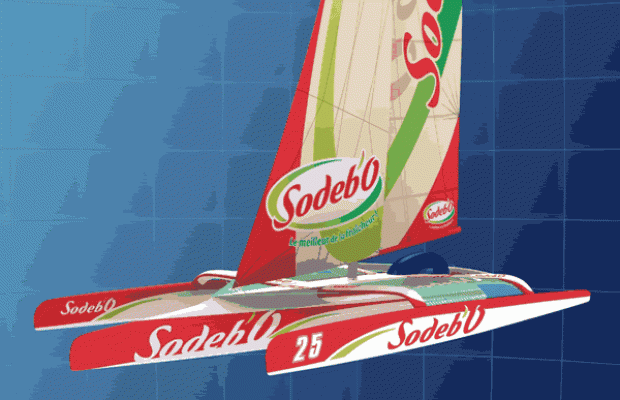
Another solo sailing whopper
Thursday June 1st 2006, Author: James Boyd, Location: United Kingdom
At a time when the 60ft trimaran circuit seems to be in stark decline, so rising like a phoenix from its ashes is a new generation of giant multihull designed solely for solo offshore record breaking and, we expect ultimately, racing.
While Ellen MacArthur's B&Q Castorama trimaran set the tone for this type of craft, so recently we have seen the announcement of Francis Joyon's new maxi-trimaran and this week that of another, a more hi-tech version, for Sodebo skipper Thomas Coville.
"The main reason was what was my best sailing experience to date was probably the Vendee Globe first and then the different Jules Vernes I have done and the multihull experience I have had with the 60 footers like Sodebo," Coville told thedailysail about why he has decied upon this project. "So then I wanted to make something summarising these two concepts, to join the two in one: to go around the world singlehanded in a multihull. It was pretty simple to identify in fact."
All three of the above boats have come from the drawing board of Nigel Irens and Benoit Cabaret but the significant difference is that the latter two will be significantly longer than Ellen's boat. At just over 100ft LOA Coville's new Sodebo will be slightly longer than Joyon's new IDEC but this is down to budget, says Nigel Irens.
Both IDEC and Sodebo started out from the same study project with Irens/Cabaret and while their overall concept is the same, the two boats have ended up having marked differences, partly due to budget, but also due to the approach of the skippers involved. Joyon's boat will be a deliberately low-tech belt and braces affair, a style it should not be forgotten that won him the 2000 OSTAR against some fierce hi-tech opposite and then allowed him to demolish the solo round the world record. The new Sodebo will be much more hi-tech and refined, reflecting the younger Coville's approach.
"They have both taken it the way they feel best and according to their budgets," explains Irens. Aside from being slightly longer, the new Sodebo has an X configuration for her crossbeams, with a separate circular main sheet track enclosing the aft end of the cockpit. Part of the reason for this is that Sodebo will be fitted with a large doghouse that will form the entire accommodation for the boat and this is aft of the area of torsion where the cross beams attach to the main hull.
While Sodebo may be more than 25% longer than B&Q Castorama, she is by no means a 25% 'bigger' boat. The beam, the first dimension of the boat to be decided upon, of Ellen's boat was 53ft (16.2m) and both Sodebo and IDEC will be around the same, says Irens: "The idea is that if you just scale up all the time you get very heavy as quickly as you get big and the power becomes completely unmanageable for a singlehanded sailor. And also there is weight involved in making the boat have that power in the deck equipment and the extra structure you need to make a wide boat. So clearly if you can’t exploit it you are carrying around the weight for nothing, so for that reason we have kept the beam down so that it is just about manageable by one person - even then it is questionable, but you have to find the best balance between the desirability of a big boat and the inability of an individual to handle the power."
Compared to B&Q Castorama the new Sodebo trimaran gains its length partly through its elongated bow, a type of probuscis as Irens describes it, the sheer dropping off dramatically forward of the forestay. As with Ellen's trimaran the rig is well aft in the boat to help prevent the bows digging in but the extra length in the bow acts as additional buoyancy forward, providing increased security against pitchpoling.
"The more we learn about this, the more we realise that fine hulls are the solution - the finer the better, so that means as it gets finer if you want to have the same buoyancy and you want a fine hull then you are getting into an area of danger as far as vulnerability to side impact is concerned," says Irens. "I have tried to strike the best balance we can with that. The bow can always be held on but obviously there is a limit to how much structure you want in there because that ups weight."
The floats are shorter than the main hull, but are as long as they can be made with two beams while attempting to minimise risk of the bow snapping off at the foward cross beam, the float snapping between the beams or even the stern being broken off.
While no specific details have been released yet about Joyon's new IDEC, the new Sodebo will certainly include some of the gadgetry found on 60ft trimarans. For example she will almost certainly have a canting wingmast enabling the centre of effort of the rig to be moved up to weather, relieving downward pressure on the leeward float, thus reducing chances of pitchpoling. However it is unlikely that she will have the retractible curved foils in her floats. "In some ways the freedom to make long hulls does get around the problem of foils because the 60 footers are trying to recover from an unfavourable situation because of the ratio between the length and the power," explains Irens. "So once you go longer then the rule of the foils becomes less critical and the downside of foils is the risk of damage and the impossibility of fixing them at sea."
A new development, and something banned currently under the rules for the 60ft trimaran class, is the possibility of carrying water ballast in the weather float. "We haven’t finally decided on it because again will the power be manageable, but it is quite clear that with any particular trimaran if you decide on a width and you want to make it a bit faster you can either make it a bit wider or you can leave it the same and add some weight to windward," says Irens. "Clearly every kilo you put up to windward has a huge effect on righting moment - per kilo on a specific basic it has more effect than a wider boat."


While the mast height at 31m off the water is roughly the same as B&Q and just a metre taller than a 60ft trimaran, the new Sodebo's sail plan is larger to power the extra weight of the boat - around 12 tonnes compared to B&Q's 9. Thus her mainsail will be 400sqm, comparing to 315 for the Sodebo 60ft trimaran, 270sqm for B&Q, 340sqm for Joyon's previous IDEC and a whopping 800sqm for Orange II.
The sail handling will be carried out via a coffee grinder and the team are currently looking at new ways of making life easier in this respect for the solo sailor on such a huge boat.
Obviously the new boats for Joyon and Coville are a development of B&Q Castorama and will be faster. "When we did Ellen’s boat we had very conservative objectives because at that stage the record was 93 days," says Irens. "It seemed like lack of reliability was the only thing that could stop us. Then Francis took the record down so much there was some doubt about whether we had done the right thing, but as it happens Ellen was able to pull it off."
Coville says the new Sodebo will be "12% more efficient than B&Q" and while the two boats might be comparible in downwind speed, the new boat will be faster in light conditions and upwind, or conditions mostly likely to be encountered on the Atlantic stretch of a round the world record.
Construction of Sodebo has already started down at BoatSpeed in Australia, the same place where B&Q Castorama was born. In fact Coville has employed many of the same people as were involved with Ellen's project, including structural engineering guru John Levell. "It is an international project because we wanted to have an open mind and to get some experience from overseas, especially from John and Nigel and also BoatSpeed - maybe all the problems we have had on the 60 footers is because it the French Connection, so maybe we should have some new blood," says Coville.
Compared to the state of the art pre-preg carbon/Nomex construction, Sodebo will be built using BoatSpeed's own wet lay-up technique and will have largely a foam core "to avoid the dangers we’ve all experienced when you have too much rigid," explains Irens. "If it is over rigid, ie Nomex and carbon, not only does it make a very stiff panel which doesn’t yield when the sea hits it, but also having broken the propagation of very rigid materials is very fast so what was just a crack now becomes a terminal injury."
The build will take a year and as with B&Q Castorama Coville will use the delivery back from Australia as an opportunity to test the boat and train, although he says he may come home via an attempt on the Yokohama-San Francisco record.
The big gig and the principle reason for building the boat is to make an attempt on Ellen's solo round the world record and the first attempt on this will take place over the winter of 2007-8. After this there is the potential to make attempts on a whole host of records including a favourite of his - New York to San Francisco via Cape Horn. This year Coville plans to resume his record program on board his 60ft trimaran with an attempt on Yves Parlier's new singlehanded 24 hour record and various course records including the lap of the British Isles.
Interestingly Coville says that now there is a 'family' of these boats - with, we understand, more in the pipeline - they have been discussing the prospects of a race, possibly even one around the world, for these boats. It is not hard to imagine a number of these boats taking the start line of the 2010 Route du Rhum for instance.
This would represent yet another nail in the coffin of the 60ft trimaran class, particularly as when compared to all the Grand Prix and crew costs and the sophistication of the 60 footers, a boat and campaign such as Coville's new one now works out cheaper. Coville says his budget for the build and campaign over four years is 1.8 million Euros per year.

"The future is not very good for the 60s for sure. We have to be honest about that," admits Coville, who is still a big fan of the class. "I think a few guys just wanted to change it. In the beginning they were more offshore racing boats which is why I was interested in it. But they have decided to make it more Grand Prix with the MultiCup and I respect that idea and I think Baron Rothschild has made a lot of effort to make that run and I hope it is going to do okay. But it is definitely not the way I want to go. I want to stay offshore. But they are amazing boats and in fact when Baron Rothschild make the proposition to do the circuit I was thinking it would be so good as it could be the new concept for the America’s Cup or match racing because they are much more exciting than the 80 ft [America's Cup] boats at the moment. [Coville was once upon a time crew on Marc Pajot's Ville de Paris].So maybe the future of 60 footers is more going that way and maybe one day Larry Ellison or Ernesto Bertarelli can come and sail with us on those boats."
Finally, another interesting point about this new generation of multihull is that they are not designed to the constraints of a rule. The sole limitation is that they must be sailed by one person and if there is one rule, it is that no powered (electric or hydraulic) winches can be used, although, oddly, hydraulics can be used for the main sheet, outhaul, mast canting, etc.
It would be nice to think that a class can survive without rules. Both Irens and Coville advocate this. As Irens puts it: "It is so sad that so many boats are compromised to meet the requirements of rules .The Achilles heel of the 60ft trimaran is its downwind safety and its ability to capsize. But as soon as you make a rule up it happens. By the same reason even with fishing boats - the objective there is to protect the fish, so they try to limit the size of the fishing boat, by limiting the length. And what does everyone do? They build huge boats that are wide, powerful with huge engines and massive fish carrying capacity and are short in length. As a result they are horrible sea boats and are appalling consumers of fuel and the objective is not met. They still fish too many fish. Unfortunately it is the same with law making and rule making - very often you achieve the counter effect to that that you desire." The 60ft trimaran class is certainly a victim of that.
Unfortunately we believe it is highly unlikely a completely open class can survive firstly because the newest boat almost certainly will always have a substantial performance edge (mind you this can be true even in one designs...) thus making older boats rapidly obsolete and is also likely to bring about an era in singlehanded sailing similar to what we saw in the mid-1970s when Alain Colas for example built the ambitious 236ft long four masted monohull Club Mediterranee for the OSTAR. One can only baulk at what a 21st century equivalent would be like - a singlehanded version of Mari Cha IV...
Anyway this is our sensible side talking. A singlehanded G-Class? Bring it on, we say!
Most Read
Most Commented
Comments
Businesses

Pro businesses
-
United Kingdom
-
-
Netherlands
-
France
Editor's choice
Member blogs
-
 Ned Collier Wakefield: MOD70 round BarbadosWell that was intense. 12 hard fought for seconds for the win. In idyllic conditions, Tony Lawsons MOD ...
 -
 Mini Transat leg 2 reportThe second leg of the Mini Transat started on 31st October, just over a month after ...
 -
Leg 1 reportI’ve been working towards the Mini Transat now for three years. In 2013 I was part ...
Business blogs
-
 The Island Sailing Club in Cowes, Isle of Wight, is delighted that Prince Michael of Kent ...
 -
Peta Stuart-Hunt chats with the 25 year-old British solo sailor Lizzy Foreman before she sets sail ...
-
The 2015 Student Yachting World Cup (SYWoC), an ISAF-recognised event hosted and run by students for ...
Editor's Choice
All time favourites...
-
 Three legs down into Ian Walker’s
 -
 Winning all but two races at
 -
 For the first time in its
Latest Comments
Add a comment - Members log in