
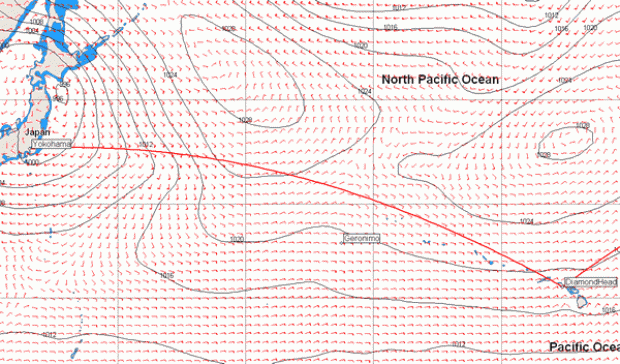
Latest position and weather. Image courtesy of Expedition Navigation Systems
Trouble ahead
Thursday April 20th 2006, Author: James Boyd, Location: Transoceanic
Yesterday, on her seventh day at sea,
Geronimo, Olivier de Kersauson's Capgemini and Schneider Electric-sponsored trimaran covered 462 nautical miles at an average speed of 19.28 knots, and continues to make excellent progress on the second half of her record attempt between San Francisco and Yokohama, Japan.
Having been forced a long way south of the direct route, Geronimo has been heading back north towards Japan ever since passing Hawaii on Sunday. After seven days at sea Geronimo and her crew have covered 3,178 nautical miles, leaving “only” 2,344 to cover to reach Yokohama. However, this latest track is giving Olivier de Kersauson cause for concern, as he explained in his latest audio report last night: “It's going pretty well. We're making nearly 500 miles a day, which is a good average. The problem is that those 500 miles bring us only 380 closer to the finish line”.
Geronimo must also cope with several areas of calm in the days that lie ahead. “We can see several cycles of calm to the north and west. The last 1,200 miles could be hazardous”. This latter section of the course may give the maxi-trimaran yet another opportunity to show just how adaptable she can be. “ Geronimo is performing well. Apart from breaking a batten in a gybe yesterday, which we were able to replace quickly, we've had no problems at all. Once again, the boat is showing just how reliable she can be”.
De Kersauson continues: “After we passed Hawaii, I thought it best to make the most of the simpler weather conditions to let the crew rest. But the many manoeuvres required mean that we must still be alert to what's going on”.
This focus hasn't prevented the crew from relaxing, just like the only Japanese crewmember on board, Kazuhiro Nishimura. “He's adapting quickly," says OdeK. "He writes everything down and is always filming his watch mates with all the enthusiasm of a boy. Every time one of us shouts on a surf, he punches the air because he's having such a good time. We've asked him to teach us a few words of Japanese. The problem is that we've no way of knowing what it is he's teaching us to say”.
Larry Rosenfeld reports from on board:
Time: 02:40:05 UTC Position 24-20 N / 180-00 W/E? 14:40:05 local time Thursday or Friday?
We've been chasing the sunset for a week and we've finally pushed it into tomorrow. We're now counting down longitude to the finish. Although it seems so obvious a solution now, the problem of time around the world was so vexing that it was the subject of paradoxes and novels like Jules Verne's Around the World in 80 Days. A couple years ago, on his record setting run from Hong Kong to New York, Rich Wilson with Rich DeMoulin, emailed from mid-ocean with a question. Sleep-deprived and working hard to beat an 1800s clipper ship record, they were not sure how Captain Waterman had accounted for the date. Would they be one day ahead or behind the ghost clipper ship they were racing? They needed to know that night.
I started by looking at Waterman's log which Rich had found in his research and saw that Waterman had written his log at noon each day, but what did he do when he crossed the dateline, I wondered? Nothing - the progression of days just continued from one day to the next. So did Rich have an extra day to get to New York? As I researched it further, I learned that the dateline was invented to solve the time paradox and adopted by most countries around 1882. It didn't exist when Waterman sailed in the 1850s. Ship captains and transportation in general used New York time reduce ambiguities in schedules. So Waterman didn't have to account for a date change since it was New York time the world around - just as we use Universal or Greenwich Mean Time on board Geronimo. The answer wasn't exactly what Rich had wanted to hear, but they worked hard, finally got some fair winds and beat the real record in a 54 foot trimaran against a 300ft clipper ship!
For the past two days we've been sailing in idyllic conditions, other than the fact that we could use a little different wind direction and more wind in the late afternoon when the trades take their daily nap down to about 15 knots from 25, reducing our boat speed by 6 knots. The one to two meter sea allows us to ride along nicely, but the winds are directly behind us, which means that we have to gybe back and forth adding 30% more distance and time.
We had planned to continue this trade winds path for most of the way as it seemed the fastest way to get to Japan, but yesterday's weather forecast changed all that. The middle of the northern Pacific usually has one or two high pressure systems that sit somewhat stationary in the middle of the ocean and support the easterly trade winds below them. The lows coming out of China and Korea usually shoot off to the northeast towards Alaska and don't cause too much disturbance to the trades and only move the high's around a bit causing them to grow and shrink. Yesterday's forecast showed a few days from now, a very strong low moving quickly to the northeast from Korea, but unlike the usual lows that moves about 600 miles a day and might take 5-7 days to reach across the whole ocean, this low and a progression of lows after it seem to affect almost the entire Pacific within a couple days. The first low is so strong it's just sucking everything into its maw, heavily affecting the usually stable high pressure system in the middle of the Pacific and distorting the moderate easterly flow of the trades into light southerlies.
Olivier, who has sailed up and down and across the Atlantic more times than anyone I know, hadn't seen this before either. It looks like a set of gears that all mesh together perfectly - the lows turning counter-clockwise and the highs turning clockwise compressing the wind faster and faster between them. But these gears are changing shape dramatically every 12 hours which is where the real challenge of prediction lies.
What it means for us is a big change in strategy and an opportunity to reduce our time further if we do it right. We need to leave the trades before they change on us, but when and exactly where to go as all these systems come together with tremendous fury way to our north? The advantage for us is to find a shorter course nearly straight towards Japan and a shorter time if we can play our hand right. If we don't time our move north just right, we will sit becalmed or beating into headwinds for a couple days. At the same time, if we go too far north, we will end up having to sail upstream against the 2-3 knots of the Kuroshio current, the Gulf Stream-like, warm current that comes up the coast of Japan and then heads east along 32-33 degrees North. Olivier and I sat together for a while yesterday and made a provisional plan. Last evening, we saw that the forecast was basically the same which lent credence to what we thought at first were strange forecasts. Then we got our latest forecast a couple hours ago and it was very different. Same basic structures, but their sizes, shapes and timing was very different. We still have 1.5 days to decide exactly where to go, but it will be tricky trying to get across the bottom of these systems. We have already jibed back to the north now and will time our exit from the trades according to what we see in the forecast tomorrow.
Meanwhile, we are taking this more relaxed and warm time to clean ourselves and the boat up a bit. Philippe even took a salt water shower on the back deck this afternoon. The guys continue everyday to perform maintenance and vigilance on all the systems and connections onboard. Each person has his own set of things to observe. Yesterday, Antoine found a problem with the steering system. If he hadn't found it, the steering quadrant could have slipped just a little further and we would have lost our steering, perhaps just at a critical moment. Didier, Philippe and Antoine were able to fix the system underway and a big potential problem was averted, just by Antoine making his normal rounds to be sure everything is was in order. In these conditions, except when we make an adjustment like canting the mast or changing a sail, it only takes a helmsman and one person on the traveler to run the boat. Kazu is helping us plan the final stages of our journey with some of his local knowledge about the coast of Japan and weather patterns he's seen there.
Thanks to many of you, the guys have really enjoyed the emails of encouragement as we continue to push our way across the wide Pacific.
Its pretty relaxed on board right now as we prepare for the days ahead and sail the boat as fast we can towards the sunset.
Time to get some rest myself. Its the middle of the night here.
Larry
Most Read
Most Commented
Comments
Businesses

Pro businesses
-
Italy
-
-
United Kingdom
-
France
Editor's choice
Member blogs
-
 Ned Collier Wakefield: MOD70 round BarbadosWell that was intense. 12 hard fought for seconds for the win. In idyllic conditions, Tony Lawsons MOD ...
 -
 Mini Transat leg 2 reportThe second leg of the Mini Transat started on 31st October, just over a month after ...
 -
Leg 1 reportI’ve been working towards the Mini Transat now for three years. In 2013 I was part ...
Business blogs
-
 The Island Sailing Club in Cowes, Isle of Wight, is delighted that Prince Michael of Kent ...
 -
Peta Stuart-Hunt chats with the 25 year-old British solo sailor Lizzy Foreman before she sets sail ...
-
The 2015 Student Yachting World Cup (SYWoC), an ISAF-recognised event hosted and run by students for ...
Editor's Choice
All time favourites...
-
 Three legs down into Ian Walker’s
 -
 Winning all but two races at
 -
 For the first time in its
Latest Comments
Add a comment - Members log in