
Ouch
Getting shipshape
Thursday February 2nd 2006, Author: James Boyd, Location: none selected
Limping home on the first leg and arriving by ship the second is not exactly what Hamble's finest, Neal McDonald, the man who brought the immaculate
Assa Abloy home in second place four years ago, had in mind for this Volvo Ocean Race.
An interesting aspect we have found while lurking around the boat park here in Melbourne is how the teams have been managing their respective crises. Much of the major breakage the VO70s have experienced over the last two legs has been associated with the canting keel rams or the structure of the boat, but how to deal with this? movistar for example have said 'enough is enough' and have reverted to their stainless steel rams. Will the extra weight versus the much improved reliability of this system really be a performance penalty in the coming legs? Will the change to stainless steel enable them to push the boat harder to make up the potential performance deficit?
A team taking a different approach to rectifying their ram issues is Ericsson. When we sit down with skipper Neal McDonald, these days it must be said looking more accountant than surfer dude, we are first given a lesson in terminology. One gets the impression that McDonald and his team have been dealing with so many different nations in attempting to find a solution to the ram issue that standardising the lingo has become important:

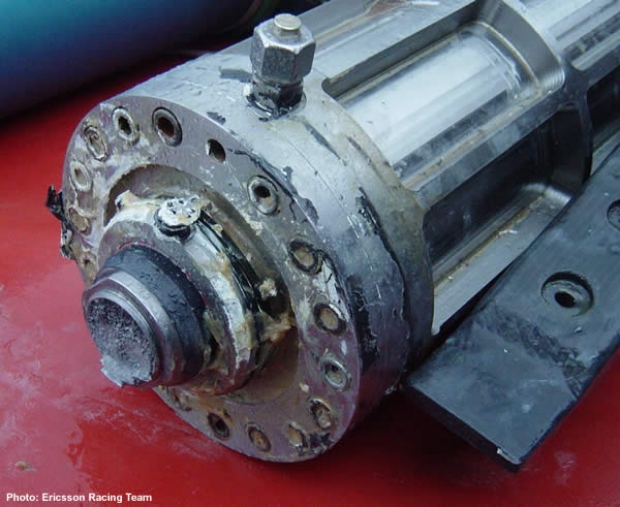
So on the titanium rams, the rod terminates in a threaded end onto which the fork/clevis is screwed. We were led to believe by one source that on the titanium rams the diameter of the threaded part of the rod was smaller in diameter than the main part of the rod and it was at this 90deg turn in that the rod had broken. Neal McDonald says in fact the ram broke at the threaded part just outside of the fork/clevis. It should be remembered by the way that McDonald, aside from being a sailor is also a talented engineer and has thus been taking much more of a hands-on approach to this problem than perhaps skippers in other teams have been.

Above: the broken rod wit half of the clevis/fork cut away
On the basis that the same or similar breakages occurred on both Pirates of the Caribbean as well as their own boat, McDonald reckons that the problem was a design fault. That is the root of the problem because in theory at least the ram shouldn't have snapped. "It was a big bit of solid titanium that snapped off. We're talking hundreds of tonnes, not 30 or 40 tonnes. It is a big piece of kit..."
Part of the problem for example might also be down to the physical properties of titanium over stainless steel. Over the past few weeks and having had a little extra time ashore than he was anticipating McDonald has had the opportunity to gen up on his metallurgy.
For example while well known and much loved stainless steel is an omni-directional material in that it has relatively uniform properties in terms of strength and compression this is less the case with titanium. "It has to be cast in its naked state," so McDonald beginneth the lesson. "In fact titanium itself is increasibly weak and very malleable and so it has to be alloyed, like most of these high performance materials. But one of the unknown facts about titanium is that it is actually quite elastic. Most people are surprised at that. It is like people talk about carbon being brittle rather than aluminium. If you had a piece of carbon and aluminium, carbon can bend 2-3 times as far (ie its elastic limit) which is why it should be a better material for making masts out of, but when we first started making masts out of, but when we first started making masts out of it, they all fell down.
"Titanium is actually half the stiffness of steel, so it can bend further - which is a very strange concept to get your head around. It is also half the weight which is the reason we use it. So the UST, the strength of the material, actually is very similar, 10-20% difference depending upon how you grade it."
This brings him on to another issue - we merrily talk about titanium, stainless steel and carbon fibre, but each of these materials comes in a wide variety of flavours, each with its own and often very different set of properties. For example your ferritic stainless steel has a tensile strength less than half of your precipition hardened stainless steel and a yield strength just over one quarter of it. Stainless steel is an alloy - ferritic types having a high chromium content, austenitic ones having a high nickel content, martensitic having a high carbon and chromium content,
When it comes to titanium there are no less than 28 different grades, most alloyed with aluminium, manganese, iron, vanadium or molybdenium to alter its properties.
Other interesting facts about titanium:
- 30% stronger than steel, but almost 50% lighter
- 60% heavier than aluminium but twice as strong
- as a raw metal it burns in air
- it has a density of approx 4540 kg/m3 (steel is approx 7900 kg/m3 and aluminium 2710kg/m3).
- it has a Modulus of Elasticity of 110 x 109 Pa compared to steel at 210 x 109 Pa
- it is the only element that burns in nitrogen
- titanium oxide is highly resistant to salt water
The titanium used in the Cariboni rams for the ABN AMRO boats and Brasil 1 is described as 6Al4V which has a 6% aluminium content and 4% vanadium content.
Unlike movistar who have an impressive armoury of hydraulic rams, Ericsson have just two which they've used from the outset, but which they have been upgrading or repairing. "We are certainly in a much better position to understand the problems, but I don’t think any of us could put our hand on our heart and say ‘well, that’s what happened’," says McDonald.
As ever time has been the issue and even lightweight carbon-reinforced rams will have their day he reckons. "If 30 years ago someone said to you they were going to make a mast out of carbon, you might have gone ‘I’m not sure’. If someone said you’re going to make a keel fin out of carbon it would like ‘you’re kidding???’ And I’d still be nervous about that now. But in 10 years time, of course there should be not reason why you shouldn’t at all. Or there will probably be some wonder fibre coming along before that."
While movistar have reverted back to stainless another seemingly obvious course of action would be to change to Caribini's titanium ram package being used in various forms on both ABN AMRO boats and on Brasil 1 and which to date has proved trouble-free.
McDonald refutes this: "There is a lot more to it than saying, 'well, let’s just buy one of those'. The more we have looked at it as a team, the more strange little bits and bobs seem to affect what you are looking at it. I don’t think, even if it was an option to get a total system just bought and plonked in, I don’t think that would necessarily be the safe or sensible solution. So it isn’t that obvious. And it takes a very long time to build a new system."
So for the time being Ericsson are still looking at their options, keeping their doors open, examining all aspects, etc. "We have a number of options open to us at the moment and we won’t make those final decisions until we have as much information as we can get. The last three weeks has been very much a fact finding mission for us. Magnus has been traveling around the world knocking on people’s doors and we have really tried to open up as many avenues of investigation as we can. One of the concerns is that you concentrate on what broke last and ignore something else, so we try to avoid that and look elsewhere and that involves a lot of talking, chatting, blue sky thinking. It has not been a process that has had a definite start or finish and there will be questions still to answer and the group of very knowledgable people we talk to will all have their own bent on it."
In the meantime the titanium Bosch Rexroth rams have been redesigned, rebuilt and are back on board. "We’ve concentrated on that area - we know what broke, although we don’t exactly know why," admits McDonald. "We’ve dealt with that particular issue and that wasn’t easy. We have a solution to make sure that doesn’t happen again. That has involved a lot of planning and thought and one of the reasons that it was very sensible to pull out in Cape Town is that we have had the time to look at that component, redesign it and it is now sitting in the boat."
Aside from the keel situation the rest of the boat is in good shape. Expecting to find a lot of work to be done while in Cape Town when they took their keel off, in fact they didn't. And since Cape Town they haven't done too much sailing.
The amount of flack the new Volvo Open 70 has been in for from some quarters McDonald thinks is 'unjustified and ill-informed'. "One aspect people forget about is that so far we haven’t had to get a tugboat out to tow anyone in, other than to get people in quicker [ Brasil 1]. All the boats have got back to shore and no one has been hurt. It is unfortunate that four boats haven’t made the end of a leg, but people forget very quickly that four boats didn’t make the end of legs in the last race and that was about the most robust boat in the world which had been raced for 15 years. I think people do have a short memory. I, like everyone else, think that in 10 years time we’ll all be sailing boats that look like this and we will have forgotten about some of the tribulations we’ve gone through."
So if Ericsson was more reliable how would they get on against the ABN AMRO boats?
"There is no doubt, they have a tidy package there, but there is no point in hiding the truth - in some conditions they have got a significant edge," admits McDonald. "In terms of crew work, sail design, even if you take away the differencies you can see in hull design they have got a few tricks up their sleeve we might not even have seen yet. But I do feel we are closing the gap a little. The little bit of sailing we did out of Cape Town alongside them, in those conditions we didn’t feel threatened at all. I think the Pirates were looking remarkably comfortable with them in several areas there."
Aside from the reliability issues, McDonald reckons that they will gain several percent in performance by just simply being out there and sailing. They haven't had much opportunity to line up against other boats for prolonged period and been able to tweak and fiddle.
While there has been much talk of the ABN AMRO teams taking a more short-handed approach to their sailing, McDonald still doesn't feel that this is what is going to make the difference at the end of the day. "In these legs it will be a case of where you can settle down into a groove and stay in it. I feel less concerned about that than us being able to catch up in terms of being able to get that set-up right in terms of the groove and the modes."
The next couple of legs we will be watching Ericsson with interest...

Most Read
Most Commented
Comments
Businesses

Pro businesses
Editor's choice
Member blogs
-
 Ned Collier Wakefield: MOD70 round BarbadosWell that was intense. 12 hard fought for seconds for the win. In idyllic conditions, Tony Lawsons MOD ...
 -
 Mini Transat leg 2 reportThe second leg of the Mini Transat started on 31st October, just over a month after ...
 -
Leg 1 reportI’ve been working towards the Mini Transat now for three years. In 2013 I was part ...
Business blogs
-
 The Island Sailing Club in Cowes, Isle of Wight, is delighted that Prince Michael of Kent ...
 -
Peta Stuart-Hunt chats with the 25 year-old British solo sailor Lizzy Foreman before she sets sail ...
-
The 2015 Student Yachting World Cup (SYWoC), an ISAF-recognised event hosted and run by students for ...
Editor's Choice
All time favourites...
-
 Three legs down into Ian Walker’s
 -
 Winning all but two races at
 -
 For the first time in its
Latest Comments
Add a comment - Members log in