
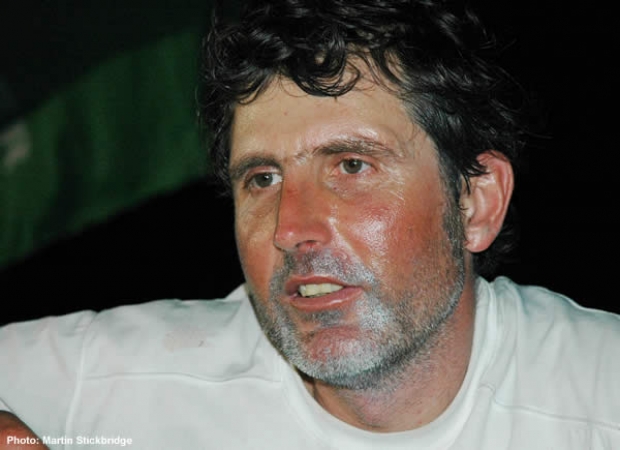
Brian Thompson, fresh from the Southern Ocean
One leg wonder
Friday January 27th 2006, Author: James Boyd, Location: none selected
Ranking fairly high up the table of 'most fortunate men' within our sport at present is Brian Thompson. With the temporary withdrawal of watch leader Mark Christensen from the
ABN AMRO One crew for leg two of the Volvo Ocean Race, so the phone rang at the Thompson household in Cowes three days before Christmas for the preliminary call-up for Thompson to take his place.
Thompson is the UK's most accomplished racing multihull sailor (although being caught fast by Ellen MacArthur), having sailed for years on Steve Fossett's multihulls, having skippered the Maiden II maxi-catamaran and then less than a year ago winning the Oryx Quest. He has also raced the Mini Transat and is a sought-after crewman on the Open 60 circuit having raced round Britain with Mike Golding on board Ecover and most recently co-skippered the Skandia Open 60 to a good fifth place in the Transat Jacques Vabre.
"It was a great surprise," says Thompson of his recent trip from Cape Town with the Dutch bank's 'A' team. "I have always wanted to do the Volvo Ocean Race and then to come on the winning boat and to win every stage of this leg has been incredible. ABN AMRO have the most well trained team, the best sail program, and have the fastest boats."
Prior to setting sail from Cape Town on 2 January Thompson had managed to squeeze in just a two hour sail on ABN AMRO Two, and another two hour sail on ABN AMRO One. "Everyone else had been sailing for a year in the boats. So I was trying to learn as I went along and not make any mistakes," he says.
With a bigger crew he could focus 100% on his responsibilities - driving, grinding and trimming - and doing these to the best of his ability. On board ABN AMRO One there were five helmsmen of which Thompson was one. With his background in racing big multihulls Thompson found steering the VO70 required a different approach. "I learned a lot from the guys because they do this all the time. I am not used to boats where you are trimming all the time! I am so used to steering to a fixed apparent wind angle and to turn the boat to always be at that wind angle rather than go straight and having people trimming the sails through different waves. So it took a little while to get used to that."
On big multihulls the view is that things happen too quickly for the sails to be constantly trimmed, so it is more a case of the rough trim being set and then the helmsman steering to this. Thompson reckons that on ABN AMRO One they trim less than the crew used to on VO60s which accelerate and decelerate more on waves. "We’re more like a multihull, trying to keep the same speed - say 23/24 knots and just steer the boat around the waves. It is only when you get out of phase or slow down on a wave that you have to ease a bit. This actually makes it a little safer, because with boats you can’t trim you have got to come up more to reattach the apparent wind. Here you can just ease the sails for the next wave and then you are off again and then you retrim." In addition to this because there are crew constantly ready to ease you as a helmsman can get away with pushing the boat harder.
Thompson reckons that on the Open 60s they should more aggressively be trimming the sails - in particular the mainsail, when they are raced with a full crew.
There is also less pontificating about making sail changes on the VO70. "On an Open 60 if you have the Solent on, you’ll keep it until it is too slow, while here they’ll change much earlier. The main is luffing quite a bit and then the wind drops a touch, then you take out a reef and it is luffing almost completely..."
In terms of steering the twin rudder ABN AMRO One, he says that the experience is very similar to steering the twin rudder Ecover in that the helm is both very neutral and very responsive. "I am glad I wasn’t jumping on a boat with a single rudder. You are much less likely to wipe out with twin rudders and I think the loads on the helm are much less, but then I am guessing now." With twin rudders, each toed out from the vertical, the range of heel angle through which the boat can maintain steerage is very much greater than with a single rudder-set up.
Thompson reckons that one of the greatest assets of the team was having the Pindar Open 60 as a trial horse. This is what pushed the rig configuration of the ABN AMRO boats towards the multiple forestay-type arrangement as typically found on Open 60s. "Movistar have a bigger upwind sail on a forestay and when it gets windy they have to go to a smaller one on the same stay, whereas we just use another stay like an Open 60. So a cutter rig! It is like the old days - we have got big gaff mains, cutters, bowsprits, etc." Generally the type of sails they are using are much the same to those found on Open 60s, because the size of the wardrobes are similar. "You are not allowed furlers for the masthead sails [on VO70s], but that is the only difference," says Thompson.
Then there has been the amount of resource available to develop the ABN AMRO boats that makes that of a typical Open 60 campaign pale in comparison. For starters ABN AMRO have two boats and have benefitted from two boat testing. "You can imagine you when you have this team of 50 people all trying to make the boats go faster, things get tested and tried that you can’t do when you just have 4-5 people on an Open 60."

While exceptionally wet on deck due to their speed, Volvo 70s have much more freeboard than Open 60s and in addition have a massive stack (see above) as well. "You have 4ft of stack. It’s almost like the bulkhead on Team Adventure/ Orange II," says Thompson. "So in the cockpit you have that little breakwater. And when you are steering you are pretty high up there."
ABN AMRO One also slams more forward than for example the Skandia Open 60, which may be because Skandia has more V-eed sections forward. Upstairs life is treacherous with waves frequently crashing over youL "On deck you are on short tethered. I tend to tie myself around a winch. I never got thrown off the wheel, but I nearly did because the motion is pretty fast."
But down below tends to be even more dangerous Thompson feels. In one of the more amusing cases of destruction from leg two, the motion of the boat caused him to demolish ABN AMRO Two's flimsy carbon fibre head compartment. "It is a three-sided box. You come in from the front where it is open and I decided to exit from the right!" recounts Thompson. Thankfully he didn't hurt himself. "It is incredibly rough out there. In fact it is as rough downwind on these boats as upwind, there is incredible jarring as you skip from one wave to the next."
Thompson believes that part of this is down to the VO70's high speed. In fact Thompson reckons the top speed of an Open 60 might be as high if not higher than a VO70, but the average speed of the VO70 will be greater. "The Open 60s are much lighter so downwind you can really get them flying. These [VO70s] are much more efficient and powerful upwind."
With VO70s now taking the monohull 24 hour record up to 563 miles there are also comparisons to made with multihull performance. "We were going 1.4x the wind speed and on one occasion 1.5x wind speed, but you are always going over the wind speed with the boat speed whether it is 1.1-1.5x - it is fabulous," he says of his latest ride. "Obviously the trimarans can go faster in flat water but particularly in rough weather you’d think sometimes we wouldn’t be going faster than this on the big cat because it’d just be too rough. With the VO70s you hardly have to back them off..." Quite a different view to others we have spoken to.
While an ORMA 60 trimaran would be faster in flat water, on the conditions experienced on this leg if the trimaran made it, it would have been in around the same time as the VO70 thinks Thompson. "I bet we’d go about the same speed as a trimaran because they’d be backed off so much." In a North Atlantic show down, we reckon a 60ft trimaran lining up against a Volvo Open 70 would make for an interesting race, but Thompson reckons it would still be a walk over for the trimaran. For example VO70s are formidably powerful upwind, pointing high and making 12-12.5 knots. However a trimaran is sailing slightly freer but sails upwind at 17-18 knots...
Interestingly considering his background Thompson doesn't belong to the lobby that was pushing for G-Class maxi-multihulls to be used for the Volvo Ocean Race prior to the creation of the new Volvo Open 70 monohull. "Because of the way historically how hard they push the boats, I think there would be carnage in terms of boat flipping over, because the mentality is 'win at all costs', although everyone is quite seamanlike. Quite a few people on board our boat were wondering whether they should have just done the Volvo in Open 60s," he says.
Using Open 60s for the Volvo Ocean Race is an interesting arguement but wouldn't lead to the same boat being using in both the Vendee and the Volvo. If this ever came to pass you would end up with boat being purpose-built for the two styles of racing. With this in mind there is little reason that the boat for the Volvo Ocean Race shouldn't be be it's own purpose-built design. "Probably this is a good idea and they’re quicker and it is great what they have done with the 24 hour record," Thompson continues our musing. "The record was 540 for a long time and the present record [563 miles] is only fractionally less than the first record we got on Playstation. You could never say these boats aren’t super quick."
Thompson confirms what we have heard from other VO70 crew that the occasions when big daily runs take place are not the most scarey. For example they tend to be 'white sail' occasions. "You couldn’t do a big day if it was scary," says Thompson. "You couldn’t do it with a big spinnaker. With a genoa you have a lot of room to bail out to leeward if you get overpowered. With the spinnaker you don’t have that so much. The big days will be the easier days with flatter water ahead of a front."
So what lies ahead for Thompson? Mark Christensen is rejoining ABN AMRO One for the next leg and Thompson hopes that if there are any other crew injuries or departures for the rest of the race he might get the call-up again. However now he is focussing on his next personal project. No longer is he looking for funding for a British 60ft trimaran project - while this woudl still be nice, he says he's shelved this idea following the carnage in last autumn's Transat Jacques Vabre. Instead he wants to have his own Open 60 campaign including the 2008 Vendee Globe.
"I feel very lucky to have done this Volvo leg. Now I can say 'I’ve done the Volvo' which I’ve been wanting to say for 20 years. It's a bit like doing the Mini Transat - are you tough enough to do it? And it is very transferable to the Open 60s, which is what I want to do now. I want to do a whole Open 60 campaign, of which the Vendee would be one race within it."
Most Read
Most Commented
Comments
Businesses
Pro businesses
Editor's choice
Member blogs
-
 Ned Collier Wakefield: MOD70 round BarbadosWell that was intense. 12 hard fought for seconds for the win. In idyllic conditions, Tony Lawsons MOD ...
 -
 Mini Transat leg 2 reportThe second leg of the Mini Transat started on 31st October, just over a month after ...
 -
Leg 1 reportI’ve been working towards the Mini Transat now for three years. In 2013 I was part ...
Business blogs
-
 The Island Sailing Club in Cowes, Isle of Wight, is delighted that Prince Michael of Kent ...
 -
Peta Stuart-Hunt chats with the 25 year-old British solo sailor Lizzy Foreman before she sets sail ...
-
The 2015 Student Yachting World Cup (SYWoC), an ISAF-recognised event hosted and run by students for ...
Editor's Choice
All time favourites...
-
 Three legs down into Ian Walker’s
 -
 Winning all but two races at
 -
 For the first time in its
Latest Comments
Add a comment - Members log in