
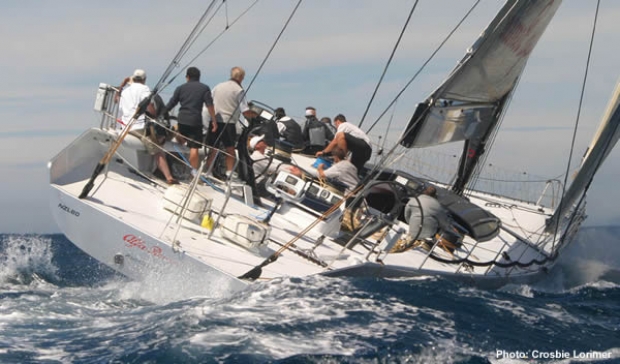
Maxi boat match race
Friday December 23rd 2005, Author: James Boyd, Location: United Kingdom
Development of the offshore racing maxi-monohull has been zooming ahead in leaps and bounds over the last months, with the advent of first the Volvo Open 70s and the now the two latest 98 footers competing in the Rolex Sydney Hobart Race - Bob Oatley's
Wild Oats and Neville Crichton's latest
Alfa Romeo. Built by McConaghys just north of Sydney both of the new 98 footers are the product of Reichel-Pugh which over recent years has been the most prolific design house for this new generation of maxis including all three of the maxZ86s, Neville Crichton's first
Alfa Romeo as well smaller boats such as Bob Oatley's 66ft CBTF Admiral's Cup winner
Wild Oats and the Stephen Ainsworth's new 60ft cruiser racer
Loki, also heading for Hobart on Monday.
Both the new maxis are built for similar reasons, for line honours in the Rolex Sydney Hobart, as well as a number of the other '600 milers' around the world, but while Wild Oats is expected to have more of a sailing future in Australia, the new Alfa Romeo will be heading for Europe fairly swiftly to continue a sailing program around the Mediterranean (saying this Bob Oatley has a residence in Porto Cervo, home of Maxi Yacht Rolex Cup). And yet while the boats were launched just a few month apart and are nearly identical, they were not built from the same mould at McConaghys. Designer Jim Pugh says that the newer of the two boats, Wild Oats XI, is a little narrower and has a little more rocker, but when there are so many other trim related variable in terms of not just the rig and sails, but the canting keel and trim rudders, is seems unlikely that this will make the greatest of differences.
"He started a little later and he wanted something a little different," Jim Pugh says of Bob Oatley. " They are within 200kg in terms of displacement."
One of the principle reasons for the development from Alfa Romeo 1 to Alfa Romeo 2 has been through the Cruising Yacht Club of Australia's relaxation of the maximum limits allowed for entries in their famous Boxing Day flight south. This has gone from an IRC rating limit of 1.61, where most boats were having to be heavily depowered in order to comply with this, to a quasi-box rule, where the CYCA have only stipulated a maximum length limit of 30m plus compliance with ORC's Offshore Special Regulations governing stablity of monohulls with movable ballast (check out appendix K on p114 in the new Special Regs - here). Jim Pugh says that the boats are optimised for maximum speed and line honours victory rather than compliance with a particular rule like IRC.
This rule change has enabled canting keel boats into the Rolex Sydney Hobart and has resulted in the progression from the first 90ft Alfa Romeo which was fitted with the America's Cup 'standard' set-up of a fixed keel and trim tab, while the two new 98ft maxis both fitted with CBTF system - ie with a canting keel and a forward steerable canard. Reichel Pugh have championed the CBTF system and have been in the process of developing it. While the CBTF system involves a canting keel, much like the Volvo Open 70s or Open 60s, instead of using one or two daggerboards to prevent leeway and provide lift when the keel is canted, it is uses the forward canard for this purpose. One issue is to establish how far forward in the boat to put this ie a steerable canard right at the bow could be smaller and less draggy than one just forward of the keel, and Jim Pugh adds that getting the size of this foil and the rudder large enough to take the side force according to the race course is critical.
As with any boat as you scale up the length, mast height goes up proportionally, sail area by the cube, but due to practical limitations draft:length ratio gets less. Having a keel that can be canted goes some way to rectifying this problem but with the new maxis this has been limited by compliance with the Special Regs, so for example while the smaller maxZ86s Pyewacket and Morning Glory can cant their keels by more than +/-50° (although this varies accord to the race - Jim Pugh says in the Transpac for example they traded away stability for more sail and lighter displacement) the new super maxis can only cant their keel by +/-40°.
The move from a fixed keel and water ballast on the first Alfa Romeo to the CBTF arrangement on the new super maxis has also resulted in the beam coming down from 5.6m to 5.2m despite the new boats being 3m longer. "To get the water ballast to be effective you have got to have beam or flair to get the ballast out there," says Jim Pugh.
To maximise their righting moment Alfa Romeo has a largely tungsten bulb, while Wild Oats XI is believed to have a partially tungsten bulb and there is a rumour going around the docks in Sydney that the world's supply of this denser-than-lead material has now all but dried up thanks to the quantities used in these two yachts...
Both boats use a single ram set-up to operate the keel - in comparison Volvo Open 70s are obliged to have two rams in accordance with their rule, while Mari Cha IV for example only has one. Due to there being less pressure on minimising internal weight compared to the VO70s the rams used are made in stainless steel rather than titanium. With hydraulics used to operate the keel, as well as many of the sail control and now the winch package, the high pressure plumbing on board the new boats is extensive, carried out by Central Coast Hydraulics.
On deck there are two significant differences between the first Alfa and the new boats. Due to their speeds neither are using spinnaker poles. "They are always sailing pretty high angles whether it is light air or in breeze," says Jim Pugh. "Even in light airs, they have huge speed potential, so luffs need to be pretty tight as opposed to what you are used to traditionally on a monohull. If they’re not you keep on sheeting the spinnaker as the apparent wind comes forward and if it doesn’t have a tight luff you end up pulling the spinnaker round. You need to keep projected sail forwards." As a result the boats are sailing at the apparent wind angle is rarely far aft of the beam so reaching and running headsails are tacked to the bowsprit. Sails on both boats are from North Sydney.
A more signficant difference is that like Grant Wharington's Skandia maxi, both are using hydraulic winch packages instead of manual coffee grinders as, rightly or wrongly is allowed under IRC for yachts of this size. Thus their cockpit are free or grinders but are peppered with waterproof push button controls. The winch package was provided by Harken on the new Alfa Romeo and Lewmar on Wild Oats XI.
Perhaps the most significant difference between the new Alfa Romeo and Wild Oats XI at this early stage of their programmes is time spent on the water, not only getting systems reliable, but also allowing the crew to work out how to sail these very different boats. In this respect Neville Crichton's team hold a six month advantage but both campaigns have highly experienced crew and shore teams
To date they haven't been given a good thrashing in open water and in theory they should be able to make 30+ knots easily given the right conditions. Zooming around Sydney Harbour in the recent Rolex Series was an awesome sight, one race culminating in the boats ending the run into the finish line match racing at 25-26 knots in 23-25 knots of wind. But their performance appears to have been optimised for lighter conditions and this is where they truly excel. "Just jib reaching in 11-12 knots with non-overlapping headsail, you are going 16+ knots," says Pugh. "These boats are very very quick. If they get a double head rig up, they are just gone."
Adrian Stead is racing in the afterguard on Alfa Romeo was in the fortunate position of being given the wheel during the Rolex Series one day when Neville Crichton was ill. He says that the performance of the old Alfa Romeo is comparible to Stewart Thwaites' very well sailed two year old fixed keel maxi Konica Minolta. "What has put it in perspective over the Rolex Series was sailing against Konica Minolta and we were crucifying her," says Stead. "These new generation boats are just so much faster. You have a 30m water line length and a lot of righting moment and a lot of sail area and they can’t help but go fast. In terms of technology it is just awesome. I came out and did Hamilton Island this year when we first launched the boat. They are an amazing piece of technology just to look at let alone race."
But the most impressive aspect of the boats is their speed. "You are doing 15 knots with just the mainsail up as you are hanging around for the start," says Stead, who reckons that they are on average 10-15% faster than the previous fixed keel boats. "I would say looking at what we do to Konica, in an hour’s windward-leeward course we are taking 6 minutes out of Konica. But there are some point of sailing where the boats are electrically quick compared to the old boat. The new Alfa Romeo is also designed for the Mediterranean, to excel in light to medium conditions."
As an example Stead races one of their first race up at Hamilton Island when they were reaching at 100°T in 8 knots of breeze doing 13 knots. "In 25 knots of breeze at 140°T, we would be moré than happy with just the jib top up. The boat just goes quick and it drags the apparent forward. Every day we go sailing on the boat is in slightly different conditions and we learn more and more about the boat. That is what is exciting about sailing the boat - you are pushing the boundaries and at the same time we have to keep the thing in one piece. So it is pretty exciting to sail."
There are downsides. With speed comes the increased risk of breaking the boat as demonstrated on the first leg of the Volvo Ocean Race and also in last year's Rolex Sydney Hobart when the two race favourites failed to finish. "I think the first leg of the Volvo has been a pretty good lesson for us in terms of appreciating the size and speed of what we have got. You can’t just go out in a lot of breeze and expect it to all stay together [pushing as hard as you normally would]. The Hobart in order to do win it, you have to finish, so we are very conscious of having to keep it all together."
More worryingly they are completely reliant on the hydraulic systems for so many areas of the boat now and this requires the engine to work too. During one of the Rolex Series races Alfa Romeo sucked a plastic bag into their engine's water intake, causing the engine to stall and overheat and with no engine and thus no hydraulic power they were unable to sail the boat.
Stead says that given the closeness of the competition they saw between Alfa Romeo and Wild Oats XI racing around Sydney Harbour it is likely that they will be in for a match race down to Hobart. He feels it is likely that the record will topple. "From the speeds we have seen on this boat I’d say that that is definitely achievable but for us it is about being first there, the record is a bonus. We have had some brilliant racing so far against Wild Oats. The big boat race around Sydney Harbour was awesome. We just hope we keep getting some good racing."
For Stead this is the first time he has sailed a CBTF boat in anger and there is now a second rudder at the front of the boat to be thought about. With the forward rudder it is possible to get the helm nicely balanced and you can definitely tell when the boat gets in the groove, says Stead. "There are a number of ways of using the canard. You can use it as a pure trim tab, or you can have it in tracking mode, which means so it is the mirror image of what the back rudder is doing it is helping you steer the boat. It is like front and rear wheel steering - it shares the load between the rudder and you use it when you need to be manouevrable. With the trim tab you just dial in 1-3 degrees up the front on the computer and it locks in on that and you balance the boat accordingly and then there are a couple of other modes as well, sort of hybrid modes we play with as well."
Whereas on the previous Wild Oats for example the forward rudder was operated via Spectra lines from the cockpit going to a quadrant up forward ( click here to see this system), on the new maxis due to the higher load and also the sheer mechanics of putting a large equivalent in place, the canard is driven by yet another hydraulic pump driven by a computer so that for example the canard will automatically mirror the main rudder in what Stead refers to as 'tracking mode'.
When it comes to driving the boat with powered winches Stead is impressed. There seems to be no occasions when they are slower in manoeuvres. "The reality is that on a boat this powerful you would probably need six pedestals to give you the equivalent horsepower. So that is 12 people on top of what you have already got [22-23 are on board to Hobart]. You can mess around with winch speeds and loading and stuff like that. We have Harken winches on Alfa Romeo and Wild Oats is using a Lewmar package which looks equally as good. We seem to gybe at exactly the same speed as they do. I think all the winch suppliers have modified their super yacht stuff to make it happen."
Obviously a high powered 100ft long canting keel maxi is 30ft longer than the Volvo Open 70s which are currently the fastest monohulls in the world over a 24 hour period. Therefore it would stand to reason that the new Alfa Romeo and Wild Oats XI might be capable in excess of 600 miles in a day. However unfortunately the owner's remit for these boats is to get line honours in races rather than records.
"We’ve never gone out and thrown it out in the open ocean and tried to break a record," says Stead. "I think the boats are quite similar but 10m extra water line, has got to help you in high sustained average speeds over 24 hours. At this stage we don’t know. Every day we sail this boat we learn something new. You might find that if we get 24 hours of northeaster on the Hobart race we surprise ourselves by how far we go. Unfortunately we might have to turn right into Hobart before we get to the end of 24 hours. These boats have incredible potential and they are very easy driven and you don’t need much sail area to make them go fast when the breeze is up. Maybe what is more in our favour is that we have 23 crew and not 10 if you compare them to a Volvo 70. I see this race as being almost a day race against three other maxis. We have got a sprint race with a right hand turn at the end of it, whereas if we had a 3000 mile downwind, we would be sailing the boat in a different way."
Maxi boat vital statistics comparison:
| Maxis |
Morning Glory/Pyewacket
|
Genuine Risk
|
Alfa Romeo 1
|
Bols
|
Skandia
|
Zana
|
Alfa Romeo 2/Wild Oats XI
|
| LOA |
26.63
|
27.4
|
27.43
|
28.3
|
30m
|
30m
|
30m
|
| LWL |
23.18
|
25.53
|
24
|
24.3
|
25.4m
|
||
| Beam max |
4.9
|
4.45
|
5.6
|
6
|
5m
|
5.25m
|
5.2
|
| Draft |
4.5
|
5
|
4.4
|
4.8
|
4.5
|
5.1
|
|
| Disp |
21 tonnes
|
21.7 tonnes
|
22 tonnes
|
23 tonnes
|
26 tonnes
|
26.4 tonnes
|
25.5 tonnes
|
| Bulb weight |
n/a
|
n/a
|
n/a
|
13.5 tonnes
|
14 tonnes
|
13.2 tonnes
|
|
| Mast height (off deck) |
31.2m
|
32
|
36m
|
38m
|
42.2m
|
||
| Spar maker |
Hall
|
Southern
|
Southern
|
Southern
|
Applied Composites
|
Southern
|
Southern
|
| Sail area (upwind) |
402.65
|
420
|
402
|
425
|
379.6
|
522
|
|
| Sail area (downwind) |
872.18
|
613
|
663
|
1000
|
874.4
|
1119
|
|
| Movable ballast |
Swing keel
|
Swing keel (+/- 50deg)
|
6 tonnes water
|
4.8 tonnes water
|
Swing keel (+/-40deg)
|
5 tonnes water
|
Swing keel (+/- 40deg)
|
| Extra appendages |
CBTF
|
CBTF-type
|
Transom flaps
|
Trim tab on keel
|
CBTF
|
||
| Builder |
McConaghy
|
McConaghy
|
McConaghy
|
BoatSpeed
|
Hart Marine
|
Hakes Marine, NZ
|
McConaghy
|
| Designer |
Reichel-Pugh
|
Dubois
|
Reichel-Pugh
|
Hugh Welbourne
|
Don Jones
|
Bakewell-White
|
Reichel-Pugh
|
| Sail maker |
North San Diego
|
North
|
North Aus
|
Doyle NZ
|
Doyle-Fraser
|
Doyle NZ
|
North Sydney
|
| Launched |
Dec-03
|
Mar-04
|
Aug-02
|
Mar-03
|
Oct-03
|
Nov-03
|
Jun-05
|
More photos on the following pages...
Most Read
Most Commented
Comments
Businesses


Pro businesses
-
France
-
Italy
-
-
United Kingdom
Editor's choice
Member blogs
-
 Ned Collier Wakefield: MOD70 round BarbadosWell that was intense. 12 hard fought for seconds for the win. In idyllic conditions, Tony Lawsons MOD ...
 -
 Mini Transat leg 2 reportThe second leg of the Mini Transat started on 31st October, just over a month after ...
 -
Leg 1 reportI’ve been working towards the Mini Transat now for three years. In 2013 I was part ...
Business blogs
-
 The Island Sailing Club in Cowes, Isle of Wight, is delighted that Prince Michael of Kent ...
 -
Peta Stuart-Hunt chats with the 25 year-old British solo sailor Lizzy Foreman before she sets sail ...
-
The 2015 Student Yachting World Cup (SYWoC), an ISAF-recognised event hosted and run by students for ...
Editor's Choice
All time favourites...
-
 Three legs down into Ian Walker’s
 -
 Winning all but two races at
 -
 For the first time in its
Latest Comments
Add a comment - Members log in