
VO70 in four months
Tuesday September 13th 2005, Author: James Boyd, Location: United Kingdom
After being spied out on the Solent last week,
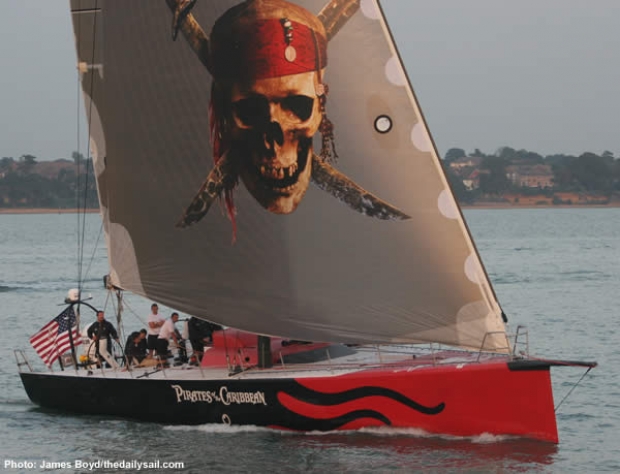
The Black Pearl and Paul Cayard's crew of ocean racing scallywags was formally introduced to the public and press late yesterday afternoon in Southampton's Ocean Village. The event was hosted by Cayard and Robert Mitchell, Managing Director of Buena Vista International UK while
The Black Pearl herself was christened by the daughter of the Duke of Kent, Lady Gabriela Windsor, who will be
The Black Pearl's godmother. None of the film's cast were present as the second and third Pirates of the Caribbean films are currently being shot in the Bahamas and Los Angeles, however at the media presentation a video was shown where Jerry Bruckheimer, the Pirates of the Caribbean's Producer and creator, congratulated the crew of the latest 'pirate' ship. According to Mitchell, Bruckheimer was the first person they went to to set up the deal between the film and the Volvo Ocean Race and he has given the project a wholehearted thumbs up.
Mitchell admits that he has gone out on a limb to get Disney to back the project - this is the first deal of its kind between a sporting event and a major Hollywood film. Buena Vista, Disney's distribution company will be cranking up promotion of the film via the boat to coincide with the Volvo Ocean Race start this November but with the launch of the second film - Pirates of the Caribbean: Dead Man's Chest - not due until 7 July next year ( The Black Pearl's sail number is 7706) it is only likely to be in the latter stages of the race that we will see any heavyweight marketing, using the film's stars.
Paul Cayard took time to introduce the exceptional crew he has mustered for The Black Pearl: navigator Jules Salter, watch captains Freddy Loof and Rodney Ardern, bowmen Curtis Blewett, Jerry Kirby and Juggy Clougher, trimmer/driver Dirk de Ridder, trimmer/sailmaker Justin Ferris, trimmer/driver Nigel King, back-up navigator Nick Moloney (who will presumably be supplying some much needed canting keel experience) and trimmer/driver Craig Satterthwaite. To a man they are all highly experienced America's Cup and Volvo Ocean Race sailors. The line-up is interesting with three bowman and a back-up navigator.
"Because we started late we went for experience," explained Cayard. "In EF when we won nine of the crew hadn’t been around the world including the skipper and navigator - that was lacking in experience. But we had nine months to work on it and we had other skills we brought to the table and we learned the seamanship side of it. This time we need to hit the ground running. The boat was launched last Monday, first sail was last Wednesday and we are heading out to sea for seven days now. That’s because we have an experienced team who knew how to get the boat ready, to finish up the build, get the boat fully loaded and system checked and capable of going to sea."
In terms of the physical challenge for his crew, Cayard compared the VO70 with an America's Cup: the VO70 has bigger spinnakers and yet is raced by just 10 people while an ACC boat has 17 on board and is racing only for two hours at a time. Compared to his old Volvo Ocean 60, the new VO70 "has 75% more horsepower, it weighs two tons less fully loaded and has 60% more sail area. It is an incredibly powerful boat. It is longer by 6ft on the waterline, so it will for sure crack 40 knots. It is more of a weapon than a boat."
In this race, as ever, Cayard believes that sails will be a big factor in deciding the winner: "This boat with those speeds, the apparent wind angle is somewhere between a Volvo 60 and a multihull. I’ve sailed the Transpac 52 this summer and we saw a lot of improvement by people who worked on their asymmetric sails. And that will be the name of the game here."
What is most impressive about the project is the short period in which it has all come together - building a state of the art 70 footer and putting a team together in just four months must be a new record.
"Paul called me up in May and asked me to get involved and there was still some of the other stuff going on. The boat wasn’t even started. Green Marine had a really short build period on the whole thing," recalls Kimo Worthington (above) who is the team's General Manager and was the first appointment after Cayard. "We got the whole team and infrastructure up and running in four months which is impressive. I wouldn’t say we are organised. We’ve just got our head above the water, we’re not drowning."
Worthington sailed with Cayard on board EF Language, but hasn't the time to do this race due to his heavy sailing schedule - he is tactician on a Farr 40, a Swan 601, the Spanish IMS boat Azur de Puig, etc. Another former EF crew, Curt Oetking, is the boat's technical manager and effectively project managed the build at Green Marine in Southampton alongside crewman Nigel King.
The team were able to save several months by being able to use the female tooling developed by Jason Carrington and Green Marine for the Ericsson VO70. While Worthington admits you do hear in advance of some of the lessons learned by the other teams, being last to build is never a good thing. "You’d rather have more time to figure it out yourself than to try and hear what other guys have done and their mistakes but it is what it is and we are just going to make the best of it."
Compared to a Volvo Ocean 60, the boat is a very much more sophisticated beast as Worthington explains: "It is a whole other can of fish. It is really complicated and the speeds will be in another dimension. The keel thing is huge. It is going to take the boat forward, but unfortunately these things can break down and that is the hard part. It is a serious thing if they break down. So it is a case of getting the systems reliable."
Getting the boat reliable is a position the crew will be attempting to achieve as quickly as possible with less than two months to go before the start of the race. Already in their first week in the water, Cayard says they want to get the roll-over test and the 2,000 mile qualifier out of the way.
Lady Gabriela successfully christened on The Black Pearl's bow first time, although we understand that an early attempt to scour a champagne bottle with a hacksaw had resulted in a spontaneous combustion.
And what of the boat herself? Last week we expressed our concerns over what we felt was an unimaginative paintjob for a boat linked to Disney, a company renowned for creating the fantastic. To be called The Black Pearl (the VO70 does have 'Isla de Muerta' on its transom as port of registry) one would anticipate the boat to have black sails - clever use of graphics could even make them look like tattered black sails - and a wave-ravaged black hull showing cannons pointing out. What is depicted on the hull we have since learned are not hot rod flames, but the black tentacles of a character we can expect to encounter in the second Pirates film - the Kraken - hence the 'eye' that appears on the topsides beneath the 'C' in Caribbean.
From a technical standpoint, the hull of The Black Pearl was gleaming yesterday, but even to the 11th hour we understand there is still much work to be done on her. Last night she was due to set off on her 2,000 mile qualifier, but no doubt any crew not actively involved in sailing the boat will continue to work through the job list.
Her hull is obviously identical to Ericsson with the standard Farr configuration of canting keel, twin boards and a single rudder. Her rig is by Hall Spar with four sets of spreaders plus jumpers at the top mast - Ericsson is unconventional in this fleet for having a four spreader rig and no jumpers. Her inner forestay appears to be tensioned at the foot by either a below-deck hydraulic ram or an ABN AMRO II-style block and tackle system, but not by the short length of fore and aft track - where tension is applied by moving the bottom of the inner forestay forward - as seen on Ericsson.
In the cockpit there is the conventional twin wheel, twin pedestal set-up (the Juan Kouyoumdjian-designed ABN AMRO boats in fact have three pedestals) but the most apparent difference compared with Ericsson is that the main sheet track has moved aft of the helm positions and is mounted on the cockpit sole. This will presumably have removed some load from the main sheet system.
It will be interesting to see the boat again in Sansenxo, Spain - where she is heading now instead of Bilbao - in a few weeks time to see how the crew have developed her.
More photos on the following pages...
To see our report on the Ericsson VO70 - click here .

Most Read
Most Commented
Comments
Businesses


Pro businesses
Editor's choice
Member blogs
-
 Ned Collier Wakefield: MOD70 round BarbadosWell that was intense. 12 hard fought for seconds for the win. In idyllic conditions, Tony Lawsons MOD ...
 -
 Mini Transat leg 2 reportThe second leg of the Mini Transat started on 31st October, just over a month after ...
 -
Leg 1 reportI’ve been working towards the Mini Transat now for three years. In 2013 I was part ...
Business blogs
-
 The Island Sailing Club in Cowes, Isle of Wight, is delighted that Prince Michael of Kent ...
 -
Peta Stuart-Hunt chats with the 25 year-old British solo sailor Lizzy Foreman before she sets sail ...
-
The 2015 Student Yachting World Cup (SYWoC), an ISAF-recognised event hosted and run by students for ...
Editor's Choice
All time favourites...
-
 Three legs down into Ian Walker’s
 -
 Winning all but two races at
 -
 For the first time in its
Latest Comments
Add a comment - Members log in