
Playing catch-up
Wednesday July 20th 2005, Author: James Boyd, Location: United Kingdom
Following the launch of the hull of
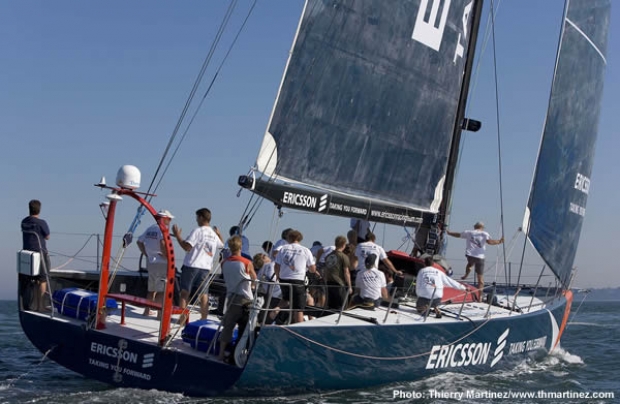
Ericsson, so the new Swedish Volvo Open 70 spent last week in Camper & Nicholsons marina in Gosport being rigged and finished off before setting sail at dawn on Saturday for her training base in Vigo, Spain. Thedailysail had a quick look at the boat and spoke to skiper Neal McDonald prior to their departure.
Examining the photos of the Volvo Open 70s so far launched there seems to be some significant differences between the hull shapes even between the Farr Yacht Design VO70s. Telefonica Movistar (as can be seen from her inversion test) clearly has a slight chine in her aft quarters whereas this does not appear to be the case with either Ericsson or the the Brazilian boat. However the chine even on Telefonica is not nearly as extreme as that of the first ABN AMRO (see her here) which is almost slab-sided. The daggerboards on ABN AMRO also appear to be substantially longer, skipper Mike Sanderson and designer Juan Kouyoumdjian presumably learning the lesson from the Open 60 class where daggerboards on canting keel boats can seemingly never be too big.
"I think we’re very similar to the Brazilians and I think Telefonica is slightly different, with their chine at the back, but they appear to have similar beam," says Neal McDonald of the Ericsson hull. "But I don’t think that will make the difference in the race. That will be other aspects. We’ve got what we’ve got. I’m happy with it."
One of the most signficant figures in the conception of the new Ericsson has been composite master builder Jason Carrington. Carrington project managed the build of Atlant's Assa Abloy , which judging from her bulb size was the lightest VO60 in the last race and Carrington is expected to have worked similar miracles in parring weight from Ericsson's structure and primary systems.
"I’d be pretty confidence we’ll have the lightest boat out there, but that is only conjecture based on the time and effort Jason spent dealing with the areas where you can save weight. Jason has been thinking about this a long time," says McDonald.
As with the VO60 so with the new 70 footer any weight saved in the hull can be plumped on the bulb gaining stability and therefore power. But with the new 70 footers this is not as obvious due to the canting keel. The weight range for VO70s is 12.5 to 14 tonnes so a bulb that is 1.5 tonnes heavier (than one fitted to hit minimum weight) when the 4.5m long keel is canted out to the maximum limit of 40 degrees allowed under the VO70 rule would represent an enormous increase in the stability of the boat at the expense of drag. We wait to see which side of the box teams have opted to hit.
When we spoke to McDonald Ericsson had been out sailing but hadn't ventured out of the confines of the Solent. "The boat is smooth, powerful. Farr’s VPPs are very precise so that you can get a good feel when you look at them. It is hard to believe but you are going to be full cant in 7 knots, but you are. So you spend a lot of time thinking if you have everything fully canted in 7 knots, what are you going to do in 27?"
He adds: "The motion is different. You get less pitching and there is an awful lot of power and the righting moment curves shows it is on-off sailing rather the smoother sailing of a fixed keel boat."
Aside from the size of the boat and the canting keel an additional aspect teams and designers have had to consider with their new VO70s is that the in-port racing, to be held this time, represents 20% of the total points available for the race.
"There are things," admits McDonald in terms of how this has affected Ericsson. "There is the [canting] speed of the keel. If you knew you weren’t doing inshores you could trade off weight for the speed of the keel. That is one question and I’m sure we would have attacked it slightly differently. The sails I think because you have got to make sails last for so long. You’ll look at most people on the start line of most inshore races and say 'they don’t look particularly light sails'. So there is a compromise there."
McDonald believes it is entirely possible for example that boats may be sailing the in-port race in Rio in three knots of breeze using sails speced to go up to 30 knots. "To have the luxury of specialist inshore sails is pretty expensive in terms of sail buttons. That is a compromise that most people will be dealing with. And it is tricky and there will be sails looking pretty shabby by the end of the race."
Down in Vigo McDonald says they expect to be out training and speed testing every day in order to catch up. With the time ABN AMRO have lost due the problems they experienced with the keel of their first boat, Telefonica Movistar, who have sailed their boat half way around the world already, are currently considered the boat to beat.
"Obviously the guys who have done lots of work have a big jump on us," says McDonald. He acknowledges the Spanish team as favourites at present "simply because they’ve had time on the water. And it gives you a great deal of confidence in Farr’s product. While there are differences between the boats they have obviously come from the drawing board. I’m not sure how much time ABN have had but it’s not as much as you’d hope for having been on the water that early."
In order to play catch up while working out of Vigo they will also be attempting to minimise down time. "I’m not paranoid, but I know there will be problems with the boat," admits McDonald. "You don’t build a light boat with this sort of performance and expect it not to have teething problems. But if we do have a problem we have an incredibly strong shore team this time. I think the shore team is going to be much more important."
McDonald says the Ericsson shore team is both bigger and has even more talent than the one he had with Assa Abloy, even if the formidable experience of Neal Graham is now with Offshore Challenges. The VO70s are obviously a new generation of boat and, as McDonald has said in the past, will probably need to be driven somewhere between maxi-multihulls and VO60s, ie there will be occasions when you have to throttle back else you risk destroying the boat. In addition to that the shore team will have their work cut out for them changing the mode of the boat from offshore to inshore ready for the in-port racing and then back again.
In terms of what happens between here and the start Ericsson is unlikely to do an Atlantic circuit says McDonald, but they have to sail the boat to Sweden for its official launch and they will probably use that to get in a longer trip.
There is still nothing planned in terms of possible two boat testing with their stable mates at Atlant, the Pirates, who's boat is believed to be due for launch at Green Marine in Southampton in August. Frankly it is hard to see what Ericsson would gain from this.
Meanwhile McDonald says he has now signed up all but two of his ten crew. In addition to himself as skipper, he has Steve Hayles as navigator plus Jason Carrington, Richard Meecham, Tim Powell, David Rolf and the most recently announced, Tom Braidwood - in short a mixture of Assa Abloy, Tyco and SEB. With four Brits on board this will be as near as we get this time to a home team.
Still to finalise is a bowman and a middle of the boat-type person. "I’m very comfortable that we have got a very very strong crew. The two slots we are still bartering with, it’s not like I am scraping the barrel. There are a lot of people who want to get out of the America’s Cup. To be fair until the boats have got on to the water this race hasn’t really been obvious. Now people are looking at these boats and saying ‘wow - these boats are really wild’. In years gone by and you’ve had training boats and it’s been in your face. Now it is only in the last couple of month people have been saying ‘this is it. This is cool’. I am getting emails every day from incredibly good people who say ‘I’m on - get me in’. The difficult thing has been choosing from an incredibly good bunch of sailors."
A name which has yet to feature is the familiar beam of Atlant's own in-house Whitbread/Volvo Ocean Race veteran Magnus Olssen, a known-speed freak who has most recently been campaigning a trimaran on Atlant's Nokia Oops Cup circuit and who despite having 'retired from the Volvo Ocean Race' is unlikely to be able to resist the lure of the new VO70. Will we be seeing him? "It’s going to be hard to stop him," admits McDonald. "He has been incredibly involved from day one. Basically any decisions of any importance go through him and it is really nice to have him in that role at the moment. The more you do with the guy the more knowledge you know he’s got. He has a massive massive knowledge base. He’s a very prominent member of the whole show."

Most Read
Most Commented
Comments
Businesses

Pro businesses
-
France
-
-
United Kingdom
-
Italy
Editor's choice
Member blogs
-
 Ned Collier Wakefield: MOD70 round BarbadosWell that was intense. 12 hard fought for seconds for the win. In idyllic conditions, Tony Lawsons MOD ...
 -
 Mini Transat leg 2 reportThe second leg of the Mini Transat started on 31st October, just over a month after ...
 -
Leg 1 reportI’ve been working towards the Mini Transat now for three years. In 2013 I was part ...
Business blogs
-
 The Island Sailing Club in Cowes, Isle of Wight, is delighted that Prince Michael of Kent ...
 -
Peta Stuart-Hunt chats with the 25 year-old British solo sailor Lizzy Foreman before she sets sail ...
-
The 2015 Student Yachting World Cup (SYWoC), an ISAF-recognised event hosted and run by students for ...
Editor's Choice
All time favourites...
-
 Three legs down into Ian Walker’s
 -
 Winning all but two races at
 -
 For the first time in its
Latest Comments
Add a comment - Members log in