
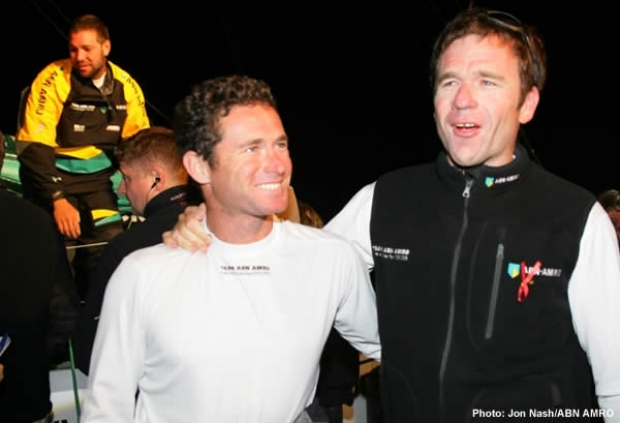
Seb Josse with Mike Sanderson
A different approach
Friday December 2nd 2005, Author: James Boyd, Location: Australasia
One of the most impressive results in the first leg of the Volvo Ocean Race was that of Sebastien Josse's team on
ABN AMRO Two. Aside from having the oldest boat in the race, Josse's team of under 31 year olds included just three race veterans.
"We never expected that," admits Seb Josse of their second place into Cape Town. "We know the differences against ABN AMRO One, but we didn’t know where we would come in the fleet, the potential of the boat and the level of the crew."
Navigator Simon Fisher agrees: "We really went into it with an open mind and said if 'we sail well and if our boat is fast then maybe in this race we will still get a few podium finishes'. But to do it in the first leg is tremendous."
During the breezy first 48 hours of leg one, when movistar and the Pirates were sent limping into port with structural problems, so the team got a taste for how they might fair in the future when they turned in the highest 24 hour mileage of the fleet - 504 miles. "We were a bit chuffed and it was a little unexpected to be honest because we were just trying to keep the boat in one piece and then the next thing you know we have done the biggest run!" continues Fisher.
"At one stage we had two reefs and the R2 when we were sailing as deep as we dared. We didn’t know what angle we were sailing because we had no wind gear which I’m sure was a saving grace (I think ignorance was bliss at that stage). We just tried to keep the boat in one piece and not hammer it too hard, although we certainly sailed fast and sailed hard. Someone saw 39 knots on the speedo, so we are pretty close to the mythical 40 knots. I saw 37 when I was driving on that first night. You go careering down a wave and then you’d hit the one in front and then you’d slow down to 25… It was fast, just awesome sailing.
"Certainly our idea was to keep the boat in one piece and not go too crazy. So we started on the Zero and not a flying sail because that was going to be too much area and then we changed down to our R2 just to try and keep things under control. But obviously we were going pleasantly fast enough. But we were trying to keep the thing in one piece and the crew as well because we were being bashed around by the waves and there were a few bumps and bruises."

Although this first evening sounds like it was one of high japes on board, generally their approach through the leg was much more conservative. "We have done a bit of sailing in breezy stuff," continues Fisher. "We know you don’t have to have all that sail up to make these boats go - they go on their own regardless of what you have up. I guess we were pretty sensible from that point of view. We got the reefs in early, we put our small sails on early because we knew it was no slower. And it makes a massive difference when you just get all the load off the boat. We changed off the Zero so that we weren’t running a massive load on the prod that was going underwater all the time. I’m sure that helped us."
This approach of backing off early is exactly that used on Open 60s and racing multihulls and is entirely different to the typical way a Volvo Ocean 60 is sailed where you can push relentlessly hard 99% of the time. "It is really close to the Open 60s," says Josse. "The feeling on these boats is the same. For sure I need to learn these boats, but I think I am learning about it faster than the guys who sailed before in the Volvo 60. I sailed one race in the Volvo 60 and it is a really completely different boat - it is not bad, but it is an old boat, old feeling, heavy boat, no power, one rudder, you need to ease all the time. Maybe sometime we sail with a fractional sail in 25 knots of wind or 23 and in the last Volvo they sailed with the masthead kite in 40 knots. So that is the big difference. In France I've spent 10 years sailing in Open boats - Minis, Open 60s with double rudders, canting keels, daggerboards - and I’m sure that has made a big difference and has given me an advantage over the other people who are just starting to sail this type of boat."
However the limits with the Volvo Open 70 are different to what Josse says was used to with his old Open 60 VMI. "In an Open boat you can’t push the boat too much because you are sure you will break something. You don’t go fast with a lot of sail, you go fast with the right sails." On the VO70 the limits are higher - the mast for example is 190kg heavier at 670kg than a typical 480kg Open 60 rig and as a result it can take substantially more abuse.
Part of this approach was also pre-empting shifts and the wind building or dropping. "We changed sail maybe one or two hours before the wind comes, so all the time we are a little bit under the power," explains Josse. "For the crew it is less tiring, it is easier to do the manoeuvres properly and this is the same as when I am sailing singlehanded. We waited just one time and for two hours afterwards we sailed the boat really badly. So it is no secret - it is just about better anticipation with these boats and chosing the right sails. I didn’t do the Volvo before and it sounds like they did a lot of sail changes, maybe every hour, because they have a lot of sails on board. Now we have just one masthead, one fractional, etc and we have to be very careful not to break these sails and because of that the rule on board is to never push with these sails. If we break the masthead we are dead. We broke the fraction one and we were lucky to have time to fix it because if we hadn’t we would have lost a lot of miles for the last part."
Josse says his approach was very similar to that of Vendee, Route du Rhum and The Transat winner Michel Desjoyeaux in that there are clearly defined times when to push and other times when it is best not to. "You push when you need to catch a system or something like that and after that you can say 'okay, I sail 90% of the VPP' because the guy behind has 5 knots less wind. We saw this situation with the black boat [ ABN AMRO One] after the Doldrums they caught more wind - 7 knots more and were going two knots faster. So it is wrong if you think by pushing more you will win more. If you push more it is more risky and for sure you will break your boat. That is what we say with SiFi all the time - ‘patience is a virtue’. Wait, wait, wait. Wait until we are in the same system. We saw the black boat get into the high pressure too early and after that it was time to start playing again, but we didn’t push before."

Fisher (above) is now coverted. "Seb’s probably the most seamanlike of us all," he says. "We all want to push hard and Seb is a good person because he knows when you can push and knows when you can’t because he’s obviously been through this experience with the 60 and he is very good at making that call. And it rarely slows us down. Throughout the race, we always changed down to sails earlier than we ever thought we had to having done the testing, but it doesn’t seem slower, so it is perfect."
Sailing the boats fast in 30 knots of wind is tough on those on deck. "In the first night I was saying 'clip on when you go on deck' and people were complaining and after two waves, after people had fallen over then they started doing it," recalls Josse. "The trimmers were locked on the winch very close. On one occasion I was fully ejected from the wheel. So the boat was going 30 knots - with no one on the wheel!"
Fisher gives his take on this: "This leg wasn’t particularly cold. We had one night after the front came through which was pretty cold and the wetsuit gloves came out and everything, if you had them with you. The rest of the race was really warm, but it is just so wet. Even yesterday when we were coming in, it was beautiful sunshine, but you were in full foulies because you were just getting hosed."
And in terms of crew injuries: "A few bumps and bruises, but nothing too major. We made sure we looked after everyone and I know when I was driving you were trying to look out for the guy on the bow. Bicey [Nick Bice] had a nasty knock when he was washed off the stack and on to the compass binnicle. So he has a bit of a wobbly tooth now. There were a few bumps and bruises where people were stumbling around. The water pressure on the first night was the worst thing and that is what beat most people up, because you get hammered by all this water. You are there trying to sit still and then you get hit by this brick wall. It fully bent one stanchion pole down, a stacking pole, bent a whole load of other stanchions - and that was all just water pressure, so you get an idea of how hard it is."
Down below Josse says the sensation is similar to when he raced around the world on Orange II. "You need to be careful when you wake up because if you don’t hold on to something you suddenly find yourself in the kitchen..."
ABN AMRO Two suffered little equipment failure. The major breakage was the R2 'spinoa' which they trawled after a snap shackle accidentally opened. Fortunately they were able to repair this. "The boys did an awesome job of patching her up," says Fisher. "That was a lot of hours work. The spinnaker was laid out for a good number of days. It would have been easy to say ‘it is too badly bust, just don’t do it’ but it would have been hugely expensive if we hadn’t I think ."

Getting the R2 back up and running was a significant factor in them gaining and holding on to second place. "We used it certainly when we came south in front of that front," says Fisher. "That was the sail of the day. The R2 certainly got us back in the race."
Compared to the competition Josse reckons, that the Farr boats are faster in less than 8 knots, theyare evenly matched at 8-15 knots and the ABN AMRO Juan K designs come into their own in 15 knots or more. Fisher adds that this is particular true downwind, the point of sail when they overhauled Ericsson.
This episode of leg one was a personal highlight of the race for Fisher, overhaulling Ericsson, on which fellow Diverse man Steve Hayles is navigating. "We had 24-36 hours with Ericsson in our sights and we managed to pull away from them in 10-14 knots downwind, so certainly the white boat is quick downwind in that moderate stuff. I have been lucky enough to sail with nearly every navigator in this race - Capey [Andrew Cape - movistar], Adrienne [Cahalan - Brasil 1], - I learned my trade from Jules [Salter - Pirates] and Hayles. To be able to beat them is a pretty sweet thing for me. Myself and Seb were pleased because we felt we sailed a good race and went the right way - apart from those few clouds in the north Atlantic we were really happy with where we were. So that was a good result. Obviously it is a bit easier when you are quick, but I think we made smart decisions."
Josse feels strongly that the most significant advantage the Juan K designs have over the Farr boats are the twin rudders. Twin rudders may be heavier than a single rudder but this configuration has the advantage of keeping one smaller (ie less draggy) rudder vertically in the water most of the times. "It is the best thing we have," says Josse. "It is really safe and we have control all the time. If you push the boat and you are at the limit, you just get the noise of the cavitation, but just the noise - you feel scared, but the boat goes straight. You ease the vang and poop, you start again. So in big waves you have control and you can never do a Chinese gybe, because if you go over you have the second rudder."
Getting used to twin rudders takes time as the natural reaction is to imagine that as the boat heels over the rudder will ultimately stall and the boat spin out. "When we did the selection [for ABN AMRO Two] in Portimao, we had Pindar [the Open 60] and all the young crew when you had too much heel, they always eased the traveller and I said ‘stop - keep the traveler and sheet where they are', because people are afraid to start luffing because they have sailed on old fashioned boats. But with these Open boats with two rudders you can just leave the sheet and you go straight. The more you are heeled the more you go fast. It is funny because it is really like a reflex inside people used to sailing old boats: too much heel - ease. Instead you should take the heel and go fast. Now on board everyone understands that."

Fisher agrees with the benefits of dual rudders: "With two rudders we are always in control. Being in control when it is knarley makes a tremendous difference and then we are really happy."
Josse reckons the next generation of VO70s should have better protection for the crew, possibly enlarging an cabin top as Sunergy have to protect the trimmers.
Ultimately there will be parallels between the evolution of Open 60s and VO70s. With the VO70s now sailing at multihull speeds, much work will need to be done to improve their aerodynamic effeciency as has happened on for example the ORMA which are now fitted with spreader-less wingmasts. Josse reckons the next step will be to use foils to start getting the boat to lift out of the water. "On Groupe Sceta, Christophe Auguin had four daggerboards but at this time it was too heavy and too slow. Maybe now it is interesting to try this thing. It is never possible to get a monohull to fly on a foil like a multihull or like Hydroptere, completely out of the water. But you can win some knots, with daggerboards that lift the boat up. Maybe that is the idea of the Farr boats with the vertical daggerboards."
Josse believes that ultimately at some point in the future we will see boats of this type sailing airborne in a similar but enlarged way as the flying Moths.
The technology developed in the VO70s will certainly see its way on to the next generation of Open 60s. "For sure we have learned a lot," says Josse. "There is more money for the design of the boat, the structure, the sail design, etc. We have built maybe 60 sails and tried many different shapes. I’ve never been able to do that before. For the Open 60 in four years I built two suits of sails one for the Vendee Globe and one for before it - that was it!"
The canting keel systems being used by the Volvo teams is also much more sophisticated for example with rams made out of titanium (compared to stainless steel or aluminum, favoured for cost reasons on the Open 60s) and the way components are built into the structure.
So it is all over - will ABN AMRO One and Two win the Volvo Ocean Race? "For sure, we got one and two in a fleet of four boats this time, but these results won’t last," concludes Josse. The next legs will see the return of two of the race's most powerful entries - Bouwe Bekking's movistar, the most tried and tested of the Farr boats and Paul Cayard's Pirates of the Caribbean entry.
"Paul Cayard - he is highly experienced and he can do a really great job," continues Josse. "So let’s wait and see in the next legs. I am confident that in the Southern Ocean the ABN AMRO boats will go fast, but there is a long way to go when you’re back in the light stuff in the north. For now we have boats built for downwind and windy conditions, but after Rio the weather changes a lot, maybe to more medium winds and light for the finishes. So it is really open. Today we are the king, but in the end maybe we will pay for having this type of design."
Most Read
Most Commented
Comments
Businesses
Pro businesses
-
United Kingdom
-
-
United Kingdom
-
Editor's choice
Member blogs
-
 Ned Collier Wakefield: MOD70 round BarbadosWell that was intense. 12 hard fought for seconds for the win. In idyllic conditions, Tony Lawsons MOD ...
 -
 Mini Transat leg 2 reportThe second leg of the Mini Transat started on 31st October, just over a month after ...
 -
Leg 1 reportI’ve been working towards the Mini Transat now for three years. In 2013 I was part ...
Business blogs
-
 The Island Sailing Club in Cowes, Isle of Wight, is delighted that Prince Michael of Kent ...
 -
Peta Stuart-Hunt chats with the 25 year-old British solo sailor Lizzy Foreman before she sets sail ...
-
The 2015 Student Yachting World Cup (SYWoC), an ISAF-recognised event hosted and run by students for ...
Editor's Choice
All time favourites...
-
 Three legs down into Ian Walker’s
 -
 Winning all but two races at
 -
 For the first time in its
Latest Comments
Add a comment - Members log in