
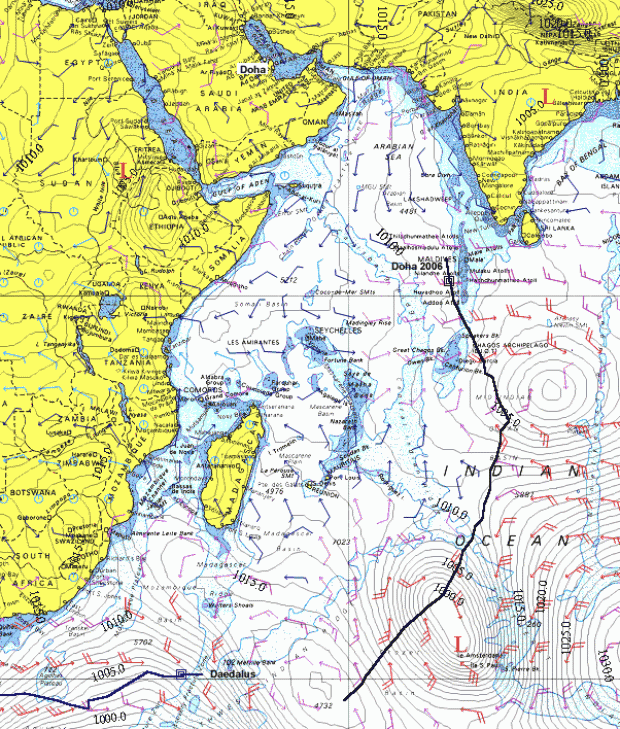
Positions and weather at 1747GMT (Image courtesy of I&M MaxSea)
Dog bowl makes its bid for freedom
Wednesday March 30th 2005, Author: Paul Larsen, Location: none selected
And back to bashing upwind again...sigh! Thankfully we had that relatively flat section in between. To give you an idea, yesterday, as now, we had two reefs plus the second smallest headsail up in only 13 knots of wind in an effort to go slow so as to decrease the violence of the motion. It's not fun, but then there is no great hurry apart from just wanting to finish. I won't use my credits (if any) begging the powers above for a weather gift to speed us to Doha. I'll save those for tighter situations.
Conditions are very tropical as you would imagine being only a couple of degrees away from the Equator. It all adds up to wearing some peoples patience quite thin. Others deal with this in the opposite manner with humurous resignation and on occasion the two don't mix... which from the outside is quite humurous. Just best not to always laugh openly. The sky is a very active place with some pretty big and spectacular cloud cells messing around with our wind. You can spend a whole watch just dealing with what first appeared as a little ball of cotton on the horizon and turns into a nervous trip into a potential 'Bear's cave'. We had a good one last night that came across as the still fullish moon appeared. The moon-light lit up the white leading edge of this cloud formation that came in like a big,low, horizon to horizon rolling pin. All the halyards were readied for anything as we gently nodded our way in.
Once under the leading edge it was black as you like but the boat was still lit from behind by the bright moon light and everything appeared chalky white. The deck became very quiet and with only the occasional gentle swish of water along the hulls. Everyone's eyes are set to maximum aperture and there is distant lightning all around. Is there going to be a bear in this one or not?
I love sailing in these conditions as it keeps you on your toes. When the bear does come out in the form of a big line of strong wind, everything happens fast, the boat takes off, courses are drastically changed and sails are eased or dropped. You are, however, often rewarded by having your hot, sweaty body rinsed by a beautiful, warm and heavy tropical rain shower at the end. Then it's time to put everything back up that you just
took down as the cloud rolls away to horizons new leaving you stuck in what is quite often the windless aftermath. So you wait for the new, or more likely, the old breeze to fill in once more while looking ahead to see what cloud is next in line.
These cloud cells can give you a nice push through a light wind area or they can park you up for hours. You try as hard as you can to ride the wind in the front and not sail directly behind but some times you just cop it either way. Someone is kept on radar watch as this picks up the rain and gives us a good bearing to see if our paths are going to cross. We will sail a long way of course to miss some of them.
So all going well we will be crossing the equator tonight. The 'slopping' of Andy [Meiklejohn] on the way south did such a good job of appeasing King Neptune (as our easy passage through the Southern Ocean testified) that we think it is only fair that we thank him once more on the way out. So our gracious navi-guessor, Will, is going to cook a meal for the first time in two circumnavigations and a spoonful from each bowl will get thrown at Andy...no, sorry, will get thrown over the side to Neptune (then again, messing Andy up did work.). The other thing to get thrown over the side recently was
Jacques' food bowl in a game of trampoline rugby where the ball (Jacques' food bowl) got passed on to...no-one, Neptune, Davy Jones... take your pick. The game play went something like this: 'Foxall breaks free from the galley and fires off a long pass cross field to Vincent in the mast pit. Vincent looks further cross field and fires a low pass to Delbarre near the port cuddy. Delbarre gets a hand to it and taps on to... the fresh air between the port life lines... Uh-oh.'
We watched it bob away at 12-13 knots all a little speechless for a while. We don't throw anything non-biodegradable overboard and now here was this bright blue, Thermos style bowl with an airtight lid on it drifting off to a whole new life. What's more is that it still had Jacques lunch in it. Imagine the poor shipwrecked soul on a raft who bumps into this after months adrift. If he/she is off a modern racing yacht and opens the little gift from god expectantly only to find... bloody freeze-dried Chicken Provinciale inside then it would probably be enough to push the poor soul over the edge. The final kick in the onions. Especially as, after a month in steamy self-contained tropical bliss, the little meaty bits are still chewy as erasers!
I will now leave our resident marine biologist, and soon-to-be chef, Will Oxley to describe what fate might befall Jacques' food bowl as it drifts along towering cloud lines of the equator.
I have endeavoured to set my own round-the-world record on this trip by never bringing up the subject of food as I think that the tales of who likes what, freeze-dried and chocolate swapping has been done to death in the past. I know that talk of rationing and Jacques' bowl may be treading close but I don't believe they cross that line. For detailed stories on the subject perhaps you should look a few thousand miles further south.
Paul.
Will Oxley writes...
Hi,
Seems to me Paul crossed the line on the food a while ago when his idle mind settled on me and cooking! But what of the fate of the bowl. As far as I can ascertain the aforesaid rugby game took place around 0800 on 28 March. At this time we were approximately 11 degrees south. The prevailing current in that part of the Indian Ocean is the South Equatorial Current which flows west at between 0.5 and 1 knots, branching north as it approaches the African Coast: a journey of over 2000nm. This means a voyage time of around 100 days if there is not too many interuptions (eg. cyclones, collisions with Islands, hungry sharks).
One possible landing point for the bowl would be the famine ravaged and war torn Somalian coast (what irony). There is a great section in the book "Life of Pi" where Pi, adrift after the freighter he was on sinks, (there is MUCH more to the story than this!), describes the sea life growing and exisitng on his makeshift raft. This book is doing the rounds on board and I guess it prompted the question of the bowl's fate.
In the early 1980s I did some work in the Coral Sea with two prominent Ichthyologists (fish scientists), Professor Howard Choat, and Dr Jeff Leis, on the lives of larval fishes in mid ocean. Turns out that larval fish are quite the keen swimmers with good hearing and visual acuity. Anyway one of the areas we looked for larval fish was around flotsam and we also had some makeshift rafts that were placed in the ocean for several hours to attract the fish. But back to 'the bowl'.
Algal (marine plant) spores would settle on the surface of the bowl within 10 days or so and create a fine green film of 'slime'. Drifting barnacle larvae might bump into the bowl and encouraged by the algal growth choose the bowl as a useful place to settle. Slowly other critters, with a life cycle that includes some time drifitng on the ocean waves, would join the barnacles and the algae. Crabs and possibly even a coral might join the party. The odd sea bird trys to land on it without success looking instead like a clown in the circus as it trys unsucessfully to balance on a rotating bowl. The bowl will be getting heavier now and less influenced by wind waves and more by the ocean currents.
Because the lid was on and the bowl was empty (sorry Paul - I got the info direct from the rugby players and they had already eaten!), save a spoon, it has plenty of buoyancy and is in no danger of sinking. However it no longer spins around and stays in the column in one orientation and this encourages further growth on that side. Along come the larval fish. Perhaps they were underneath a piece of driftwood which bumped into the bowl and they decided to change homes or perhaps as the bowl passed the Seychelles the larval fish hooked a ride while they were out looking for greener pastures (another reef). It seems that some larval fish can 'hear' the sounds of a coral reef and actively swim at speeds of 1-3knots towards the noise to find a home. Seems amazing for a fish perhaps only a few cm long.
This whole ecosystem would then bob along until finally it washes up on the African coast where those who are able to depart depart and the others perish. Maybe a soldier in Mogadishu, seeking a respite from his dutues, is walking along the beach and finds the bowl and takes it back to base and cleans it up to use for his rations. So much for the bowl's fate.
Meanwhile the person who missed the ball (bowl) makes do with another container for his food. It will come as no suprise to the Kiwi and the Aussie rugby supporters that the person who missed the ball was a Frenchman.:-)
Cheers Will
Most Read
Most Commented
Comments
Businesses

Pro businesses
-
-
United Kingdom
-
France
-
Editor's choice
Member blogs
-
 Ned Collier Wakefield: MOD70 round BarbadosWell that was intense. 12 hard fought for seconds for the win. In idyllic conditions, Tony Lawsons MOD ...
 -
 Mini Transat leg 2 reportThe second leg of the Mini Transat started on 31st October, just over a month after ...
 -
Leg 1 reportI’ve been working towards the Mini Transat now for three years. In 2013 I was part ...
Business blogs
-
 The Island Sailing Club in Cowes, Isle of Wight, is delighted that Prince Michael of Kent ...
 -
Peta Stuart-Hunt chats with the 25 year-old British solo sailor Lizzy Foreman before she sets sail ...
-
The 2015 Student Yachting World Cup (SYWoC), an ISAF-recognised event hosted and run by students for ...
Editor's Choice
All time favourites...
-
 Three legs down into Ian Walker’s
 -
 Winning all but two races at
 -
 For the first time in its
Latest Comments
Add a comment - Members log in