
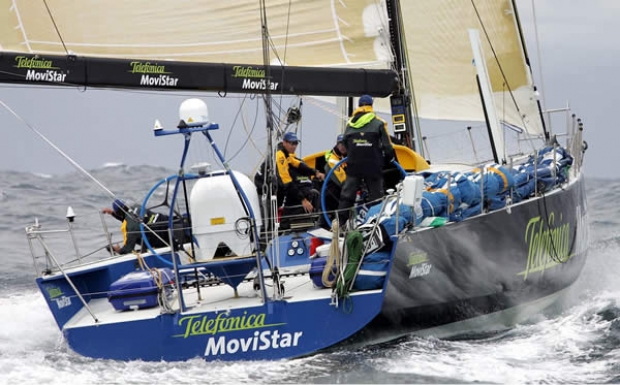
Boat to beat
Friday October 14th 2005, Author: James Boyd, Location: none selected
Given that the 2005-6 Volvo Ocean Race is being contended in a brand new type of boat, it is widely felt that the team with the longest time on the water will be in the strongest position come the start of the fully crewed round the world race on 12 November. If this proves true then the Spanish entry
movistar would top the form book.
Bouwe Bekking's Farr Yacht Design Volvo Open 70 was the second to be launched, hot on the heels of the boat we now call ABN AMRO II on 25 February after a build at Boat Speed - Peter and Sari Ullrich's yard to the north of Sydney, where the maxi Bols and Ellen's B&Q Castorama trimaran were constructed. She was then rigged in Auckland by Southern Spars before setting off on her own bottom through the Southern Ocean towards Cape Horn and back up the Atlantic towards Europe - exactly as Ellen did with her trimaran and her faithful Open 60 before.
What few were expecting was that in the Southern Ocean movistar would break Mari Cha IV's outright 24 hour monohull record setting a new distance of 530.19 nautical miles. It was at this moment that the sailing world - Volvo included - suddenly woke up to just how fast the new generation of 70 footers are. [Volvo recently amended their estimated arrival times for each leg and on the longer legs the ETAs have come forward by as much as five days...]
"It was almost a case of seeing and believing," says movistar skipper Bouwe Bekking. "The first time we sailed on it, we thought 'hello, we're going to have a bit on here', because they just go. But it brings so much joy to the sailing. Racing is good, but going fast is great and then to keep the speed going... I think that will be the biggest thing in this race - people who can maintain high speeds for a long period without collapsing all of a sudden, because when the wheels fall off on one of these boats, there are only 10 of you to sort it out. That was the thing about sailing the Southern Ocean - we looked each other in the eye and said ‘it’s good we’ve done this’."
Since arriving back in Europe the Spanish team have continued with their training out of the marina in Sanxenxo, but no other team has come close to getting the amount of sea time in as they have.

Boewe Bekking says that one of the principle reasons for building 'down under', was so that they could put the boat through its paces in anger. "The whole plan was to build in Australia or New Zealand and it ended up in Australia and the real reason was just to sail back. We had some issues with the designers’ late changes because we were supposed to be ready at the end of December so we were two months late. And then of course the Southern Ocean doesn’t wait for you weather-wise - that was our biggest worry, because it was late autumn [in the Southern hemisphere] with just six or seven hours of day light."
Movistar were the first team to sign up with Farr but it is hard to say how much of an advantage this may have been. Are they a first generation VO70 and the later Farr boats such as Ericsson, The Black Pearl and the Brazilians second generation, or did going to Farr first mean they had an illbruck-style head start on the others?
"This boat is a standard design from Farr and we spent weeks talking and having lots of meetings with them and we pushed it to a certain direction what they thought would be probably better," says Bekking. "Then the chine came into the equation and we made some changes to the bow section, so there were all these things going backwards and forwards while we were taking measures of risk. In terms of beam waterline we are probably a couple of centimetres of each other so we pushed one side of the rule where we thought we might get an edge with a better sail program.
"They [Farr] did some really nice homework on all the beam waterline differences because that is always what you want to know about and displacement differences, but it became obvious that the base design was quite a good boat, because they sail them virtually around the world and some boats were really faster in the offshore and some didn’t make any points on the inshore."
Movistar has a noticably different hull to her three other syblings, with ABN AMRO-style chines in her aft quarters, the three other Farr boats lack. Compared to the ABN AMRO boats these chines are lower down the topsides.
Movistar and the other Farr boats also appear to have a narrower Bmax than the Juan K or Australian designs, but how they compare in terms of waterline beam is harder to say - the ABN AMRO hulls have much more flair. Maximum beam allowed under the VO70 rule is 5.50m and we know Juan K takes the view that 'stability is king' thus we suspect the ABN AMRO boats are approaching maximum beam. In comparison Bekking says movistar's Bmax is just over 5m wide, the Farr office having run simulations on boats with around a metre difference between their waterline beams.
Bekking states the case against maximum beam: "You can go for a very beamy boat but due to the sheer physical size you are getting a way heavier boat with all that extra material and extra wetted surface."
Given these figures for their beam it would appear that the ABN AMRO boats are hard core power reaching machines, while the Farr boats like movistar are more low hydrodynamic drag affairs. In theory this should make them faster in light to moderate conditions, upwind or downwind, perhaps giving them the edge during the in-port racing. But it is by no means that simple as demonstrated by the fact that movistar is the current holder of the 24 hour record, set while blast reaching in the Southern Ocean and proved herself to be extremely sticky in this year's extremely light Rolex Fastnet Race. However Bekking does acknowledge that movistar, and presumably the other Farr boats have been optimised for light to medium conditions. "In the past that is always where the race gets won."
While the ABN AMRO boats may be approaching maximum displacement, the Farr boats may be lighter, although Bekking says it is hard due to the restrictions of the VO70 rule to get much below 13,200kg (the VO70 displacement range is 12.5-14 tonnes). "I think everyone will be pretty high on the limit, but I am not sure about maximum displacement. You have to have the minimum weight of the bulb, you know how much the boat is going to weigh, etc so that is just a case adding up the numbers. It is harder to go much lighter than that."
Having a crawl around movistar and the general impression one gets is of the strength - the gear all seems beefy in the extreme - and how well sorted it is. The main sheet track is mounted on the cockpit sole aft of the two helm positions, which have a robust-looking hatch between them down to the nav station and a piece of substantial scaffolding outboard of each wheel to prevent the stack sliding inboard. Just forward of this there is a separate island for the main sheet winch with the controls for the rig's hydraulic systems on its forward side and for the keel canting on the aft side. There are two coffee grinders, two Harken primary winches and a further two winches each side to handle halyards, reefing lines, etc which come back from the mast inside the cabintop to an array of hefty jammers. Along the side decks there are two short athwartships-mounted tracks for the headsail cars.
Above deck movistar sports a Southern Spars rig with four sets of spreaders and jumpers to support the topmast. The standing rigging is Future Fibres PBO rod connecting to carbon fibre chainplates, the Vs on turnbuckles, the Ds pinned. "We spent a lot of time with the rig," says Bekking. "That was an advantage of being the first with Southern Spars and we made our own profile. ABN has changed from Hall Spars to Southern, but they don’t have the same top taper as us."
One of the biggest variations between the boats this time will be with the sails, states Bekking. "That will be the amazing thing in this race, the sails will be so different that you can’t cover like you could in the last race when you would sail the same angles as everybody, because everybody had more or less the same sails. Now if you don’t have a sail that someone else has you can’t match them, so you have to really go your own way. But probably everyone will end up in the same place at the same time. That’s what happens very often in offshores anyway."
The team have been working with North Sails' Andrew Lechter who was with Assa Abloy four years ago. Bekking reckons they are now onto their fourth generation VO70 sails.

Obviously the VO70 rule is in its first iteration and one of its weak points in terms of restraining costs, is in the specification of the canting keel. Teams have been having to work to par down weight from their boats in a much more extreme way than they ever had to with the VO60s. This is all the harder with the weight of so many of the key components of the boat fixed and yet there is no maximum weight for the bulb. Thus some of the richer teams have been trying to par weight from their keel canting mechanisms by using rams made of carbon fibre or titanium (the rule offers no special limitations to the materials permissible for use in the hydraulic rams driving the keel - other than that they must be off-the-shelf products and not custom-made).
While carbon fibre or titanium hydraulic rams may not be available off the shelf from your local chandlers, the cunning Volvo teams have been able to lay their hands on them. "They are all American navy and airforce rams," says Bekking. "And they are very expensive. We have done a lot of testing. You want to be sure that it doesn’t break because you have to finish and you know that when the thing is dangling underneath the boat it is not very pretty."
He feels this is one area of the VO70 rule that could do with being tightened up. "I think with the rams, they gave a lot of materials for free and maybe they should have just said, cheap stainless steel, everyone has the same and with the minimum requirements. We have spent so much money on the rams because you can save a lot of weight in them and systems. Some people have gone for total titanium rams and some have tried carbon rams. So a lot of development has been done, whereas it should be standard equipment."
Otherwise Bekking says Volvo have done a good job in specing the canting keel systems so that they are safe. "It is still a new area and considering the conditions these boats will be going through it is good to be on the safe side, because it would be a disaster if one of the boats breaks down and doesn’t finish."
One of the benefits of movistar's run through the Southern Ocean was improving reliability. The high speeds of the boats have induced more load on them than many of the teams had anticipated and all have experienced gear failure. "Construction-wise we haven’t had any problems," says Bekking. "We have changed quite a bit of deck gear because some of the loads are a bit higher than everyone thought. In fact the loads are just humungous."
For the race itself, there is a concern among all the teams about the pressure on the crew. Compared to their predecessors, Volvo Open 70s are way more powerful, loads are bigger, they are faster so green water sluices the deck with greater violence and yet there are less crew to sail them.
"You have to look after people and everyone has to look after each other," says Bekking. "It is way harder than the last race, just the amount of time you are spending on deck and whenever there is a manoeuvre how many hands you are actually calling up, it is different. When we arrived in Rio we were worse off than in all the Volvos we’d done before - physically just totally drained."
As a result of this crew strength and fitness requirements will be at a premium and Bekking is expecting to work a crew rota system between legs along similar lines to the way America's Cup teams have been working. "You can change 50% of the crew, but then they have to race on the inshores. You can bring two extra people in for the inshore and nine people have to sail either the previous leg or the next leg.
"I don't think we'll have two squads - it won’t be that bad. I think we will go a long way with this team, but for every position we have a back-up. You are going so fast just the chance of injuries are way bigger, especially for the bowman, when they are going up front. When there is 25 knots of breeze, you are doing 25 knots you dig it in once and they are coming down the deck at 25 knots. That happened in Newcastle the first weeks we were there. Both our bowmen were out. One couldn’t even sail the first leg around the Horn because he broke his wrist, he broke his collar bone and just got smashed around. But that is the nature of the boat. You just have to be careful and you have to down throttle all the time and that aspect is more important than it has ever been before."
To date movistar is the only team to have competed in anger - in the Rolex Fastnet Race in August - but this failed to demonstrate the potential of the VO70 and they finished among Open 60s. For that race Bekking says they were in Volvo trim and not IRC trim and weren't able to use their light airs sails.
Since the Fastnet they have returned to their base in Sanxenxo maintaining a program of two weeks in the water sailing, two weeks out. They have slowly been joined by other teams such as ABN AMRO and the Pirates.
"We haven’t really been looking at them," says Bekking of the competition. "I think they have been more copying us, because we were the first. That is just how it is. You can get all secret, but we have been very open. It was nice that ABN was over here, because they have a completely different boat, so you could work and do things. If there had been another Farr boat here then it might have been a bit more tricky, because you are quite similar. We have a couple of systems that the other boats don’t have. With ABN that was not a problem, because they are a totally different concept."
They have since fitted a new mast and a slightly larger bulb, but all the teams here at present are feverishly attempting to optimise displacement.
Since the Rolex Fastnet Race Richard Clarke has stepped down from the permanent crew for personal reasons, but Bekking says he is still likely to do a couple of the legs. He has been replaced by highly experienced South African sailor Jonathan Swain.
So will they win? Against Cayard, Ericsson, ABN? The book is still open.
More close up images of movistar on the following pages...

Most Read
Most Commented
Comments
Businesses

Pro businesses
-
Italy
-
Netherlands
-
-
Italy
Editor's choice
Member blogs
-
 Ned Collier Wakefield: MOD70 round BarbadosWell that was intense. 12 hard fought for seconds for the win. In idyllic conditions, Tony Lawsons MOD ...
 -
 Mini Transat leg 2 reportThe second leg of the Mini Transat started on 31st October, just over a month after ...
 -
Leg 1 reportI’ve been working towards the Mini Transat now for three years. In 2013 I was part ...
Business blogs
-
 The Island Sailing Club in Cowes, Isle of Wight, is delighted that Prince Michael of Kent ...
 -
Peta Stuart-Hunt chats with the 25 year-old British solo sailor Lizzy Foreman before she sets sail ...
-
The 2015 Student Yachting World Cup (SYWoC), an ISAF-recognised event hosted and run by students for ...
Editor's Choice
All time favourites...
-
 Three legs down into Ian Walker’s
 -
 Winning all but two races at
 -
 For the first time in its
Latest Comments
Add a comment - Members log in