
Ice ahoy
Friday February 27th 2004, Author: James Boyd, Location: Transoceanic
Position at 05h10GMT: 48deg 50.010S 43deg 24.530E
Course/speed: 090 deg/24.8 knots
TWS/TWA: 21 knots 313 deg
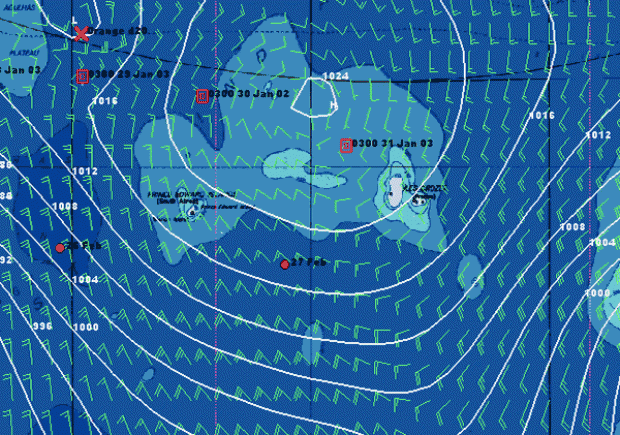
As Steve Fossett explains below he and the crew of Cheyenne halted their dive south when yesterday they spotted icebergs. The maxi-cat is still making excellent progress having logged a very useful 565 miles in the last 24 hours (until 0510 this morning). This puts them roughly 760 miles ahead of Orange' s equivalent position on their record setting round the voyage in 2002 and just 77 miles behind Olivier de Kersauson's blisteringly fast passage (in this section at least) on board Geronimo last year.
Yesterday afternoon Steve Fossett wrote: "We got a close look at our first icebergs of the trip this morning. This one is at 3 miles. Maybe we have gone far enough south for the time being!
"These full sized icebergs should be easy to avoid hitting. The danger are the growlers - which are chunks of ice of mere 'truck' size. If we hit one it would be -- well, catastophic. The theory is that growlers will be found up to three miles downwind of an iceberg. This means we must divert course to assure that we pass upwind of icebergs. We have tuned up the radar for constant monitoring at nighttime.
"The winds are bit better to the south but we are pleased with our progress and we must not get greedy."
Ken Campbell of Commanders Weather added: "They should be looking at good winds for the next four or five days, moving them across the Southern Indian Ocean very quickly. The breeze will back a little on Friday and they'll need to make a decision then whether to push further south or to go a bit to the north - where the winds may get a little lighter."
Brian Thompson writes from on board
Today we saw our first iceberg, passing about three miles down our leeward side to the south of us. It looked a couple of hundred yards long and not too tall, as you could see the spray breaking over the top.
An hour later we saw our second one, about three times the size and brilliant white in colour. This one looked like the size and shape of a car carrier ship, but one that was 'not under command’. It was a beautiful sight, the only solid surface we have seen since Ushant. Naturally there is a certain level of risk with their presence, and the more numerous they are the greater that is. Fortunately we are right at the northern edge of their limits at the Antarctic Convergence Zone, which is the limit of the cold water from the frozen continent. It is in fact unusual to see them in this location, according to our weather routers in the US. During the following eight hours we have not seen any others.
This one showed up at seven mile range on the radar and passed the same distance to leeward. If there are any loose bits of ice they are generally to leeward of the berg so we were clear of these. Now it is night we are paying very close attention to the radar, we will only have 15 minutes warning of any target, just enough time to furl the blast reacher and head above it, or to bear away and try to pass further to leeward.
There seems to be little tracking of these individual bergs as there is in the N. Atlantic in the Labrador current, presumably due to the vast area and the scarcity of vessels passing through these waters. There was a report of some ice from the US navy at 50S and 25 W, well to the S and W of us. Most of the anecdotal data that does exist from previous races and passages through these latitudes suggests that as we head east the risk diminishes, in this ocean at least.
Sailing conditions are still perfect with 20 knots of wind propelling us east at 25 knots. Up ahead we have the Kergeulan Islands, which are on our route. There is a large bank of shallower water around this area with a lot of kelp and the potentially rougher seas. So we are going to have to decide tomorrow, in the light of the latest weather, which side of them to pass. They are now 1300 miles ahead.
Today we dropped the blast reacher for a while to shorten the luff rope, which has been stretching since the start of the trip. Justin [Slattery] and Fraser [Brown] were working on this project.
Otherwise all good, and as Jacques [Vincet] said, this is all gravy and very unusual for here. Damian [Foxall] was here on Kingfisher 2 last year and was under storm spinnaker and two or three reefs, with big seas. We are gliding along under full
sail with low stress on the boat and the crew...
Brian
Most Read
Most Commented
Comments
Businesses
Pro businesses
Editor's choice
Member blogs
-
 Ned Collier Wakefield: MOD70 round BarbadosWell that was intense. 12 hard fought for seconds for the win. In idyllic conditions, Tony Lawsons MOD ...
 -
 Mini Transat leg 2 reportThe second leg of the Mini Transat started on 31st October, just over a month after ...
 -
Leg 1 reportI’ve been working towards the Mini Transat now for three years. In 2013 I was part ...
Business blogs
-
 The Island Sailing Club in Cowes, Isle of Wight, is delighted that Prince Michael of Kent ...
 -
Peta Stuart-Hunt chats with the 25 year-old British solo sailor Lizzy Foreman before she sets sail ...
-
The 2015 Student Yachting World Cup (SYWoC), an ISAF-recognised event hosted and run by students for ...
Editor's Choice
All time favourites...
-
 Three legs down into Ian Walker’s
 -
 Winning all but two races at
 -
 For the first time in its
Latest Comments
Add a comment - Members log in