
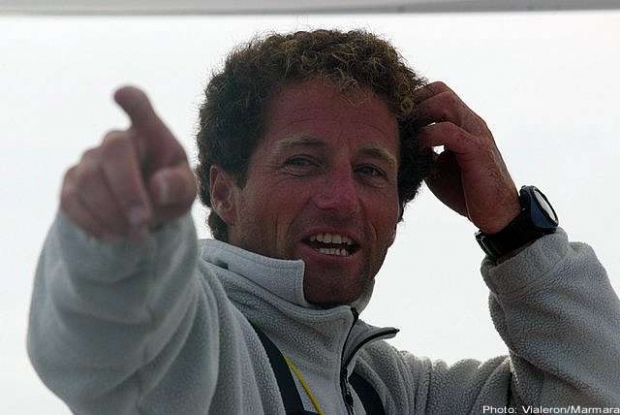
Le Professeur gives his latest lesson
Monday August 18th 2003, Author: James Boyd, Location: France
Michel Desjoyeaux is one of the top sailing stars in France. He's sailed in the Whitbread Round the World Race twice with Eric Tabarly, he won the last Vendee Globe singlehanded non-stop around the world, he campaigns the 60ft trimaran
Geant. At the moment Desjoyeaux has returned to his roots and is currently lying in fourth place in the Solitaire du Figaro which kicks off today on its final leg back to France.
"I stopped in 1998 after one year where I won 12 races of 28 races and my worst place was 12th and all the other places were inside seventh. And I won 4 of the 5 legs of the Figaro Race so I decided to stop," says Desjoyeaux in a tone which is neither bragging nor apologetic. With little more to learn in Figaro racing, Desjoyeaux, nicknamed Le Professeur because of the number of Figaro rookies he has tutored and encouraged over the years, retired from the class.
"After such a year there wasn’t much point in continuing, so I looked for something else. I wanted to have a tricycle [his nickname for a 60ft trimaran], but then a certain Isabelle Autissier proposed to me that I sail on PRB and that was before she capsized with the boat [in the 1998/9 Around Alone]. So we made a new boat for Vendee Globe. We won the Vendee Globe and then I decided that it was time to have my tricycle. And now I have it - and in that I won the Route du Rhum. But I’d already decided to sail the new Figaro for this race but I was waiting to be sure that my trimaran project was on the rails enough to be able to do something else without opening the door for my sponsor to say ‘you should be working on the tricycle - not going and playing games..."
Desjoyeaux says he proposed the Figaro sponsorship to Geant, the giant French supermarket chain and his sponsor, following his Route du Rhum win. "I think it is important you want to do it rather than someone asking you to do it. Also I wanted to do it because when you see what happened in the Route du Rhum, the more singlehanded racing you do the more training you have for such a race. This year there is no singlehanded sailing so I'm using the Figaro for training for the multihull program." He also points out the cost of campaigning a boat in the Figaro is a 20th of a trimaran budget.
Desjoyeaux thinks the standard of competition as well as professionalism has improved in the Figaro class since his last tenure. This has been indicated by the tightened of the race rules, not allowing for example shore crew to leave port on the boat prior to the start of races. "It is a singlehanded and the crowd want to see the skippers alone on the boat when they leave the harbour. Also it is a way to show there is no difference between big and small sponsors in the Figaro."
This year's Solitaire du Figaro is Desjoyeaux's first race in the new Figaro Beneteau 2 one design introduced this year. He says he has not taken part in any of the other races so far this season in the Figaro circuit as they have conflicted with his trimaran programme. "We should have had the boat in the middle of April to do the Tour de Bretagne and then be able to sail the tricycle and spend that time to prepare the boat. But due to the technical problems with the boat in the beginning we were not able to get the boat until the middle of May when I was busy with the trimaran." Desjoyeaux says that his Figaro was launched 12 days prior to the start and he had sailed it just 10 times prior to the prologue in Les Sables d'Olonne.
Desjoyeaux is well aware of what it takes to win the Figaro. Part of his reason for coming back this year he maintains is that if he'd stayed away any longer it would have been harder still. "I've done the race seven times and this circuit. In 1990-2. In 1992 I won the Figaro and then I stopped for two years and I came back in 1995 for four years, and when I came back I spent two years try to get back to the top level. So I know it is difficult to come back.
"It's not really any technical differencies between the boats because they are one design for everything that governs the performance of the boat. The difference is in the way of using it. For sure when I was sailing the boat before in the 1990s it was very easy for me to manoeuvre the boat, because I was very easy alone. For the others there were wind strengths when they were not efficient especially in high wind. And now I am sure they are all very easy, even in high winds, so it is harder than before.
It doesn't surprise him that it is the top players from the class last year that are still on top now. "The new boat for all the ones who were sailing on the old boat didn’t change a thing. The top 10 is much the same. For us [old timers] the chance we have is with our experience in technological problems we can solve problems in a few days, just because of our experience. For example with the double rudder system, they are not trimmed well. So you go on the boat, you sail for one hour, you say it is not good and then you trim it and then the problem is solved. For example we also have put load cells on the rods, and during one day we trimmed the rig as I wanted it. Then I saw all of the top ten was at the end of the forestay length so in one our we changed the rake while keeping the same mast trim, because of the load cells. So there are a lot of small things like that which give us the possibility of reaching the top 10."
Desjoyeaux was responsible for a number of innovations in the old boat, such as the double basket in the companionway into which the spinnaker is dropped. He says that there has been no time to make such improvements this year, but he expects to come up with some next year provided he continues to race in the class.
Meanwhile the Geant trimaran is currently having a refit prior to the Fecamps Grand Prix and the two handed Transat Jacques Vabre which he is sailing with multihull and round the world veteran Herve Jan.
He believes that following the carnage in last year's Route du Rhum the next event will be followed with even greater interest by the press and public. "Remember what happened with the Vendee Globe. In 1996/7 there were a lot of problems [the loss of Gerry Roufs and the capsizes of Tony Bullimore, Thierry Dubois and Raphael Dinelli] and in the last one there was very big coverage. And so I think it will be the same in the Route du Rhum.
"For the technical problems, for sure there was a problem, but in fact we didn’t change the rules, because there was nothing to change, just for each team and each skipper to decide what they want to do with their boats. In France we have the Paris-Dakar rally. This year there was a Japanese guy who died and nobody spoke about stopping this race. When there is only a few problems and nobody dies you should stop everything? No way. So - keep cool guys. It is a race. It is a mechanical sport. If don’t accept this, you have to change sports."
Most Read
Most Commented
Comments
Businesses

Pro businesses
-
-
France
-
Netherlands
-
United Kingdom
Editor's choice
Member blogs
-
 Ned Collier Wakefield: MOD70 round BarbadosWell that was intense. 12 hard fought for seconds for the win. In idyllic conditions, Tony Lawsons MOD ...
 -
 Mini Transat leg 2 reportThe second leg of the Mini Transat started on 31st October, just over a month after ...
 -
Leg 1 reportI’ve been working towards the Mini Transat now for three years. In 2013 I was part ...
Business blogs
-
 The Island Sailing Club in Cowes, Isle of Wight, is delighted that Prince Michael of Kent ...
 -
Peta Stuart-Hunt chats with the 25 year-old British solo sailor Lizzy Foreman before she sets sail ...
-
The 2015 Student Yachting World Cup (SYWoC), an ISAF-recognised event hosted and run by students for ...
Editor's Choice
All time favourites...
-
 Three legs down into Ian Walker’s
 -
 Winning all but two races at
 -
 For the first time in its
Latest Comments
Add a comment - Members log in