
The new benchmark - part two
Tuesday September 16th 2003, Author: James Boyd, Location: Transoceanic
Read part one of this article
here
Movable ballast
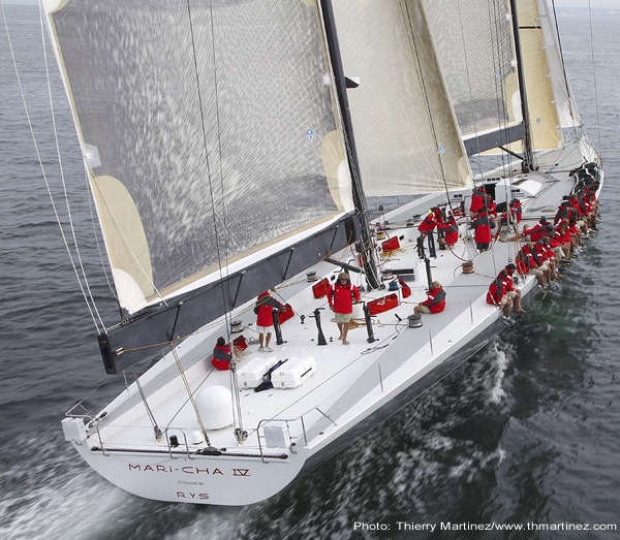
Once one has got over the shock of her scale and being a schooner, Mari Cha IV is in many ways quite conservative. One area where they have made a possible development is in the movable ballast. With no rules to work to the design team came up with a novel solution that would be illegal under the Open 60 or VO60 or 70 rules.
She has a canting keel with a 10 ton bulb that can be swung by +/-40degrees. This is driven by a single hydraulic ram on the starboard side that is capable of shoving 200 tonnes and has a throw of 2m. To give some idea of the ram's size - an adult could just about get their arms around its circumference.
Normally canting keel boats require some sort of centreboard arrangement to prevent leeway when the keel is up to weather, but for reasons of weight saving and because she is primarily a reaching and running machine Mari Cha IV doesn't have this. Instead when sailing upwind the keel is locked in the down position and she uses water ballast fitted in tanks along the gunnel. These are only used upwind and so are located further forward than the tanks on for example a Volvo Ocean 60. 10 tonnes of water ballast can be brought on board when it is needed ( Mari Cha III could take on 7 tonnes). "The boat prefers water ballast to go upwind, because the boat is under displacement - it is too light to go upwind," explains Sanderson.
What Mari Cha IV cannot accept is being fully water ballasted at the same time as having the keel fully canted. "The boat is set up to achieve maximum righting moment with one or the other," says Sanderson. "If you fill them both up you're going to blow the rigs out of it. So you can have a combination. We have two tanks a side so you could have 3/4 cant and half a tank of water. You know water ballast is going to be better upwind - the boat gets longer with water ballast and if it gets super light maybe we'd try a bit of leeward cant to tip the sail plan."
Most of the important records such as the west to transatlantic should be 'downwind' affairs - although like the maxi-multihulls the apparent wind will rarely be aft of the beam and when we were on board, inevitably in little breeze, the boat was regularly sailing at twice wind speed. Sanderson sees little reason why a boat such as this should be designed to go upwind like a train, since in the open ocean you will always have to throttle back.
"30 knots upwind you have to slow your Whitbread 60 down to 8-9 knots, on Sayonara you have to slow down to 9 knots on Mari Cha III we have to slow down to nine knots. So what is the point of building a sloop that can go upwind at 13 knots when you all have to back off to go upwind as soon as it gets heinous offshore anyway? So there are boats around which are going to beat us upwind in St Tropez."
Mari Cha IV has her upwind water ballast and her keel the latter located further aft because she is schooner rigged and designed for reaching and running. But unlike Open 60s she doesn't have great flexibility in being able to alter fore and aft trim (in fact it is hard to imagine achieving this in a boat so long).
Sanderson says that in comparison with other maxis such as Alfa Romeo, Bols and the new maxZ86s due for launch later this year, the water ballast and keel canting mechanisms do not operate as fast but instead have been designed for reliability.
While the boat may be belt and braces at present Sanderson and d'Etiveaud have plenty of ideas of how to make her go faster. They will introduce these as and when they feel it to be necessary, but probably not until another monohull comes along to threaten their performance and at present we are not aware of any three masted 190ft schooners on the horizon.
Down below
Below decks there is so much space one could get lost.
There are two companionways. The forward one leads down to the 'bridge' were there are two Sparco swivel chairs designed for a rally car. Quite how well these will work when the boat is heeled remains to be seen. The chart table includes all the bells and whistles you would expect and is based around twin fully plumbed-in desktop PCs.
From here there are stairways down either side. Forward when we were on board was highly partitioned with bulkheads but otherwise empty ready for sail stowage. Aft in the starboard side of the hull there is a galley and aft of this the crew pipecots mounted on the hull and the outboard side of the starboard longitudinal.
In the starboard the layout is similar but with a separate cabin and head for the owner in place of the galley. Between the two longitudinal bulkhead there is a large space aft empty save for the aft companionway while forward is the engine room and keel box.
The speed
At present Sanderson says they are unsure of how they will be able to sail the boat. At one end of the spectrum maxi-multihulls, in particular highly powered ones like PlayStation, have 'speed limits' to help prevent the boat blowing up. Sanderson hopes that they are more at the Volvo Ocean Race end of the spectrum where you can push the boat hard without too much fear of reprisal.
The boat is currently heading for the States to go on standby for a first crack at winning back her west to east monohull transatlantic record and on the delivery and during sea trials off Cherbourg they so far haven't experienced much in the way of big conditions - although they did encounter the back end of Hurricane Fabian which saw the boat falling off waves as it powered upwind.
"We don’t know what it is going to be like when it is doing 35 knots," says Sanderson. "To date she has shown no vices. Normally you get a good idea when they are doing 25 knots, so you get a pretty good idea about what it will be like at 35 knots and so far you wouldn’t change a thing."
Because of this inability to push to the limit on maxi-multihulls the crew tend to focus on high average speeds and astronomic daily runs rather than maximum instantaneous speed. If Mari Cha IV can really be sailed to the limit, then she should be capable of both high maximum speeds as well as massive runs. The top speed on Mari Cha III was 32 knots, on the new boat some of the crew believe they could see 40 knots. With this kind of performance she should take no time breaking illbruck's 24 hour monohull record taking it to over 500 miles. If her performance is really as good as is to be expected then in theory she could possibly be capable of a 600 mile 24 hour run.
Her best day during the delivery was 428 miles. "We used to joke about 'champagne sailing' when conditions are nice and basically any time we had reasonable breeze it was awesome. In light to moderate air we were just cruising along, we banged out 428 mile one day without even noticing. It was unbelievable to do a 400 mile day with your shorts and T-shirt off," recounts Sanderson.
"The delivery took 14 days - a slow trip as we went roaring around the Atlantic trying to find breeze and not headwinds and trying to dodge hurricanes, but the boat is outperforming its polars, it didn’t break anything, it was dry down below when we were reaching at 20 knots and shy reaching at 70degs true we would be in full wet weather gear on a Volvo boat and we were cruising around in short and T-shirt. It couldn’t have been any more enjoyable to go offshore racing."
Upwind the boat has been performing faster than her polars. The team were expecting 12-12.5 knots on this point of sail. "The only time we had breeze was when we went upwind which in reality was good for us as we got to do some pounding. So we put the boat upwind at full pace, sailing at 13.5 knots in waves and it went well. It is a tough boat which is such a relief."
The sum total of their breakages was one tack strop that attached the jib to the A frame.
Mari Cha IV put into Bermuda shortly after Hurricane Fabian had devastated it and they sailed on to Newport with only a crew of eight! Skipper Jef d'Etiveaud recounted what proved to be a rather swift delivery: "We brought the boat from Bermuda to Newport in less than two days averaging 20 knots - the last 18 hours in 20 to 30 kts of wind... and all that with all-manual winches and two person watches!"
The problem seems to be how to slow the boat down. "With 25 knots of true wind sped we had two reefs in the main and three in the mizzen and a #4... We were seeing 22-24 knots constantly and got 30 out of her without really surfing..."
From next week Mari Cha IV will go on standby in Newport, RI ready for an attempt on the west to east transatlantic record. Originally Sanderson expected to take 25 crew on this, but is now thinking more in terms of 20 because the sails are designed to take a wide range of wind conditions and it is essential to keep the boat light.
"At the end of the day, it is under 10 days so we can push the guys pretty hard. If we all have to get up to do a sail change it is not the end of the world. It is not like the Volvo, where you are changing sails every 2 knots or every 10 degrees. It is very broad strokes. That is the beauty of the schooner, your sails are so spread out: if the breeze builds you can put a reef in the mizzen and that is only a five man job. If the breeze builds again you can put a reef in the main and that is a six or seven man job, so it is very managable."
The crew are an impressive bunch and will be separated into two watches with Bob Miller and Sanderson skipper and racing skipper, Jef d'Etiveaud and Mike Quilter navigating and Brad Jackson and Stu Bannatyne as watch captains.
Otherwise her crew includes Team New Zealanders like Jared Henderson and Richard Meacham offshore racers like Brad Jackson, Robbie Naismith, Stu Bannatyne and Jan Dekker to French multihull legends like Herve Jan and Jacques Caraes. Among the race crew there are at least 50 round the world races and as many America’s Cups. They have even managed to prise former Peter Blake/Grant Dalton navigator Mike Quilter out of retirement.
Their window for attempting the record is mid-September until mid-November, but with a boat that can notch up great distances even in light to moderate conditions the window for opportunity of breaking records is greatly widened. "I guess we just need to try and get on to some system that is going to get us two thirds of the way across and then rely on the boat’s speed to finish the job off," says Sanderson. "We don’t need anything startling to break it but we just need good breeze. The tricky part is getting out of New York. We’re pretty comfortable that the boat’s pace is will be fine, as long as we’ve got two thirds of the way across.
The record attempt will also be an opportunity to see if they can break illbruck's 24 hour record. "If we can get the boat pumped enough and if a Volvo 60 can do nearly 500 miles, then we are nearly capable of doing - who knows? Is 600 out of the question?" says Sanderson warily. "First it would be nice to be the first to break 500 miles because that hasn’t been done on a monohull. Saying that we didn’t do a 400 mile run on Mari Cha III when we broke the transatlantic record."
Following the transat the boat will return to JMV Industries in Cherbourg to be finished. "We have really stolen it out from under JMW’s nose to have a crack at the record because we didn’t want to miss a season," admits Sanderson.
Next year the schedule will be to have another crack at the 24, take in a couple of 'fun' regattas like Antigua Sailing Week, then possibly take the boat to the west coast of the States for the Pacific Cup. Later in the year they're planning to be back in the Atlantic to have another attempt at the transatlantic and 24 hour records, this time in anger. Then they may have a go at becoming the first fully crew monohull record holders round the world.
"Hopefully we have got the fastest thing out there," concludes Sanderson. "We want to start something new. We want to raise the bar on The Race record on the transatlantic record, on 24 hour record, and just start a new game. It is fantastic because the boat looks impressive and while lots of other classes are getting smaller and trying to cut the costs down, this is a big impressive boat which is still cheaper than doing a Volvo campaign or something like that.
"If you are a private owner then this is a big boat which is fast and exciting to sail and you can go out and win races and break records and it is a very enjoyable boat to sail because it cruises along and it is incredibly well mannered and behaved. If you have got wind you are doing 15 knots and you’re unlucky if you not doing 20 and it doesn’t start to get exciting until you are doing 25 and it probably won’t get thrilling until you are doing more than 30."
See more on board pictures over the next pages


Most Read
Most Commented
Comments
Businesses

Pro businesses
-
-
Italy
-
Netherlands
-
United Kingdom
Editor's choice
Member blogs
-
 Ned Collier Wakefield: MOD70 round BarbadosWell that was intense. 12 hard fought for seconds for the win. In idyllic conditions, Tony Lawsons MOD ...
 -
 Mini Transat leg 2 reportThe second leg of the Mini Transat started on 31st October, just over a month after ...
 -
Leg 1 reportI’ve been working towards the Mini Transat now for three years. In 2013 I was part ...
Business blogs
-
 The Island Sailing Club in Cowes, Isle of Wight, is delighted that Prince Michael of Kent ...
 -
Peta Stuart-Hunt chats with the 25 year-old British solo sailor Lizzy Foreman before she sets sail ...
-
The 2015 Student Yachting World Cup (SYWoC), an ISAF-recognised event hosted and run by students for ...
Editor's Choice
All time favourites...
-
 Three legs down into Ian Walker’s
 -
 Winning all but two races at
 -
 For the first time in its
Latest Comments
Add a comment - Members log in