
Mid-Atlantic with Nick Moloney
Thursday November 6th 2003, Author: James Boyd, Location: Transoceanic

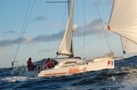
Earlier this afternoon we spoke to Nick Moloney on board Team Cowes, still crashing her way south down the Atlantic...
"I am feeling alright. We've got Jojo [Sebastien Josse on VMI with whom Nick sailed round the world on Orange last year]. We’can’t see him yet, but he’s just over 10 miles directly to the north of us. So we are going to have some company soon - he’s going quite quick."
[VMI have been having problems with their ARGOS beacon used to get the positions of the boats - hence she appears to be jumping up and down the results]
The conditions at the time of our interview is 20-25 knots upwind, directly on the nose. "We are just awaiting what we hope will be the final frontal systsm. We are just anticipating, 25-30 knots in the next few hours which will signal the arrival of the front overhead and then we’ll see the breeze shifting into the 220s and 230s and we’ll tack over and start hopefully freeing sheets. Then we’ll be on fire. "
The last 48 hours has seen some equally severe upwind conditions
"When the weather is quite shitty you tend to forget it quite quickly! We have had a lot of wind. Last night we had quite fresh conditions again. Every night we have seen 30 knots plus. We got warm for the first time last night, although it still got really cold - a lot colder than what we were expecting it to be this many days into the race.
"Every night has been a bit of a butt-kicking. Generally it has come in prior to darkness, but last night it came in the darkness and it is always harder working down through the sail selection in the dark when you are a bit more knackered and the difficulty of not being able to see where the headboard setting is on the mast. But it is getting exciting, now we can see northwest flow on the GRIBs and we can smell the coffee!"
Whats the routine on board?
"We have a great system to be honest. We have not been setting alarms, but just going down and falling asleep and when you wake up you go up on deck and change out. We’ve had that many manoeuvres to do - like winding reefs in and out and changing the sails all the time - that we are concentrating on getting the rest that’s required and I think we both feel great. Upwind there is not a lot to do other than steer and trim, so you don’t require two people out there. It is really really wet, so you don’t require two people to be sitting in the wet, one basically doing nothing. So the other person is down below sleeping or cooking a meal.
"The biggest change in the last three days is that we have been eating properly and that has made us feel a lot stronger. Like all these events when you first take off, you aren’t terribly race fit. These boats take so much preparation and effort and you locked into the basin a week before the start and you are eating as much as you can because you know you’ll be deprived of so much during the race that you come out and the first day or so, it is pretty tough on the body. It takes a little while to get in tune with the whole sea state, particularly if you go into such an on-slaught, like we had in the beginning.
"So those first two days was pretty tough on us and we didn’t really didn’t eat anything other than snacking food for the first two days. Now with proper cooked meals we feel pretty strong and we are swinging away at the handles, completely different people strength-wise and attitude-wise."
Their regime on board has resulted in them getting around eight hours of sleep [at the time of our conversation Sam Davies is crashed out down below]. Nick says. "we are feeling quite good. The first few days was pretty swamp-like living, we were laying in this wet bilge just sloshing around in our dry suits soaking wet. That was a bit uncomfortable for a little while. We’d just fall in a heap on the floor and there was this little wave of water sloshing back and forth all the time you wake up. So that was a good test for the Musto dry suits. So we’ve just been getting downstairs and collapsing, because it is just so draining grinding all the time and changing sails. So as soon as we finish a manoeuvre we either cook someone or someone rests. So we have been really regimented."

What's you view on the performance of Ecover and Virbac?
"I think both the design forums will be relieved that they have taken the class to a new level, because the pressure was on somewhat. The step between the generation prior to Kingfisher and Kingfisher was a huge step and now we see a similar step again in upwind performance. You look at the boats - we always knew both would be strong upwind, and since Kingfisher and Sill and I supposed PRB as well, there has been a swing away from such heavily orientated downwind boats and making boats more all round.
"Now when you look at Ecover and Virbac they are very very much upwind boats and it has yet to be seen how they reach and run. In light to moderate air they might be a little sticky running, because they have so much full volume and the extra wetted surface area and heavy bulbs. So I think it is a bit of a relief to see them do so well because it is progress and interesting all the time, but it is a long long way to go and we have still got plenty of weather to see. Those guys are going to have a bit on. Being next door to each other, in new boats, starring at each other has also helped their performance - not to say that anyone else is backing off. It makes that little bit more difference when you are starring at someone."
On deck Nick says he helms whenever possible. "I treat the race as a helming race. There are points of sail, particularly when you are getting tired when the pilot is better. So I continually check in: If I find myself wandering at all, I’ll take a break, I’ll put the pilot on for a bit, I’ll clean up, I’ll reconfigure the trim and then I’ll re-engage myself on to the tiller and drive again.
"I’ve got this thing in my head that I should be faster than the pilot, but that is not always the case. You have to accept that when you’re really tired, or you are distracted or it is rough - sometimes when you are steering the motion on the boat make it hard to stay on the deck, so it is really hard to keep composure against the helm - in cases like that the pilot is a lot better. So I do try and steer as much as I can.
To see Nick and Sam (occasionally) live on board - check out their website
Most Read
Most Commented
Comments
Businesses
Pro businesses
-
-
-
United Kingdom
-
France
Editor's choice
Member blogs
-
 Ned Collier Wakefield: MOD70 round BarbadosWell that was intense. 12 hard fought for seconds for the win. In idyllic conditions, Tony Lawsons MOD ...
 -
 Mini Transat leg 2 reportThe second leg of the Mini Transat started on 31st October, just over a month after ...
 -
Leg 1 reportI’ve been working towards the Mini Transat now for three years. In 2013 I was part ...
Business blogs
-
 The Island Sailing Club in Cowes, Isle of Wight, is delighted that Prince Michael of Kent ...
 -
Peta Stuart-Hunt chats with the 25 year-old British solo sailor Lizzy Foreman before she sets sail ...
-
The 2015 Student Yachting World Cup (SYWoC), an ISAF-recognised event hosted and run by students for ...
Editor's Choice
All time favourites...
-
 Three legs down into Ian Walker’s
 -
 Winning all but two races at
 -
 For the first time in its
Latest Comments
Add a comment - Members log in