
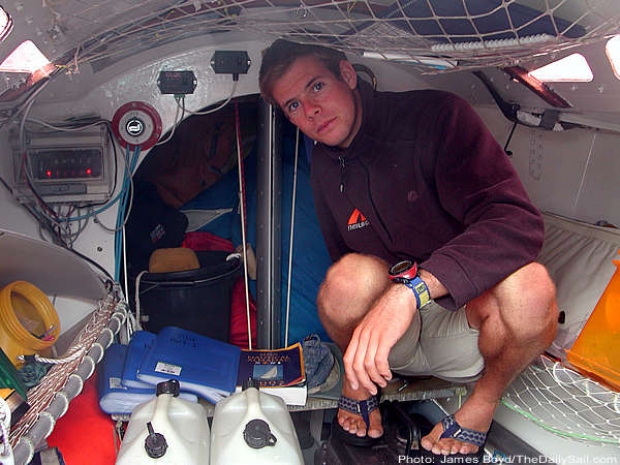
Solo sailing's new nipper
Sunday September 7th 2003, Author: James Boyd, Location: United Kingdom
At a mere 20 year old James Bird is the youngest competitor entered in the Mini Transat and, if it means anything at all, a year young than Ellen MacArthur was when she took the start line of the 1997 race.
Despite his tender age Bird is no newcomer to singlehanded offshore racing. He impressed this journalist immensely when aged 14 he had the wherewithall to go down to meet Ellen who at the time was slumming it in a portacabin in Hamble Yacht Services contemplating how she was going to sail her first Mini Transat.
"I read about Ellen doing the race," says Bird. "Then in 1999 I went down to see the start of the Mini Transat in Concarneau and that was when I really got bitten by the bug. So from then on I decided I wanted to compete myself..."
At the time Bird was living with his parent near Hampton Court in southwest London and was sailing Cadets. Among Cadet sailors his desire to go Mini sailing was unique. "With most people it was a bit of the sheep thing - everyone followed the normal path from Cadets onto 420s or Lasers so there were only a few who wanted to do big boats stuff and I haven’t seen many of them wanting to try and do the Mini."
It has taken Bird five years to get into the position where he can take part. "It is difficult when you are younger because you don’t have the assets to put behind it. Only now am I in a position when I can get money together to run a half decent campaign."
At the start of the 1999 race he got to know the competitors such as Alex Bennett, Nick Moloney and Paul Peggs. "From then I did some two handed racing with Paul and Morse [Paul Blaker – who had a sistership to Peggs’ Mini]. Then when people were putting boats together for the 2001 race, I helped out and bummed around and I was fortunate enough to work for Brian Thompson which was really good in terms of learning things about the boats, because he’s got a wealth of experience. Then I decided that 2003 was the race that I’d try and get a boat together for."
Among the 2001 Mini Transat competitors Bird also met Mike Inglis who was sailing a relatively ancient 'proto', a Berret-Racoupeau design built in 1991 called Atomic. "The whole idea of this design was that they were kit-built prototypes, so it is plywood construction, glass sheathed. I think there were seven boats built out of the 12 kits sold and as I understand it my boat is the only one which has done a Transat before. I think a few of them have done a number of the short races," says Bird.
Inglis agreed to charter Bird Atomic for this race. "I pay charter fees on a monthly basis which is quite handy because you are not lumbered with a boat you’ve got to sell at the end of it, although you don’t see any return on your investment."
Racing the Mini Transat for a 20 year old is a relatively expensive expensive business. How has he afforded it? "Most of it was money I had saved," says Bird. "Deciding that I was going to the race early on helped because it allowed me to save money but I have been working up until June this year just funding it and keeping things ticking over. Even if you have a boat it costs a packet to run it so I have had to work which has put a dampener on my racing." The last months have seen him working at Hyde Sails in Hamble.
Taking part in the Mini Transat on a shoestring requires around £20,000. A top level campaign that stands a reasonable chance of winning is closer to £50,000. With 70 yachts taking part this time the amount of money spent by competitors on taking part in this year's Mini Transat is around £2.5-3 million.
Seeing from previous races how difficult it is to qualify Bird got this out of the way early. He sailed in the class' Demi-Cle race last year from Lorient to Ireland and back and then immediately set off on the obligatory 1,000 mile qualifying passage. "This year I did the Odyssey d’Ulysses from Antibes to Tunisia and back, but that has been it because I had to go back to work to get some money together."
He is still getting to grips with the unique disciplines of solo sailing in offshore races. "On the qualifier I learned a lot in terms of managing my sleep and eating. Sometimes singlehanded, it sounds funny, but you forget to eat, because you are so pre-occupied with navigation and keeping the boat going. Certainly the singlehanded deliveries I’ve done I haven’t struggled too much even through they’ve only been 3-4 days. I’ve always finished them and still felt that I could carry on, which is good in a way because I haven’t hit the pontoon and collapsed."
In the Mini Transat the frontrunners are expecting to take 10 days to get down to the Canaries and then around twice this to get to Brazil. As a result a different approach is required. "You’ve got to learn to pace yourself a bit more, and there are obviously times when you want to push hard and keep the boat going at 100% all the time, but you have to remember it is a long race and you have to conserve your resources and just keep it going at 85% all the time, whereas other people will go 100% for the first four days and then maybe burn out. You have to remember it is a marathon more than a sprint."
So is sailing in the Mini class as good as he thought it would be? "I have enjoyed the whole thing, but there are some aspects I have enjoyed more than I thought I would. When I started I didn't know how I'd enjoy being on board on my own - I thought I’d find it a bit difficult. But I’ve enjoyed it a lot more being out there and you get a huge sense of self-satisfaction when you finish, whether it’s a qualifier or a race - you feel like you have achieved something." In some way the process, like most offshore racing, is a fiarly masochistic one. Bird agrees: "You put yourself through hell and then somehow you find some pleasure from the challenge aspect of it."
Bird says that he is going to use this Mini Transat as a taster before deciding upon what to do next. His driving ambition is to take part in the Volvo Ocean Race. "If you come back from this race and you still enjoy it, then you obviously have to look at your future. But my plan at the moment is after this race to see if I can get the money together to get a better prototype and obviously come back and really race rather than just compete."
He says that people back in the UK regularly come up to him and say they want to race in the Mini Transat, but very few have proved to have the commitment to make it happen. "I think myself and Nick [Bubb] are still quite young, so hopefully we have shown there is a way you can step towards it. Ellen is the only other person and people have seen her now up there at the top and I think they have been a bit overwhelmed and think maybe I can’t do that, because she has achieved so much. Obviously Nick has received quite a lot of publicity and hopefully it should it encourage more people into offshore sailing and maybe one day we’ll have a whole squad of Mini and Figaro sailors."
Most Read
Most Commented
Comments
Businesses

Pro businesses
-
United Kingdom
-
Italy
-
-
United Kingdom
Editor's choice
Member blogs
-
 Ned Collier Wakefield: MOD70 round BarbadosWell that was intense. 12 hard fought for seconds for the win. In idyllic conditions, Tony Lawsons MOD ...
 -
 Mini Transat leg 2 reportThe second leg of the Mini Transat started on 31st October, just over a month after ...
 -
Leg 1 reportI’ve been working towards the Mini Transat now for three years. In 2013 I was part ...
Business blogs
-
 The Island Sailing Club in Cowes, Isle of Wight, is delighted that Prince Michael of Kent ...
 -
Peta Stuart-Hunt chats with the 25 year-old British solo sailor Lizzy Foreman before she sets sail ...
-
The 2015 Student Yachting World Cup (SYWoC), an ISAF-recognised event hosted and run by students for ...
Editor's Choice
All time favourites...
-
 Three legs down into Ian Walker’s
 -
 Winning all but two races at
 -
 For the first time in its
Latest Comments
Add a comment - Members log in