
Sky's the limit with composites
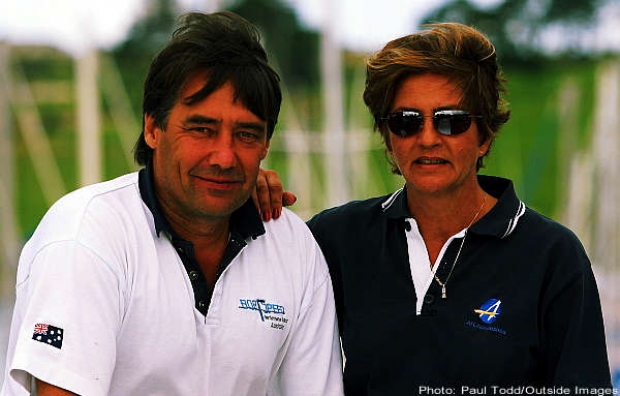
The company was set up in 1986 by Peter and wife Sari Ullrich, both qualified shipwrights and race boat sailors. Peter Ullrich is also a qualified naval architect
Since 1986 they have built many Sydney-Hobart winners such as the Farr 47 Ninety Seven and George Snow's two Brindabella maxis. They have also been heavily involved in the 18ft skiff circuit in Sydney, building various designs by Ben Lexcen and the Bethwaites.
In 2000 they built the Hugh Welbourn designed 50 footer Heaven Can Wait and as a result of this Welbourn recommended that the construction of the new Bols maxi should take place at the new Boatspeed yard.
Sari Ullrich says they spent 15 years planning the new facility. “It was like Christmas putting it together.”
Central to their set-up is a 170ft long by 24ft tall and 36ft wide oven. This clearly impressed Bols skipper Gordon Kay. "To give you an idea when they cooked the boat [ Bols], the biggest temperature variation in this massive oven was just under 2 degrees and it was warmer at the bottom than it was at the top, because the fans were that good".
According to Peter Ullrich the oven can also legally double as spray booth as it can circulate up to 30,000lt of air per minute.
Aside from this the Ullrichs managed to secure a research and development grant from the Australian goverment that allowed them to spend 4.5 years developing their own in house pre-impregnation technique called Custom Preg.
Custom Preg is based around a computer driven machine that dictates the level of wet-out of the cloth passed through it. In the construction of sandwich boats this can be used to increase the amount of resin held in the cloth on the layer closest to the core to ensure optimum adhesion. Equally the wet out can be reduced on the outer layers where shear is not so much a problem.
Impregnated carbon can come out of the machine ready for immediate lamination. "We have two days working time and we can put the stuff in the fridge for three weeks, but as soon as you do that - and that is a problem with proprietary pre-pregs - you put it in a fridge and cool it down, take it out - it gains humidity and you get dew on it," says Peter Ullrich, adding that this is the prime cause of skins blowing off Nomex as the laminate is cured (as experienced by Peter Goss' Team Philips).
Lessons learned the hard way and because carbon, foam or Nomex core materials and the resin have to be sourced from three different suppliers, none of whom will guarantee the other's products, have led the Ullrichs to have a healthy degree of paranoia about their build methods and given them the desire to develop maximum control over the process. "We are totally confident in our shells," says Peter Ullrich. "It is a lot more work for the builders and it is not a cheap alternative to regular pre-preg, but it is far more controlled and if you are prepared to put in the time the product is so superior."
Another advantage of their build technique is that it doesn't necessitate the use of high temperature curing. "We’re curing our boats at 60degC," says Peter Ullrich. "Most pre-pregs are high temperature cures and for example, the foam cores have a do-not-exceed temperature of 85 degrees, while the pre-pregs cure at 85degs, so you are working inside of a fine line. Besides at 85degC your tools can deform badly."
In addition to this their system allows some slip in the laminatation process "which you don’t have with proprietry pre-pregs," explains Peter Ullrich. "This means you can compound it and you don’t have any folds or creases."
Bols was the first big project Boatspeed have taken on at their new facility. The maxi was constructed over male plugs in uni or bi-directional carbon fibre using PVC and Airex foam core of 30mm in the hull and 15-20mm Nomex in the deck. Aware of the problems associated with foam cores shearing in areas of high impact, Airex was used in the front section of the boat to add flexibility.
"PVC foam in big panel areas did suffer core shear," says Ullrich. "It is almost a fatigue issue. We had a boat that did suffered core shear in the bow. That was a PVC core that appeared to have got to the end of its flexible service life. We did a quick repair and it hasn’t been a problem since. Linear foams [such as Airex] have really good fatigue and flexibility values. There was a time when we had designers who were questioning the value of those cores because PVC core is naturally more rigid and rigidity in a boat is considered a bonus by designer, but you have got to have some pliability and a really stiff boat suffers badly. We have since seen big carbon boats where the frames were jumping out of it and that was because they were too rigid."
Outside skins of
Bols were around 2mm thick, and 1.8mm inside. A single Kevlar skin was laminated into the slamming area forward for impact resistance.
Interestingly Ullrich says that in his experience scantlings for boats built for the northern hemisphere are often not man enough to withstand a Sydney-Hobart. "We find that every boat we build needs to have some form of reinforcement in the area forward of the mast. There are some boats we have built to Northern hemisphere scantlings where we have asked the owner if they are going to do a Hobart Race. If you do a Hobart race you are sure you are going to get a hammering, so we have asked designers to put in extra frames and skins as a matter of course - but this boat [
Bols] certainly doesn’t need it."
Ullrich says that through experience, particularly building 18 footers to the absolute extreme, they use Nomex with caution. "We ended up doing balsa cores in the 18 footers because it was more reliable than the Nomex."
An obvious market for Boatspeed to move into with their new oven is superyachts particularly as developments in composite building no longer make it essential to build in alloy or steel the larger you go. "The sky is the limit with composites now," explains Ullrich. "They are heaps quicker, they use less fuel and the lifespan of the hull is longer than alloy. You also get electrical issues with alloy boats, plus service and paint issues.
However despite the price of carbon fibre coming down dramatically, he admits that it is still around 10-15% more expensive to build in composites because it is a harder to set up a 'production line'. "If you build a big alloy boat you go to Huismans, where there's a metal shed, paint shed, fit-out shed - you can’t do that with a composite boat. You are still working with buckets of resins three days before the boat goes out of the door. It is a one piece component when it is made out of composite and it can’t be good in a production boat format."
Businesses

Pro businesses
-
Netherlands
-
Italy
-
United Kingdom
-
United Kingdom
Editor's choice
Member blogs
-
 Ned Collier Wakefield: MOD70 round BarbadosWell that was intense. 12 hard fought for seconds for the win. In idyllic conditions, Tony Lawsons MOD ...
 -
 Mini Transat leg 2 reportThe second leg of the Mini Transat started on 31st October, just over a month after ...
 -
Leg 1 reportI’ve been working towards the Mini Transat now for three years. In 2013 I was part ...
Business blogs
-
 The Island Sailing Club in Cowes, Isle of Wight, is delighted that Prince Michael of Kent ...
 -
Peta Stuart-Hunt chats with the 25 year-old British solo sailor Lizzy Foreman before she sets sail ...
-
The 2015 Student Yachting World Cup (SYWoC), an ISAF-recognised event hosted and run by students for ...
Editor's Choice
-
 Three legs down into Ian Walker’s
 -
 Winning all but two races at
 -
 For the first time in its
Latest Comments
Add a comment - Members log in