

Singleminded and singlehanded
Wednesday March 19th 2003, Author: James Boyd, Location: Australasia
New Zealand as a sailing nation may be top of the pile in the America's Cup and the Volvo, but when it comes to singlehanded offshore racing their experience is limited. However, as ever, there is one exception.
We first encountered Chris Sayer at the start of the 1999 Mini Transat. With his lanky frame and spectacles he ressembled a white collar worker on his day off while having an impressive amount of aloofness and stubborn singlemindedness, more akin to European solo sailors of 20 or 30 years ago. Even four years ago singlehanded ocean racing in New Zealand was considered swimming against the stream and Sayer bore all the trademarks of an outcast.
Alongside the sexy looking Finots and Lombards, his boat Navman appeared to be a pig. She was designed by John Welsford better known for his kit-built boats, yet Sayer had sailed her and sailed her in the harsh conditions around New Zealand and was completely familiar with her. Sayer proceeded to confound race pundits by finishing the singlehanded transatlantic race third against some tough competition.
He sold Navman at the end of the race and returned to France in 2000 to race the Figaro class' two handed Transat AG2R with fellow Mini-ist Yannick le Monnier.
"It was interesting, but I am not a one design sort of person," admits Sayer of his Figaro racing experience. "It was good to have sailed against all my heroes - Isabelle Autissier, both Poupon brothers, Alain Gautier. It was quite daunting in fact, but great." They finished the race 13th out of 30 starters, significantly ahead of Autissier and Erwan and Patrick Tabarly (brother of Eric).
With his success in Europe under his belt Sayer returned to New Zealand intent on getting an Open 50 campaign together for Around Alone and ultimately the Vendee Globe. He worked with Auckland-based designer Brett Bakewell-White on the concept for a boat, but in a country so unfamiliar with singlehanded offshore racing as New Zealand, he was unable to secure sponsorship.
"I think most people down here look at it and think 'it’s too hard'," says Sayer on why solo ocean racing has yet to catch on in NZ. "A) it is a lot of money and b) it is a small boat to go offshore. But maybe some of the younger people that are up and coming will tend to look at it a bit more seriously now. They’ll no longer just get laughed at, which was certainly the case when Navman first went in the water. Too radical. Too difficult. It’s perfectly normal for France, but with the big swept spreaders all the way out to chainplates at the gunnel, people would just shake their heads and laugh. Then Around Alone came here (the race before this one) and a little while later everyone’s doing it."
Sayer was forced to moderate his program, opting instead to build another Mini, but this time a state-of-the-art one. Another Bakewell-White design, hull number 403 was called Up The Blue after a book Sayer's grandfather had just had published about serving in the army in Africa during WW2.
" Navman was a very very cheap boat," admits Sayer comparing his two Minis. "There were three key areas for me to improve on. We wanted a lighter boat. Navman was built with a cedar and fibreglass. The new boat is carbon fibre, everything is vacuum bagged with a foam core. The second thing was the rig. Navman had a very heavy mast section with wire rigging. This time we are nowhere near the rule minimum, but we are all rod rigging and we’ve paid a lot more attention to detail in the rig.
“Finally there was my pilot system," Sayer adds. "In 1999 Sebastien Magnen [the winner of that year's Mini Transat] spent about $10,000 on his pilot system. I had a little $750 off-the-shelf pilot. Basically all the boats had rate gyros, etc etc. I couldn’t leave the boat to sail downwind, the pilot could hardly cope downwind without a kite up, let alone with one. And now Navman are finally building pilots and it’s pretty good.” Aside from this he says the rest of the improvements are just refinements.
A boatbuilder by profession, Sayer took on the construction of Up the Blue himself in his spare time. The build started in April 2001 and the new boat was launched at the beginning of 2002. Her first big outing was when Sayer and Rob Neeley took part in the two handed Round North Island Race.
Despite being the smallest boat in the race by some margin they had good racing against the larger Young 11s and won it on PHRF. In the breezy conditions they hit 24-26 knots fully reefed main and a storm jib - not bad for a 21 footer.
Sayer then sailed the boat singlehanded to Sydney to race the two handed Sydney-Auckland race. Unfortunately during the race they lost the rig the second night out when the hook on the D1 failed. They recovered the rig and sailed back to Sydney under jury rig.

Back in harbour Sayer cut out the broken section of mast, rejoined it and set off again singlehanded. But disaster was to strike again.
400-450 miles off the coast of New Zealand at 11pm the boat suffered a collision with an underwater object that ripped out the keel. Remarkably the boat stayed upright and gingerly Sayer sailed on - turning back and heading downwind to Australia with a depression brewing he felt wasn’t a seamanlike option.
But the following afternoon about 300 miles from New Zealand the inevitable happened as the boat turned turtle. “Probably my mistake was not cutting the rig down," Sayer admits. "I should have chucked the whole rig over the side, lowered the centre of gravity and jury rigged with the boom. We’d been sailing alright without the keel, but it was a building breeze and building waves…
"Once we were upside down it was all over basically. It was too far to paddle! The boat stayed watertight for a while because it was quite bumpy, but one of the support tubes for the solar panel snapped off and we had a 2in hole in the boat and I didn’t discover where the water was coming from until after I got out."
Sayer stayed inside initially and then sat on the upturned hull for quite some time when the boat was filling up with water. There was floatation inside and, of course no keel to pull her down. “There was no chance of her sinking, but sitting in a boat pretty full of water was not great and sitting on the bottom of it with waves breaking over you wasn’t great either…”
Just after dark he was spotted by an Orion reconnaissance plane and 13 hours from turning on his EPIRB he was plucked to safety by a Taiwanese fishing vessel, his boat abandoned.
On board the fishing vessel Sayer believed his singlehanded career was over. The boat of course was uninsured. "I didn’t think there was any chance of me mounting another campaign having just spent my life’s savings and everything I had - $90,000 plus 2,500 hours and $20-30,000 worth of gear off Navman. So I thought it was game over for me. It wasn’t until I got back that I discovered so much support had come in and I decided to go for it again.
“It was pretty unbelievable really,” says Sayer of the support he got. “All the same people that have helped before that have been behind us since Navman days have supported us again to a greater extent because obviously I was a bit broke…”
Last September Sayer embarked on the construction of Up The Blue v2 at the Vauderay Miller boatyard in Henderson, just outside Auckland. This time he worked on it full time. He says the boat is more or less identical to the previous one.
Annoyingly the male plug for the boat had been broken up. "That was about $7,000 and 4-500 hours to build the deck and hull moulds again," says Sayer. Fortunately he still had the moulds for the rudders and keel. He points out that moulds are available free to use for anyone who wants them. One person to take up this offer was Amer Sport Too bowman Liz Wardley and the two joined forces, building their boats in tandem at the yard,
Sayer’s boat was launched three weeks ago and when The Daily Sail visited him he was working at Southern Spars finishing the mast - unusual these days for the Auckland uber-spar manufacturer to be building a mast so small and in alloy (carbon is not allowed in Mini rigs).
Once the two boats are complete he and Wardley will be doing a lot of sailing including carrying out their qualifier prior to shipping their boats to France. There then remains the possibility that they still might not get a place in this year's Mini Transat due to the high demand for places. "I don't know what you're meant to do about that," says Sayer. "I'll be there. I'll be ready on the start line. If they haven't got a spot for me, well I guess I'll have to go for a sail by myself across the Atlantic. But I'm not doing all this work and preparation and then not go."
Money is still very tight. "I live in a caravan out the back of the workshop and I don’t eat too much. Yo
u get by - you scrimp and you scrape.” However Sayer is adamant he will be in France. If Sayer could finish the Mini Transat third in Navman then he is sure to be a line honours contender in his new beast.
The boat
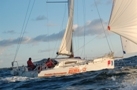
Sayer's new Brett Bakewell-White design is a typical wedge-shaped Mini, although not quite as fat in the stern as some of the French design. She has an enormous articulating bowsprit, a canting keel, twin asymmetrics daggerboards and twin rudders.
Unusual is the foil for the canting keel which is angled forwards. "It is no difference when you're sailing the boat," says Sayer of the keel system. "The only difference is your lateral resistance is slightly further aft your centre of gravity is where it needs to be still and the top of the keel is under the cockpit instead of in the middle of the boat. It means all the keel control lines come up through the cockpit sole. If there is any water penetrating below goes into the keel case."

Not having the top of the foil and its tackle in the main part of the already cramped interior, will make life down below easier. Between the cockpit sole and the hull there is a watertight V-shaped compartment in which the keel and its canting mechanism are housed. The keel cants by 28degrees to achieve the 10degree static heel angle allowed under the Mini rules.
One interesting development made on the original Up The Blue, but which Sayer says will not be on the new boat, is the unusual forward facing strut to ‘pole’ out the top of the jib (see photo below). Sayer says it was a good idea, but gives the impression it didn't work too well on the Mini.

Obviously the boat is a substantial improvement over his 1999 boat. "It is considerably faster than Navman was," he says. "But it comes down to the same old same old. It is not boat speed so much as reliability and reliability. Navman was a pretty quick boat but it was by no stretch of the imagination the fastest boat especially in the light airs downwind which we had a lot of in the second leg. But it was reliable and I knew it.
"That boat [Navman] was a little bit deceptive. Any boat which you can average 19.5 knots for an hour in isn’t a slouch. In the right conditions it was absolutely ballistic. It's weakness was light airs flat running. We'd overcome that a bit with our sail wardrobe. It was certainly a lot heavier than everyone else’s, but I knew it very well and it was reliable. And that is going to be key with these new boats which is why I would like to get a lot of miles in before the start. Time and time again that pays dividends. You don’t need the newest and flashest boat - you need a good boat which is reliable."
You heard it from the man...
Tomorrow we talk to designer Brett Bakewell-White
More detail photos of Sayer's Mini on the following two pages


Most Read
Most Commented
Comments
Businesses
Pro businesses
-
-
United Kingdom
-
United Kingdom
-
United Kingdom
Editor's choice
Member blogs
-
 Ned Collier Wakefield: MOD70 round BarbadosWell that was intense. 12 hard fought for seconds for the win. In idyllic conditions, Tony Lawsons MOD ...
-
 Mini Transat leg 2 reportThe second leg of the Mini Transat started on 31st October, just over a month after ...
-
Leg 1 reportI’ve been working towards the Mini Transat now for three years. In 2013 I was part ...
Business blogs
-
 The Island Sailing Club in Cowes, Isle of Wight, is delighted that Prince Michael of Kent ...
-
Peta Stuart-Hunt chats with the 25 year-old British solo sailor Lizzy Foreman before she sets sail ...
-
The 2015 Student Yachting World Cup (SYWoC), an ISAF-recognised event hosted and run by students for ...
Editor's Choice
All time favourites...
-
 Three legs down into Ian Walker’s
-
 Winning all but two races at
-
 For the first time in its
Latest Comments
Add a comment - Members log in