
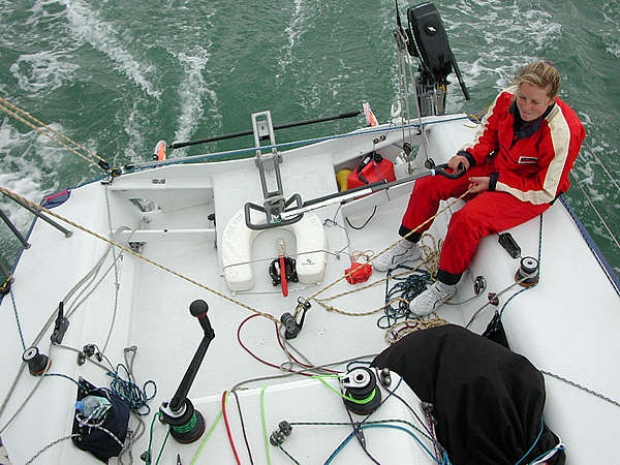
Sam Davies - back in her Mini days
Sam Davies on the Doldrums
Tuesday October 7th 2003, Author: James Boyd, Location: Transoceanic
Sam Davies took part in the Mini Transat two years ago aboard Andrew Cape's
Aberdeen Asset Management. Here Sam, who will be passing through the Inter-Tropical Convergence Zone (or Doldrums) again in November when she and Nick Moloney sail this course aboard their Open 60
Team Cowes in the Transat Jacques Vabre, recounts what it is like aboard a considerably smaller Mini.
"Horrible’ in a word!" she says of the experience generally. "Because you have no information so you can’t sail through the narrowest part of the ITCZ. You have a bit of information if your SSB is working, if you can receive Monaco radio. They do a special broadcast for the Minis and concentrate on the area where the fleet is. At the Doldrums they are quite specific about where the lines of squalls are both north and south of the ITCZ, how many miles of squalls you have to pass through, so they give you a northernmost and a southernmost latitude. Radio France does a bit of information, but Monaco Radio is much better.
"So you’ve got that, but because the boat is going so slowly you can’t really use it for any routing purposes. So you go with the plan you had at the beginning and you just hope that you sail as quick as possible. And even with the squalls you see coming across, because the boat is pretty slow you can try and get to the right side of them or get to the windier section or get out of the windier section, but really they are travelling too quick for a Mini to make much use of. You just have to take what you get and that’s that."
On bigger faster boats such as Team Cowes it is possible to play the squalls - to sail into them if they are windy or avoid them if they are not. "It depends upon if they are sucking or blowing clouds," says Sam. "Different people say different things, but you have to look at them and try and work out which you’ve got. The best is to try and stay in them as long as possible if they have some breeze. In the Doldrums when I did the Mini I got stuck in a cloud going the wrong way. It wasn’t a squall. It was right in the no-wind area. There were no squalls there. There were just these clouds with zephyrs in them and the swell was such that the only direction I could go was the direction that the cloud was travelling in which was northeast, whereas I was wanting to go southwest at the time. And I stuck with this cloud for three or fours hours before I realised that I just had to stop and let it go past and get the real wind. So I pointed it in the other direction but where there was no boat speed and the cloud sailed off and I eventually got into better breeze.
"So it depends. If they are squall clouds they are good because they have got wind in them and as long as they don’t wipe you out - which happened a few times as well and by the time you’ve sorted yourself out the cloud has gone and you’ve got three reefs and a storm jib and there’s no wind! Another thing about a Mini is they are so light. In a bigger boat normally if a squall hits you can bear away but you can send it and you might be going slightly low but you are sending it so you are going really fast whereas in a Mini you generally can’t get away with just bearing away - you just get flattened before you get a chance to bear away. So there is a bit of action..."
As Jonathan McKee said of his strategy for tackling the Doldrums prior to the start of leg two, Davies says that she came up with a plan with Andrew Cape, currently one of the navigators with Alinghi, who sailed the Mini in 1999.
"You know it is generally better to be in the west. The further west the narrower the band is and so there are two trains of thought - one is go direct and the other is head west but with the trade winds if you head west you are sailing low and slow. When I did it the ones for whom it paid off were those who sailed high because they got away with it, when they reached the ITCZ there was no ITCZ even east and they got there fast and got through quickly and then it [the Doldrums] developed as the people who sailed a bit more conservatively arrived. So the choices are go west to avoid the no-wind zone or stay on course and get what you take."
Aside from having to deal with psychology of going slowly and having to remain focussed when you are pulling your hair out, the Doldrums hold other delights: "It is horrible in a Mini because there is so much rain there and you think 'doldrums, tropics, sunny and nice and hot' but I was actually wearing thermals most of the time and oilskins half the time because it just rains and rains and everything is wet inside the boat and outside but it is not that cold, so everything smells. So it is disgusting and uncomfortable. When I was there the sun never came out, but there were some amazing sunrises and sunsets because of all the clouds and squalls.
"It was the hardest bit of the race for me and you were going so slowly you could see the fish swimming past faster than you. There are loads of fish there just jumping around. And you are going really slowly and you think you are going to be stuck there forever and you’re never going to get any wind to get out of there - there are going to be barnacles growing on the bottom because I’m not going anywhere..."
So spare a thought for the 66 Mini sailors tackling this at the moment...
Most Read
Most Commented
Comments
Businesses

Pro businesses
Editor's choice
Member blogs
-
 Ned Collier Wakefield: MOD70 round BarbadosWell that was intense. 12 hard fought for seconds for the win. In idyllic conditions, Tony Lawsons MOD ...
 -
 Mini Transat leg 2 reportThe second leg of the Mini Transat started on 31st October, just over a month after ...
 -
Leg 1 reportI’ve been working towards the Mini Transat now for three years. In 2013 I was part ...
Business blogs
-
 The Island Sailing Club in Cowes, Isle of Wight, is delighted that Prince Michael of Kent ...
 -
Peta Stuart-Hunt chats with the 25 year-old British solo sailor Lizzy Foreman before she sets sail ...
-
The 2015 Student Yachting World Cup (SYWoC), an ISAF-recognised event hosted and run by students for ...
Editor's Choice
All time favourites...
-
 Three legs down into Ian Walker’s
 -
 Winning all but two races at
 -
 For the first time in its
Latest Comments
Add a comment - Members log in