
Sprit-tastic
Wednesday January 7th 2004, Author: Andy Nicholson, Location: United Kingdom
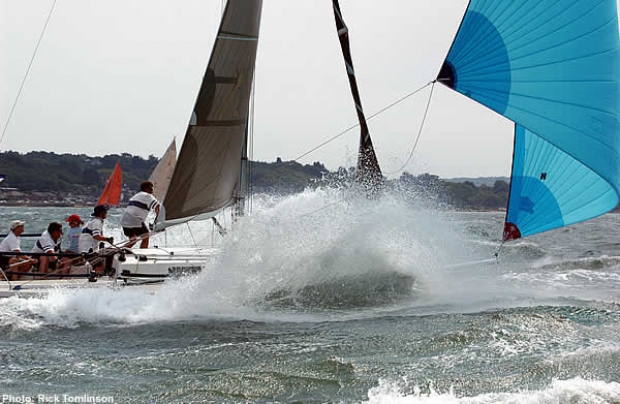
Bow sprited J Boats have been around for a number of years, but now more than ever they seem to have found a very solid niche within the market. The Daily Sail caught up with Paul Heys of J UK who ran through the current range and what the prospects look like for the year ahead.
Centrepiece of J UK stand at the Schroders London Boatshow will be the new J133, it will be the boats European debut. This hasn’t deterred four existing British J Boat owners who have already put their orders in.
It owes much of this demand to the smaller J109. The 35 footer has been incredibly successful, launched in 2001 there are now 160 boats worldwide. 27 of these are in the UK, with another eight due for delivery by the end of April, and are spread around the country with eight in the Irish Sea, five in Ireland and three in Wales. The biggest fleet is on the south coast with others in the Channel Islands, East Coast and Scotland.
The J109 has also done very well in Europe and Heys is hoping that some international racing will be on the cards in the coming year. France and Holland both have a number of boats, paving the way for some one design class racing.
So why has the J109 become so popular? Heys says that a lot of this is down to the design being the first of the J range where the designers have cast their eye over the IRC rule. Heys maintains that things like spinnaker size and weight have been restricted: “They haven’t gone extreme in areas that would be penalised by IRC”
This strategy has paid off handsomely, with the J109 appealing to a wide audience of owners and delivering some excellent results under IRC. Jonathon Goring has taken his Jeronimo to overall victory in RORC’s Class Three with four wins in four races, including the Fastnet. At Spi Ouest in France the top three spots in class were all taken by J109s. The boat has also proved successful in the short handed arena, with victory in the double handed Round Britain Race going to a J109.
Heys explains a little more about what makes the boat tick for owners: “Every boat does some racing and most boats do some cruising. The classic owner profile is someone who would do Cowes Week, the J Cup, The Round the Island - which they’ll be pretty serious about - and then they will do a two week cruise in France for the summer holiday. It’s a proper duel role boat.”
Heys says that the owners come from a diverse range of sailing backgrounds. Some trading up from sportsboats, like the 1720 and J80, others trading down - plus an influx of new people too.
 The new J133 (left) has already won Sailing World magazine’s Overall Boat of the Year and looks to have just a bright a future as the J109. The boat has a fully fitted interior, with either a six or eight berth layout. The sailplan uses non-overlapping jibs on a furling drum and, of course, an asymmetric spinnaker on a bowsprit. The mast is carbon fibre from Hall Spars, there is also a facility for an additional inner forestay if required offshore of for cruising. Length is 13.11m (43ft), beam 3.9m and draft 2.29m. Price is in the region of £230,000.
Next on the list of J boats is the J105 (below). This has attracted a range of experienced owners including ex Mini Transat sailor Simon Curwen and Malcom Jakes, an ex Laser 5000 National Champion.
“It is an extremely good boat if you don’t wan to go cruising on it as the headroom is a bit restricted” Continues Heys, “If the breeze it up it planes really nicely.”
One owner has had four J 105s and maintains that this is the perfect boat for him. This year the J105 nationals will be held in Seaview on the Isle of Wight.

The smallest bowspritted J is the J80, which is very strong in France, Germany, Sweden and the US. New boats are being built at the rate of 130-140 per year. The British fleet is mainly centred in the South West. The French fleet has just been boosted with the French navy putting in an order for 55 new boats, these are to replace it’s ageing fleet of Surprises that are used mainly for Cadet training.
Demand still exists in the UK, but not necessarily for new boats. “The second hand market very strong and we have a waiting list of seven or eight people for them.” Says Heys.
The little J is also ISAF rated, and had been used for the ISAF Sailing Games. It attracts top helms for events like the Worlds, last years was won by John Kolius.
 Heys explains why the J80 stands out from the sportsboat crowd: “The J80 is the only 26 foot sportsboat that is category B rated, which means that it’s very capable. It has the stability and safety features that mean you can race it across the channel if you wanted.”
J Boats have reorganised slightly with a new company called J Boats Europe that is responsible for building all the range in France. This, Heys says, will improve the quality and delivery times. TPI continue to build the boats in the States and J Boats Italy look after the classic J24 and J22. Five new J24s have gone into Ireland in the last six months.
A feature of J racing in the UK has been the emergence of the ‘J Sprit’ class at several events. The class starts at 30 foot and so eliminates the bowsprit sportsboats from the equation. “Our owners are always racing against other J’s which they prefer,” say Heys. “If it ends up with an all reaching or all running course then it doesn’t matter as they are all bowsprits.” This J Sprit class will appear for the first time at Cork Week this year. Heys expects a large turn out, similar to Cowes week last year where the J boats were the biggest IRC class with 36 yachts racing.
Alongside Cowes and Cork, the J Cup in September will be another big event for J owners. It will be held out of Hamble and the Royal Southern Yacht Club will be running the racing.
For Heys the Schroders London Boatshow is an important event in the boat sales dairy. He is cautious about the move to Excel but also feels supportive of it. “We have to hope that Excel proves as popular as Earls Court” says Heys. “I have spoken to a lot of customers of the past few weeks who weren’t aware the boatshow had moved. Clearly they [the British Marine Federation] haven’t done enough marketing.
However it does have its benefits. “The Irish very pleased as they have all got cheap flights into City Airport. There’s no doubt it will open up the East Coast, and there will be plenty of people working in Canary Warf and the City who will come over to the show.” Says Heys.
Heys does see a couple of drawbacks for exhibitors. This includes all the effort going into securing a good spot for you stand. Secondly will be the lack of mast space for yachting exhibitors. “If you take a J133, it’s a boat that is going to cost £230,000. Of that £50,000 is in the carbon fibre Hall Spars mast. So we’re not even going to have the mast there.”
“We worked very hard over the years to get a prime spot at Earls Court [next to Guiness stand…]. Now everything has changed and we don’t know what is a prime spot anymore. We are certainly at the very far end of the hall away from the Guiness stand, so whether that is a blessing or not I’m not sure. But we’re certainly going to need some sort of rickshaw service to fetch our Irish customers from their embassy to our stand, otherwise it’s a long walk!” concludes Heys.
Most Read
Most Commented
Comments
Businesses

Pro businesses
Editor's choice
Member blogs
-
 Ned Collier Wakefield: MOD70 round BarbadosWell that was intense. 12 hard fought for seconds for the win. In idyllic conditions, Tony Lawsons MOD ...
 -
 Mini Transat leg 2 reportThe second leg of the Mini Transat started on 31st October, just over a month after ...
 -
Leg 1 reportI’ve been working towards the Mini Transat now for three years. In 2013 I was part ...
Business blogs
-
 The Island Sailing Club in Cowes, Isle of Wight, is delighted that Prince Michael of Kent ...
 -
Peta Stuart-Hunt chats with the 25 year-old British solo sailor Lizzy Foreman before she sets sail ...
-
The 2015 Student Yachting World Cup (SYWoC), an ISAF-recognised event hosted and run by students for ...
Editor's Choice
All time favourites...
-
 Three legs down into Ian Walker’s
 -
 Winning all but two races at
 -
 For the first time in its
Latest Comments
Add a comment - Members log in