
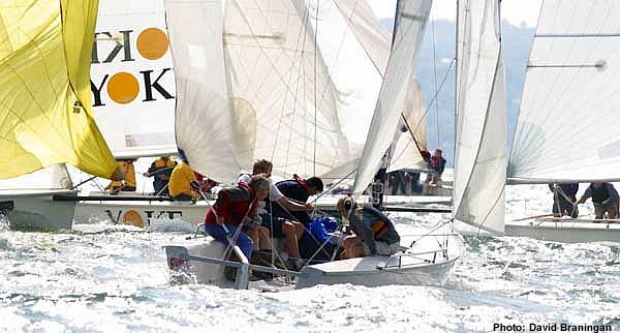
1720s at pace
Friday December 19th 2003, Author: Andy Nicholson, Location: United Kingdom
The 1720 is a boat that will be very familiar to our Irish and British readers. With over 150 boats now sold this 8m long sportsboat is very strong in both countries and because of its performance and unique sit-in arrangement for the crew is hugely popular with those that sail in the class.
Key Yachting, the distributor of the boat in the UK, has recently bought the building rights for the boat and has announced a range of developments, both for the class and how it will be marketed abroad. The Daily Sail caught up with Key Yachting’s Paul Heys, who explained the background, the changes and the future for the 1720.
The most significant change will be the introduction of a Club version. This will have reduced sail area, a jib furler (normally the jib is on hanks), and a reduced crew limit.
While a majority of the boats sail in one-design fleets, there are boats dotted around UK and Ireland that race under IRC or the Sportsboat Rule, and struggle to find a regular crew of five or six to race it.
“We have had a lot of feedback from owners,” says Heys, “especially in the regions where there are not enough boats to sail one design. They are sailing to handicap on round the buoys courses, which often means reaching, and the standard 1720 with it’s large masthead kite and hanked on jib can be a bit of a handful if you are shorthanded on shy reaching courses.
“It’s designed as a one design beat and run boat, once you shy away from that it’s pretty hard work. So the owners are asking for a version of the boat that they can sail in club fleets at home with three or maybe four people. Less sail area, take some power out of it, and then they can upgrade to the normal spec when it comes to the nationals or any big regatta.”
The bowperson’s role on the boat was identified as a key position that could be simplified. Heys says that this is the biggest specialist job on the boat as the jib has to be dropped and the spinnaker sheets cleared over the hanks before you can gybe. The new Club version will have a Harken furler fitted, so no perilous trip up the front.
More significantly the sail plan will be reduced. The addition of a furler results in a 10% smaller jib - which is then easier to pull in. The mainsail area has been reduced and the Club version will have one fractional asymmetric spinnaker.
The mainsail reduction, which takes about 10cm off the roach off the sail, has a big impact on the IRC and sportsboat rating, as it is usually penalised.
Heys explains the thinking behind the spinnaker choice: “The reason for using the fractional halyard is to prevent the boats tendency to lay on its side if you broach. With the masthead kite in 25 knots of wind you have to let the halyard fly to get the boat back up on its feet. And if you have a short crew, or a weaker crew in terms of confidence and experience that’s quite a tough call to make. With the fractional halyard, you just let the sheets go and the boat will come back up, like any other keelboat.” The sail will be in size, slightly larger than the standard fractional sail.
Most of the development decisions behind the new Club version have been conducted in-house, with key input from Jochem Visser who has sailed the boat extensively. Key Yachting has also been advised by four of the most prominent sailmakers in the class: North, Hyde, UK and Sobstad.
Input from owners has also been taken on board, but Heys says that someone had to take the decision: “It’s not a committee decision, because we have to be a little bit dictatorial about this, it’s the best way to make things happen.”
The new sail package will only be available from one or maybe two lofts. “Probably one of the most contentious areas for the Club class has been the decision to make the sails one design from one sailmaker” explains Heys. “We have done that because we don’t want to fire off another arms race for sails in the Club class boat. It should also have a significant effect on the cost. We have asked the four most prominent sailmakers to tender for the class and it will be a cost based decision. Because we feel that cost is the key for that particular package.”
The Club version then produces a stepping stone into the class, with an owner just needing to put the wire forestay back on, get some big sails (or even put them back on) and a couple of extra crew to get into what will now be called the Classic trim.

It's at this stage of the race that the new Club rig will help smaller crews
Heys says that it is hoped that this will rejuvenate the 40 or 50 boats that he reckons aren’t sailed very regularly. This may be with existing owners having a route back in through the Club trim, or new owners, who can pick up a second hand boat and buy the Club package, which he thinks will cost between £12k and £15k depending on the boat they find.
Tony Castro originally designed the 1720 back in 1993 after he was contracted by a small number of experienced racing owners from the Royal Cork Yacht Club (which is the oldest yacht club in the world, founded in…1720), who wanted a sportsboat to race locally. After it’s Cork Week debut in 1994, interest was such that the design went into full production.
Key Yachting are now keen to inject some new life into the design, which they can now do as they own the building rights. First up is a new deck mould; this has some detail changes, which include a toerail on the foredeck, a new rudder post design and simplified storage access for the outboard motor. There are also a number of smaller detail tweaks. Heys says that this should help sell some new boats, something that was very slow this year. A new production run has been started (using the same builders in Ireland) and the first of the new style 1720 will be on display at the London Boat Show.
Heys has been involved in selling the 1720 since the early days and will now be implementing a new commercial structure to market the boat. He is in the process of putting the Irish agents in place and also has European distribution coming on line, in France, Holland, Germany, Austria and Italy.
“That’s a weakness of the class, it needs more international boats, so we can get higher numbers at events” says Heys. “It has never been shown at an international boat show, never been advertised in a foreign magazine.”
Across Europe the 1720 has a number of competitors, notably the Melges 24 and Beneteau 25. Heys maintains that the boat “still has a niche within the market, because it is a sit in boat with good stability and top performance.”
With the prospect of some ‘foreign’ fleets the door is opened to introduce some regattas abroad. “We have a pool of owners who every year ask for an event to be organised at a glamour overseas destination.” Heys continues, “And I am sure that will happen, maybe in 2004, but definitely in 2005.” The prospect of 50 odd boats turning up to Garda for a championship is certainly one The Daily Sail warms to.
Depending on how the Club class boat takes off, it is their intention to run two fleets at the Europeans next year, as Heys explains: “The existing 5-6 crew, high level class in the regular 1720 - then an owner driver, smaller crew, one design sail package, for the Club class, so there will be a good differentiation.”
The circuit looks to shaping up well next year, with four main events happening over the summer, in a sort of British Isles Tour. First up is the UK Nationals at the beginning of July in Milford Haven, South Wales - which is very much growing fleet with two boats sold there in the past weeks. The Class association are organising the delivery of the boats from Milford over to Ireland for Cork Week, which runs from the 10-16 July and famously attracts a huge 1720 entry.
Boats can then be taken north to Belfast for an event on Belfast Lough before heading back across the water at the end of August. Largs in Scotland is hosting the Europeans from 31 August to 4 September.
Included in the year’s fixtures are Spi Ouest regatta in France during April, the Bell Lawrie Scottish Series in May, Round the Island Race and Skandia Cowes Week in August. There are also a number of weekend events throughout the year for one design class racing.
The Europeans will again be the major regatta for the year and historically attracts a very hot fleet. At this stage Heys is unsure whether Volvo Ocean Race CEO Glenn Bourke will defend his title. “The last four or five Europeans have had a very high standard, the top 20 especially. In the past Ben Ainslie has won it, Shirley Robertson and Dean Barker have also competed,” says Heys.
The detail changes to the boat, the introduction of the new Club class, new International marketing and a very strong looking calendar of events for 2004 look set to make the 1720 class stronger than ever.

Most Read
Most Commented
Comments
Businesses

Pro businesses
Editor's choice
Member blogs
-
 Ned Collier Wakefield: MOD70 round BarbadosWell that was intense. 12 hard fought for seconds for the win. In idyllic conditions, Tony Lawsons MOD ...
 -
 Mini Transat leg 2 reportThe second leg of the Mini Transat started on 31st October, just over a month after ...
 -
Leg 1 reportI’ve been working towards the Mini Transat now for three years. In 2013 I was part ...
Business blogs
-
 The Island Sailing Club in Cowes, Isle of Wight, is delighted that Prince Michael of Kent ...
 -
Peta Stuart-Hunt chats with the 25 year-old British solo sailor Lizzy Foreman before she sets sail ...
-
The 2015 Student Yachting World Cup (SYWoC), an ISAF-recognised event hosted and run by students for ...
Editor's Choice
All time favourites...
-
 Three legs down into Ian Walker’s
 -
 Winning all but two races at
 -
 For the first time in its
Latest Comments
Add a comment - Members log in