
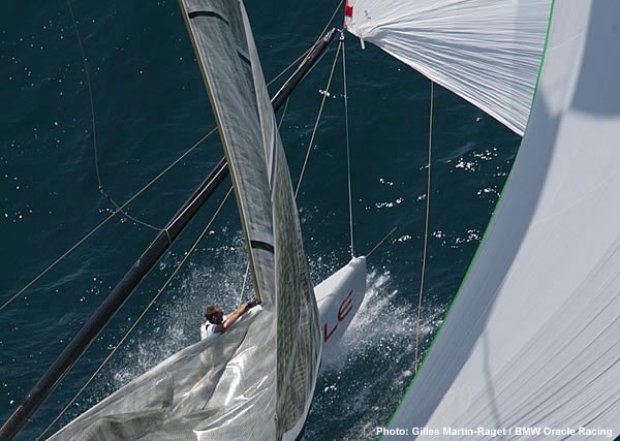
The coolest guy on the boat
Friday May 18th 2007, Author: Andy Nicholson, Location: United Kingdom
After the skipper, the bowman is the most sought after catch on a boat for racer chasers. He may not have a similar sized wallet, but he makes up for that in straight forward coolness. Among their strong union being an America's Cup bowman such as BMW Oracle Racing's Brad Webb certainly means that you have coolness in spades.
Webb first worked on Chris Dickson’s team in 1995 as part of his TAG Heuer campaign. At 22 years old he admits he was "extremely green". 10 years on he is the number one bowman choice for Larry Ellison's mighty San Francisco team. That was until Monday this week. Being tough does not come without risks and Webb suffered knee ligament damage during a leeward mark rounding in the first race of the Louis Vuitton Semi Finals.
Now that is hard. When we spoke to him prior to that Webb enthused about how much he was looking forward to the racing and how the four years of hard graft was about to play out in tense, exciting matches. Our wishes go to Brad for a swift and full recovery.
 Webb, a New Zealander, came through the usual ranks of the Kiwi dinghy scene and only stepped into keelboats in his late teens. In 1995 he says that he happened to be in the right place at the right time and landed himself with a contract which said ‘Foredeck Crew’ - he ended up doing three races in total in San Diego as mastman and found himself surrounded by his heros: "Basically I was there with guys I had been reading about. I was extremely green then, but I certainly didn’t squander the opportunity. I just absorbed as much as I could,” he says.
For the following five years Webb travelled the world, sailing as much as he could and looking to the future, got stuck into matchracing at an early stage. "I recognised that the match racing circuit was the way to go," he says. "I begged my way onto a few boats over that time as well and that, as far as match racing and skills that you take on to the America’s Cup arena, that’s where I got that from. I just started at the bottom. I started match racing with Neville Whitty - simply because he would have me! I did a couple of regattas, watched the good guys and watched what they did and development my own style from there."
To be a good bowman Webb says that agility and quick thinking is what is needed most. To be a good Cup bowman you need to "know the game". It’s about understanding the rules, understanding the situation and understanding what is likely to come at you next. This he says comes from doing the hard yards on the matchracing circuit: "In a small boat match race you probably do 15 moves in the start and about another 30 around the course. In the Cup you do maybe do 4-5 in the pre start and 8 or 10 around the track." In short, it is prefer preparation.
On board the Cup boats the biggest difference to normal racing is the crew’s use of two-way communications. This is becoming more common on bigger racing yachts now, but the technology is very much from the Cup. At BMW Oracle Brit Mark Sheffield has the communications as part of his responsibility within the shoreside electronics team. So reliant are they now on the headsets that Webb says they feel "naked" if they go out without them. Webb explains how it works: "I have a direct two-way line to the helmsman at the start, and then round the course I have a direct line to the midbowman, mastman and pitman. It is a very, very handy tool! Normally you can just talk and not have to gain eye contact and wait for eye contact back."

At the start, much of the traditional bowman’s role of calling the start has gone - this now falls to the navigator and the metre accurate GPS read out and time on distance info on the screen of a tablet PC. Webb says that the focus has shifted away from the bowman passing back information about where they are in relation to the other boat and the start line. But computers are machines as Webb comments: "The hard part of it is that you are up against the computer and sometimes the computer is wrong, so now if you are seeing something that is wrong, or is about to go wrong, then its about getting your point across in the melee of everything else that is going on. So it comes back to communication and saying what you need to say while saying the bare minimum."
You may think that with 20 tonnes of lead hanging off the keel makes for an easy, stroll around, life for the bowman. None of it, Webb says that he is conscious of being on the bow of the boat for not a moment longer than he needs to. "These boats are very twitchy, very sensitive, so any amount of time on the bow is seconds so it’s just as important as a smaller boat. The helmsman can feel it," he says.
It’s not just his weight up there, but also the effect on windage and the general distraction you cause to your team mates. This group of head honchos is what Webb calls the ‘Speed Team’ - the helmsman and trimmers - and they do not want their eyes taken off the boat speed goal for a second. "The boats are getting very close together around the track” says Webb. "Every second counts and I try to be set up a couple of moves ahead of myself, just so that I am not caught out and you spend more time on the bow as necessary.”
Interestingly Webb says he can feel if they have a different underwater configuration on by the boat's movement in the water - each boat having its own characteristics and each bulb having its own characteristics, and he can tell which one is on. Although the boats don’t whip around too much the danger zone is being en-route from the bow to the mast, or vice versa. "If it goes bad you just hit the deck," he laughs.

With mark roundings, the crew are a well drilled machine, and all permutations and combinations have been practiced over and over. Yes, they have a spreadsheet with all the timings on it for every conceivable situation but Webb still relies on keeping his head out of the boat and watching what is going on. As part of a close-nit foredeck team they work together on every manoeuvre and trust each other implicitly; “if someone calls 'go', we don’t hang around and have a discussion about.”
The bottom mark is where all the action is and where the game has been complicated considerably by the introduction of two gate marks - allowing the afterguard the option of rounding whichever of the two is tactically favoured. "It’s got tougher," Webb confirms. "We have come up with little gadgets and little ways to cut corners and save ourselves time, or catch ourselves up if things go different. Coming into the bottom mark it is all about communication, we talk a lot and can make last minute decisions. So if someone makes a call, you're just head down and get into it.”
The introduction of impressive string-line drops has led to the crews keeping the spinnaker on until the bow is just metres from the mark. On the BMW Oracle boats it is the aft grinder which links into the string line and this is hooked up below on a super-secret system which sucks the chute down the forehatch in a matter of seconds - drops on the top teams now take as little as six or seven seconds... The string line is used for both windward or leeward drops and Webb says that to set it up for either side takes about 15 seconds. On the Asymmetric sails the line is kept in a pocket in the tack and it is a simple case of nipping out to the end of the pole to get it. For the symmetric kites the line is grabbed as the sail comes smoking out of the hatch at the hoist.
This whole bottom mark manoeuvre is further complicated by getting the headsail up. "One of our biggest problems now is the jibs - they have got so much bigger," admits Webb. "They are all running battens and it’s not as simple as it used to be. Jibs used to be 100sqm, they are now 160sqm - so they have got bigger while the foredecks have got smaller. So getting the jib up has become a bit of a hurdle in the whole game.
“We know we have to be careful all the time, that’s the sail that is going to get us to the mark at the top of the next leg so we handle it with kid gloves, as well as trying to get 5,000 sqft of spinnaker off!”
In comparison the spinnaker staysail, which on BMW Oracle's yachts is set with the Asymmetic kites, “used to be a pain in the neck, but we’re used to it now as part of the deal.”
The luff foil on the boat has only one groove as they would never consider changing the headsail upwind unless there was a serious failure. When the American team was unexpectedly beaten by China Team in Round Robin 1 it was due to the luff ripping out of the headfoil, a recurrence of a similar incident in Act 13. “Shit does happen out there and there are a number of things we do practice on a regular basis and we have back up procedures for a lot of failures," says Webb. "You have to look at every situation as it is presented to you. It’s hard to actually practice the jib coming out the luff as you end up destroying all your gear in doing it. But we have talked about things like that and how we deal with them - we would just jump into it and we know what we have to do.” Although Webb was not onboard in the race against the Chinese, the foredeck team were able to get a headsail up and were able to continue the race, albeit a long way behind.
During the race any up-rig work is usually done by the mid-bowman, allowing the bowman to ensure that he is fixed on the race. If Webb goes out to the end of the pole he always clips onto the foreguy –-“It’s dumb if you don’t” - and because of the long climb he uses the jib halyard to go out to the end of the pole when flying a symmetrical kite.
When it comes to his most important piece of equipment, apart from the obvious sailing attire, he wouldn’t go to sea without his Leatherman Wave. "That’s basically your tool box right there. And it’s also your lifeline it you get trapped underwater or get into difficulty up the rig."
Webb finished the race on Monday and underwent micro-surgery on his knee by the team doctor in Valencia. He is recovering well and hopes to be back before the competition concludes. Meanwhile Kazuhiko Sofuku has stepped into the role of coolest guy on board.
Most Read
Most Commented
Comments
Businesses
Pro businesses
-
Italy
-
-
France
-
United Kingdom
Editor's choice
Member blogs
-
 Ned Collier Wakefield: MOD70 round BarbadosWell that was intense. 12 hard fought for seconds for the win. In idyllic conditions, Tony Lawsons MOD ...
 -
 Mini Transat leg 2 reportThe second leg of the Mini Transat started on 31st October, just over a month after ...
 -
Leg 1 reportI’ve been working towards the Mini Transat now for three years. In 2013 I was part ...
Business blogs
-
 The Island Sailing Club in Cowes, Isle of Wight, is delighted that Prince Michael of Kent ...
 -
Peta Stuart-Hunt chats with the 25 year-old British solo sailor Lizzy Foreman before she sets sail ...
-
The 2015 Student Yachting World Cup (SYWoC), an ISAF-recognised event hosted and run by students for ...
Editor's Choice
All time favourites...
-
 Three legs down into Ian Walker’s
 -
 Winning all but two races at
 -
 For the first time in its
Latest Comments
Add a comment - Members log in