
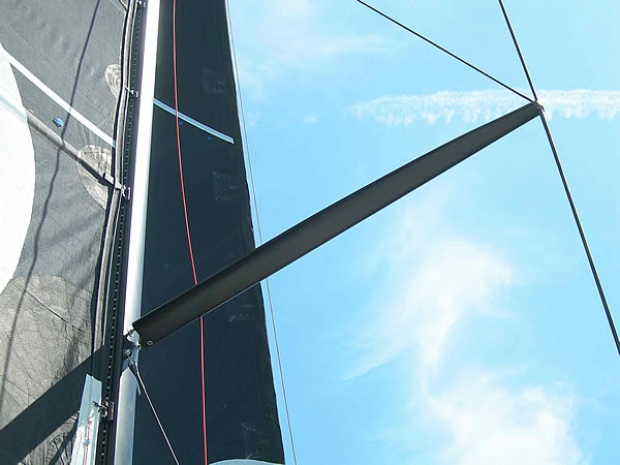
Element C6
Wednesday October 4th 2006, Author: James Boyd, Location: United States
Composite rigging is now commonplace on racing keelboats of all shapes and sizes in classes where it is allowed. Although significantly more expensive than rod, composite rigging is one third to one quarter the weight of its metal equivalent and as fitting it results in a considerable weight saving aloft it can make a significant difference to a yacht's righting moment.
While PBO has became the material of choice for standing rigging and runners, a key player in the market is now pushing hard with a new type of rigging made from our favourite material: carbon fibre.
After years working their way up to becoming one of the market leaders in composite (carbon fibre) masts and booms, Southern Spars in around 2000 began looking at diversifying into new markets relating to their existing business.
"The impetus for the whole thing started five or six years ago," states Scott Vogel. "The big rigging manufacturers you’d go to for Nitronic 50 rod, people like OYS, Navtec and PFI, weren’t really addressing the future of standing rigging which needed some sort of composite solution and we felt it was time, customers were asking about it and at that point there seemed to be no clear choice. So we did a bit of investigation and thought there was an opportunity for Southern Spars to increase the size of our supply and integrate more components of the whole engine above the deck. We looked around at what was available and what the emerging technologies were and felt that a carbon fibre-based solution was the way to go."
The new carbon fibre rigging, now known as Element C6, has been in development for around four years. A prototype set has been sailing around Auckland on a Farr 52 and been given a sound thrashing for at least three years and has stood up well, according to Vogel.
To move squarely into the rigging marketplace almost three years ago Southern Spars acquired Aramid Rigging in Newport, RI, one of the leading suppliers at the time of Kevlar rod rigging. In addition to their composite rod business, Aramid also included a chandlers and a service business. On acquiring it Southern Spars divided the business up, keeping the chandlers and running rigging business in Newport but setting up a new facility in Rhode Island to build their new carbon fibre standing rigging. The company, now a sub-division of Southern Spars, was rechristened Composite Rigging.


So what's so flash about carbon fibre compared to PBO? Vogel, who runs Composite Rigging (and is also an America's Cup veteran having been part of OneWorld and before that Dennis Conner's Stars & Stripes campaign at a time "when it was more of an adventure than a job") explains: "Carbon is a base element - there’s not that much more you can do with it - it has already been burned! So the fibre is pretty inert environmentally, it doesn’t really care about moisture or UV or any of that stuff which some of the other fibres have a problem with. It is pretty durable, has a high fatigue life, etc"
These are in fact the main advantages of carbon fibre compared to PBO as its physical properties, such as stretch, stiffness and strength, are very similar to PBO. "Longevity and durability and things like that - in those respects the carbon is far superior," says Vogel.
But in addition to the material, what makes Element C6 different to PBO rigging is that instead of comprising filaments wound around two bobbins which is then encapsulated, C6 comprises a bundle of carbon fibre rods each of around 1mm diameter. "The poltruded rods do a couple of things for you," explains Vogel. "For one it reduces the fatigue life of the carbon, because the fibres are not loose. They are not going to get damaged by compression or bending or chafe or things like that. It is stablised by the resin."
So why not make the rigging out of one solid carbon fibre poltrusion? The reason, as ever with composite rigging, is over the way to terminate it. Carbon fibre doesn't turn corners as readily as PBO and so the end of the carbon rods are splayed out and then encapsulated in an epoxy cone. This is then over-wrapped with carbon fibre to resist splitting forces.

"With a solid extrusion you can easily see in your mind making a single monolithic piece of rod rigging for a 30 footer, but imagine trying to scale that up to megayacht size," says Vogel. "The problem is that the amount of fibre in the rod goes up with the square of the radius of the rod but the surface area doesn’t - so how do you grab on to it all? With all these little rods it allows us to really grab on to every fibre in the bundle so terminating is a lot more scalable process."
Carbon fibre comes in numerous different flavours each offering different strength and modulus characteristics. For Element C6, Composite Rigging use the reasonably high modulus fibre T800. "It is very high strength but it has lower stiffness," says Vogel. "At some point having additional strength doesn’t add much to the performance side of things when it comes down to the stretch characteristics that drive the design. T800 is just better suited to sail boat rigging."
As so many people in the marine industry are finding, carbon fibre is at present extremely hard to get hold of in any quantity. Due to its properties, T800 for example is used a lot in the aerospace industry and is being bought up in bulk by Boeing for use in their new 787. Fortunately in comparison to the demand by a company like Boeing, most marine companies aren't big users. Fortunately Vogel says while supply is an issue, the price of carbon has remained reasonably stable.
As with PBO rigging the applications are enormous. Element C6 has been fitted to Alinghi navigator Mike Drummond's A-Class catamaran, although it is terminated in a different way, while at the opposite end of the spectrum it is also to be used on a 160ft schooner being built by Royal Huismann in Holland. "For the mega-yacht guys it is a way of making a significant change to not necessarily the performance of the boat, but to the design parameters of the boat," says Vogel. "On a boat this size [the 160 footer] we are going to save roughly 1,000kg in the rig. That then turns into quite a lot of displacement on the boat from a righting moment standpoint. It is a significant number which some guys like to use to increase the stability and some like to re-use in the displacement."
With Vogel's background in the AC, it comes as no surprise that four America's Cup teams are using Element C6, although this is only in the headstay, backstay and jumpers - composite standing rigging is still banned under America's Cup Class rules.
In terms of race boats Element C6 has been used on several US East Coast keelboats in the 60ft range like Numbers and the new Blue Yankee. It has also been fitted to the Swan 100 Fantastica and the Wally 94, Y3K and on Genuine Risk and the last water ballast Shockwave/ Alfa Romeo. Alex Thomson's Hugo Boss is the first oceanic race boat to fit it and as we mentioned in yesterday's article, has continuous rigging. "For a performance boat like that it makes a big difference," says Vogel as to why Hugo Boss's rigging is continuous. "It saves a big chunk of windage, weight and drag at the spreader tip. If you can imagine at the spreader tip you have three cables coming into it, it saves you three terminations and a cross pins or a tip cup to join it all together. So it is a pretty significant saving."
It will be interesting to see whether or not carbon fibre becomes the rigging material of choice ahead of PBO in the next few years. Certainly with Southern Spars behind it, Element C6 comes with considerable marketing clout.
Most Read
Most Commented
Comments
Businesses

Pro businesses
-
Netherlands
-
Italy
-
France
-
United Kingdom
Editor's choice
Member blogs
-
 Ned Collier Wakefield: MOD70 round BarbadosWell that was intense. 12 hard fought for seconds for the win. In idyllic conditions, Tony Lawsons MOD ...
 -
 Mini Transat leg 2 reportThe second leg of the Mini Transat started on 31st October, just over a month after ...
 -
Leg 1 reportI’ve been working towards the Mini Transat now for three years. In 2013 I was part ...
Business blogs
-
 The Island Sailing Club in Cowes, Isle of Wight, is delighted that Prince Michael of Kent ...
 -
Peta Stuart-Hunt chats with the 25 year-old British solo sailor Lizzy Foreman before she sets sail ...
-
The 2015 Student Yachting World Cup (SYWoC), an ISAF-recognised event hosted and run by students for ...
Editor's Choice
All time favourites...
-
 Three legs down into Ian Walker’s
 -
 Winning all but two races at
 -
 For the first time in its
Latest Comments
Add a comment - Members log in