
For sale: GBR Challenge - one careful owner
Tuesday February 15th 2005, Author: Andy Nicholson, Location: United Kingdom
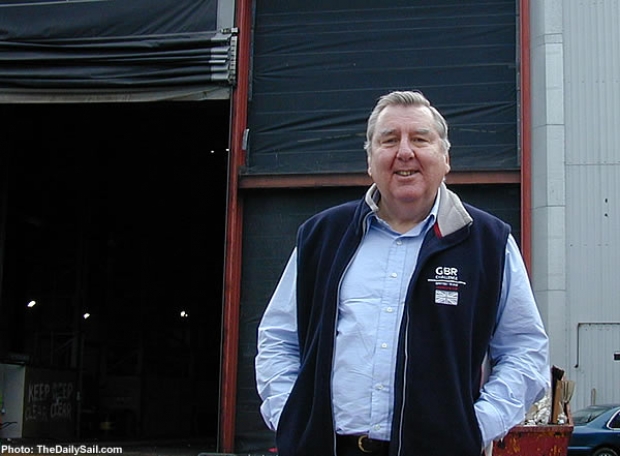
It was a rainy, dull February Friday in Cowes when TheDailySail spoke to Peter Harrison about the demise of his GBR Challenge. A drafty, disused shed in the old Souters yard seemed a long way from the glitz and the glamour of the America’s Cup.
Harrison was presenting his plans for the redevelopment of the 15 acres of land on the Medina River the Harrison Trust owns in Cowes, which also includes the former FBN boatyard used as the GBR Challenge base. The formal planning application has gone in and Harrison is preparing for an expected fight with the Isle of Wight Council over his proposal.
‘It’s not over until it’s over’ is one of the most common phrases used by sporting commentators and competitors alike, and there remains an element of this over the future of GBR Challenge.
An announcement was made in November that the team was to “suspend operations” and was, to all intents and purposes, the end of the road for Harrison’s financing.
In fact the final key date is the 29 April 2005, the absolute deadline for entries the 2007 America’s Cup and the costs of just filing an entry between now and then are not for the faint hearted. First up is a Euro 1,000,000 Performance Bond (which is refundable subject to specific tasks being completed – like competing), a Euro 50,000 payment to the Challengers Commission, and a US$50,000 payment to AC Properties (for trademark issues) and finally a Euro 200,000 late entry fee (which is levied on Challenges accepted after the first deadline of 17 December 2004).
So as Harrison first points out, it’s not yet over: “It is technically still possible if someone comes up with £10m between now and April to revive it.”
Since the team’s return from Auckland, GBR Challenge has continued to be fully financed out of Harrison’s own pocket and since April 2004 a further £3m has gone in (Harrison says that in total he has spent £26.5m on the campaign since its inception). How close was he to securing all the money required for another go? “I got Charles Dunstone willing to put up £15m,” says Harrison, “I was to put up £5m and we were talking to HSBC Bank and a number of other institutions for £10m. And in the middle of November HSBC bank withdrew.”
It has been clear from previous articles published on TheDailySail that Dunstone (owner of the Carphone Warehouse retail chain and owner of the maxi Enigma) was only in if the remainder of the full budget amount was committed.
Harrison is hugely disappointed with HSBC. "I was talking at the highest level with them.” Says Harrison, “Sir John Bond who is their Chairman Chief Exec turned me over to Peter Stringham, who is the Group Marketing Director. We had strong support from two of the major divisional heads in the Corporate Banking and Investment area, but the overall decision of where any company channels its sports sponsorship money is through the marketing department.”
HSBC had been courted for over 12 months and in the last four months of this period, says Harrison, they were down to the detail. What is the more astonishing is that Dunstone’s involvement started back in May 2004 and this still was not enough to influence HSBC’s marketing suits. “Charles and Carphone Warehouse is a major banking customer at HSBC, as I am,” says Harrison (their combined personal worth is estimated to be in the region of £600m+) “So I thought as two major customers we had got it cracked, but we hadn’t. I think they have made a mistake. It’s their money, it’s their choice, and they have all have missed a great opportunity.”
And what rubs salt into the wound even more is the HSBC sponsorship of the Oryx Quest. Harrison only comments that he is curious that they are “backing Tracy Edwards in the Doha thing.” Other sources suggest that following the embarrassing debacle over the HSBC Education Trust’s sponsorship of Graham Dalton, HSBC have been reluctant to back ‘teams’.
With the extraordinary events of the past week with Ellen MacArthur and B&Q, has he been tempted to pick up the phone again? “I did think of ringing the people we got into the final discussions with to say ‘well look at what Ellen has done are you going to reconsider?’ But I couldn’t bring myself to do it,” says Harrison, “because to some extent I am exhausted with it. I thought that what we had kick-started and achieved would be an inspiration to encourage others to join in. With the Cup now in Europe, in the same time zone, - two hours flying time from Munich, London and Paris to the event - it would really be worth it.”
Instead the GBR Challenge office is in the process of winding up and another ‘America’s Cup starter pack’ is up for sale.
Any syndicates that already have boats are unlikely purchasers. Under the America’s Cup Class rules a team can only own two ‘old’ boats. Thus the most likely candidates to buy the GBR Challenge assets will be a start-up team. A major difference over previous America’s Cups is that under the new Protocol for the 2007 event it has been possible to purchase a team’s design and R&D data - a change for this event.
The deadline passed in October 2004 allowing teams to sell just their data to others, without having to buy the assets as well,so the only real avenue open to Harrison now is a sale to a ‘boat less’ team and he says he has had some interest from Europe.
A purchaser would get a lot for their money, including all the data from the 2001-2 campaign, and the two years of subsequent work into Version 5 of the rule that was ‘suspended’ in November last year. Both GBR 70 and 78 have been matched in terms of hull shape and a lot a work has gone into sorting out the rig balance. Harrison says it is now just the appendages that differ, although GBR 78 is rumoured to have had her experimental forward canard removed.
“It’s massive,” says Harrison of the data gathered since the last Cup finished. “You would have all the CFD, tank testing, video footage and analysis. It is better to put it into years. It’s worth two years of work. In fact it’s worth even more than that because we had two years worth of work on the previous campaigns. You could re-recruit people who were part of my team who can immediately reinterpret that information.”
Harrison also presented a new idea to us. This strategy involves selling the whole lot to another British team, but not to compete in this Cup cycle, but the next.
Ignoring the fact that the next America’s Cup after this one could be in a completely different design of boat, in a new venue and with new rules, Harrison seems engaged with the idea of keeping it all for Britain.
“I would rather hope that an English syndicate would come along and buy what we have got, f not to use this time then for the next time. If you let them go the chances of a [British] syndicate starting something from a standing start again is not likely,” he says. “The last benefit to me is if I thought that sometime in the future a [British] syndicate would revive those assets, rather than have them gone to nought.”
And who would go for such a plan? “I have got an idea but I don’t want to say the name,” says Harrison. “We have to find somebody who is willing to take an entrepreneurial investment to say that: ‘I will buy this and have these [assets] next time round.’ If we are not going forward then I don’t want to hold onto these assets.”
What seems to be a more likely situation, if there is one, is that another British team – and there have been rumours of one – comes out of the woodwork. As long as the entry goes in before 29 April this year, it would then be a case of negotiating with Harrison about the purchase of the GBR assets. If the campaign was serious then one cannot in any way imagine the ‘new team’ not competing in the current America’s Cup cycle.
One thing as certain as it is shameful, is the personal commitment of two of Britain’s wealthiest entrepreneurs has not been enough to sway the board, and ultimately the shareholders, of corporate Britain.
Most Read
Most Commented
Comments
Businesses

Pro businesses
-
Netherlands
-
United Kingdom
-
United Kingdom
-
Editor's choice
Member blogs
-
 Ned Collier Wakefield: MOD70 round BarbadosWell that was intense. 12 hard fought for seconds for the win. In idyllic conditions, Tony Lawsons MOD ...
 -
 Mini Transat leg 2 reportThe second leg of the Mini Transat started on 31st October, just over a month after ...
 -
Leg 1 reportI’ve been working towards the Mini Transat now for three years. In 2013 I was part ...
Business blogs
-
 The Island Sailing Club in Cowes, Isle of Wight, is delighted that Prince Michael of Kent ...
 -
Peta Stuart-Hunt chats with the 25 year-old British solo sailor Lizzy Foreman before she sets sail ...
-
The 2015 Student Yachting World Cup (SYWoC), an ISAF-recognised event hosted and run by students for ...
Editor's Choice
All time favourites...
-
 Three legs down into Ian Walker’s
 -
 Winning all but two races at
 -
 For the first time in its
Latest Comments
Add a comment - Members log in