
Transpac 52 update
Thursday September 30th 2004, Author: James Boyd, Location: United States
Back in June we took
our first detailed look at the Transpac 52 class, the headline of the article being 'The New Big Thing?' It is safe to say that the question mark can be removed from this title as at present the class is going through the marine equivalent of a Christmas rush.
Recently Farr Yacht Design have announced four new commissions - three building at Cookson in Auckland - in addition to Bright Star, Sjambok and Esmeralda that were launched at Goetz Custom Boats earlier this year. One of these is a new Bribon for HM King Juan Carlos of Spain and two others, a new Caixa Galicia and Sirius are also destined for Spanish owners making the move out of IMS. According to Tom Pollack, the TP52 Class Association's Los Angeles-based Executive Director, around 17 examples will be sailing next year in the Mediterranean and US - possibly more.
There are any number of reasons why this rush is happening. Maybe it is simply that the class has emerged at the right time, when grand prix racing under IMS has come to the end of the road in most parts of the world and its death knoll is sounding even in Spain following the King's move into the new class. Certainly some owners such as Bright Star's Richard Breeden say they couldn't wait around for a new Grand Prix Rule to come into existence. The more pessimistic feel that the Grand Prix racing community has become so factionalised over the last two decades since the demise of IOR that agreement would never be fully reached over such a rule.
Pollack gives his views as to why the surge in interest in this class is suddenly taking place: "Guys who haven’t been active in yacht racing for 10 years have suddenly got excited by the prospect of owning a boat where there is longevity to it, where the rule doesn’t change every year from under your feet. Even the sponsors in Spain have got tired of buying a new IMS boat every year - that gets expensive. It is much cheaper to swap a fin and a bulb rather than it is to swap a hull. The IMS 50 footers are kind of like looking at 40 beautiful people on the beach, but they all have cancer - they are all going to die in two years.
"At the top end [of IMS] , the grand prix level, the solution was to produce larger LOA boats that were slower and slower. The Transpac 52 rule developed so there is no credit for a slow boat. And what we are really finding out is that there is no such thing as the perfect Transpac 52. There are certain ones you can shade a certain way and a lot of people like that challenge."
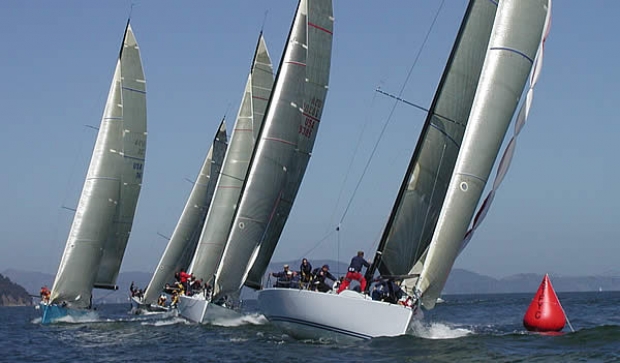
At the Rolex Big Boat Series in San Francisco, the west coast racing community got a first hand demonstration of why these boats are 'the next big thing'. There on one occasion Kenny Read on board the winner of the series, Esmeralda and Gavin Brady on Beau Geste found themselves about to pass each other on port and starboard, both boats sailing at 24 knots with a closing speed of 46-48 knots
"They were not sure who was going to pass and they crossed within a boat length of each other," Pollack takes up the story. "I think their eyes got really big and they both said ‘wow - we don’t do that every day’. So they loved it. All the pros loved it - Dee Smith and all those guys thought it was pretty cool racing. They go well upwind and they haul the mail downwind."
At recent owners' meetings at regattas including the Rolex Big Boat Series, a number of the issues that surround the class have been more or less resolved. In the US the majority want the class to be owner-driver, while in the Mediterranean they want it to be pro-driver. This potential split has been papered over.
Pollack explains how: "The Mediterranean guys said we’d like to have professional drivers and all the US amateur owner drivers said ‘yes, we think that is a great idea in the Med’. When we come over there we’ll bring our pro-drivers too. But if you come to Key West, or some other place in the US you have to play by the class rules. And the Mediterranean guys said ‘that’s fine’."
Whether the Mediterranean owners will make it beyond Spain or Italy remains to be seen. In addition to the three Spanish owners, Bottin & Carkeek have a new TP52 designed for Italian Alessandro Pirera, who this year has been campaigning the Farr 53 Orlanda Olympus with Tommaso Chieffi driving. (More on this new boat tomorrow in our interview with Shaun Carkeek). Greek keelboat veteran George Andreadis is looking for a builder for the fourth of the new generation Farr TP52 designs and an Irish owner is said to have signed up with Reichel Pugh for a new design. King Harald of Norway is said to be considering a new TP52 Fram and Britain's Peter Harrison went to the expense of sending a representative over to the owners' meet in San Francisco recently. Further afield an Australian owner has a build slot for a TP52 at DK Composites in Malaysia.
At present the TP52 doesn't seem to be causing a whole scale migration from the Farr 40 class as some observers expected. The only Farr 40 owner who has confirmed to us that he is heading for the Transpac 52 is Peter de Ridder with a Judel-Vrolijk design, but this will not be until the 2006 season.
"There are a lot of people giving the class a hard look," says Pollack. "As I tell the owners - this is not the Farr 40 class and it's not the maxi 80ft class. It’s somewhere in the middle. You’re not necessarily going to finish first and you’re not going to have fibreglass widgets. You can pick the parameter you’re going to go the most on and build a boat to that. And that has a certain attraction to people."
One suspects that due to their local sponsorship arrangements the Spanish boats will not want to sail that far away from Spain although Pollack hopes that come 2006 when the fleet should be swelling in the States he will be able to coax the Med fleet over to Key West as what else is there to do in the Mediterranean at that time of year?
This year the Med fleet looks set to be joined by possibly as many as three boats from the States including Roger Sturgeon's Rosebud, possibly Bright Star and another US boat yet to reveal itself.
The attraction is that the Mediterranean TP52 circuit is now formalised starting with Punta Ala in early June, followed by the Trofeo SM La Reina in Valencia in early July, the Trofeo Breitling in Portals, Majorca at the end of July. Then there is the Copa del Rey in August before the boats head back to Sardinia for a one design classes regatta to be held the third week in September.
While it is expected that the boats will be largely pro-driver, a trophy will be presented to the top amateur driver at each of these regattas.
Another point of contention was that the US owners were known to want to sail more offshore races than the Mediterranean owners. The latter party have now agreed that their circuit will be 75% windward-leewards and 25% offshore or coastal. Uniquely the Med Circuit will be scored by races sailed rather than by events. The season includes 43 races, 32 windward-leeward, two offshore races (counting for double points) and seven coastal races. One discard will be allowed for every ten races sailed, but only one offshore or coastal race can be discarded. An equivalent hasn't been formalised for the US circuit, but Pollack expects the inshore/offshore proportions to be similar.
Cleverly legislation of this kind should go some way in preventing boats being optimised for inshore or offshore racing. However this makes it difficult to stage a World championship event for the class. What is likely is that the class will end up with a World championship series instead - like an enlarged international version of the Med Circuit, and due to the numbers won't exist before the 2006 season.
"When you talk about a World Championship is that you have to decide what that means," says Pollack. "Would a World Championship be a buoy regatta or an offshore regatta? I’m not going to say we’re going to have the world championships in one location, because people will turn up in boats built for that location and people who don’t feel competitive won’t go. So why do that?"
At the owners' meeting in San Francisco a weight limit for the crew was set at 2,800lb. If owners are not present at weigh-ins a default weight will be set for them. While items such as the race schedule is sorted out at these owners meetings it is harder to get class rule changes passed. These have to be sent around in writing 90 days before a class AGM and then they have been be agreed by 80% of the owners.
Pollack says that he has had little involvement in getting the TP52 class accepted in the 'bigger picture'. "The only agreement I had with US Sailing was that they are going to come up with a Grand Prix rule not us. That sounds like a great idea, but I am selfishly devoted to building this class, not to build this class to go racing under IRC or a new Grand Prix rule. This class exists on its own. I think that is what people have seen and that’s why people are buying the boats. They are thinking with their feet. They said ‘that’s cool’ - I can build a boat and I can fit my boat in a box and I can go anywhere in the world and race and that’s great. If the boat ends up with a standard IRC rating that’s great. They have given them a standard PHRF rating. The IMS ratings are all very similar, with just a few seconds a mile between them. But I don’t think about that. I try and get as many owners on the same starting line as possible that are happy and that are in the box."
Come the 2006 season Pollack expects the growth to continue exponentially as owners such as Peter de Ridder, holding back from the first season to see where the class goes in its first year, join the party. Several sponsorship contracts on Spanish IMS boats are also expected to be up at the end of 2005, which along with the King of Spain having spent a season demonstrating his TP52 is certain to see more Spanish owners joining the class from the top end of the IMS circuit.
The TP52, Pollack says, has the advantage of selling itself. "It turns out that they are as fast as a 60ft boat going upwind and a 70ft boat downwind. So it makes sense that no one is going to build a boat between 45 and 65ft that isn’t a Transpac 52 because they are just so fast."
For sponsors in Spain, there is no longer the complex process of working out who has won on handicap. For 2005 the Mediterranean TP52s will be racing alongside the IMS but Pollack points out that while they may be starting with the IMS boats they certainly won't be finishing with them.
Looking forwards the only issue in our mind that the class have yet to address is the potential for one of the most impressive display of escalating costs. At present there is no limit on changing keels, appendages, rigs and sails and there is every possibility it will be necessary for shore teams to remode the boats substantially between regattas according to whether the format for the next race is more orientated towards windward-leewards than offshore/coastal.
Tomorrow some of the TP52 designers give their views on the class.
Most Read
Most Commented
Comments
Businesses
Pro businesses
-
-
France
-
Netherlands
-
United Kingdom
Editor's choice
Member blogs
-
 Ned Collier Wakefield: MOD70 round BarbadosWell that was intense. 12 hard fought for seconds for the win. In idyllic conditions, Tony Lawsons MOD ...
 -
 Mini Transat leg 2 reportThe second leg of the Mini Transat started on 31st October, just over a month after ...
 -
Leg 1 reportI’ve been working towards the Mini Transat now for three years. In 2013 I was part ...
Business blogs
-
 The Island Sailing Club in Cowes, Isle of Wight, is delighted that Prince Michael of Kent ...
 -
Peta Stuart-Hunt chats with the 25 year-old British solo sailor Lizzy Foreman before she sets sail ...
-
The 2015 Student Yachting World Cup (SYWoC), an ISAF-recognised event hosted and run by students for ...
Editor's Choice
All time favourites...
-
 Three legs down into Ian Walker’s
 -
 Winning all but two races at
 -
 For the first time in its
Latest Comments
Add a comment - Members log in