
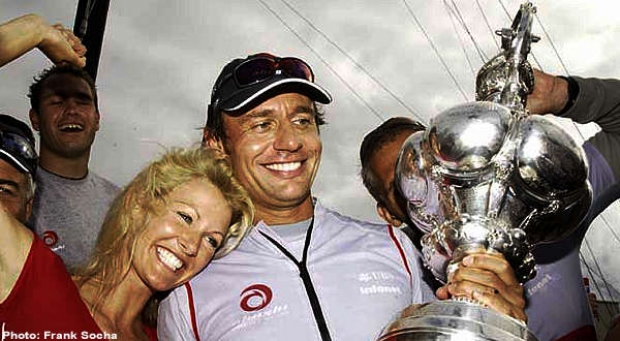
Why Alinghi won the Cup
Monday March 3rd 2003, Author: James Boyd, Location: Australasia
Over the last couple of weeks we published the reactions of many of the top players in our sport about the relative pros and cons of Team New Zealand and Alinghi, or their crew and their boats NZL82 and SUI64. At the end of the day two words summed up Alinghi's 5-0 victory: boat speed.
If there was ever a final test of the two boats and their teams then Sunday's final race was it - with a stable 12-15 knot northeasterly. These are supposed to be the typical conditions for Auckland in February/March, conditions for which the black boat was specifically built and in which many even up to the end expected her to be dominant.
As it transpired Alinghi outstripped NZL82 on the first beat, pointing higher and ekking out their lead metre by metre. There were no significant shift to help either team as there had been in race three. Yet by the time they reached the weather mark Alinghi had pulled out a 21 second advantage. From then on NZL82 didn't have a look in, a situation which was only marred when they broke their spinnaker pole towards the end of the second run. It was all over. Alinghi - the better boat, crew and team - had won.
Over the course of the Louis Vuitton challenger series and the America's Cup, Alinghi dropped just three races on the water, plus another they conceded to Prada in RR2 without sailing.
In our interview with Rolf Vrolijk, the Alinghi chief designer told us that the brief for the boat was to go like the clappers upwind. And their performance throughout the series has shown this trait of the boat's performance, particularly against TNZ82, where they consistently seemed able to sail a fraction higher yet at much the same pace as the Swiss boat. This seemed true regardless of the conditions.
Despite being good close hauled, SUI64 was no slouch downwind despite the Kiwi boat's much hyped 'hula'. Generally there seemed to be little noticeable difference between the two boats. In yesterday's race in supposed hula favourable winds, SUI64 seemed faster on the runs, despite being in the lead and TNZ trying both symmetric and asymmetric kites.
Conversely in the second race TNZ rolled Alinghi downwind, only to be outwitted tactically when the Swiss boat showed a remarkable turn of speed as she lured NZL82 up on to a tight reach and pounded past her to retake the lead.
But it was not simply SUI64 that was fast, it was the team driving her. The Alinghi crew were the supreme team. Coutts has never dropped an America's Cup race since 1995. This America's Cup has propelled him from being merely the world's top match racer to becoming a match racing legend with more Cup wins to his name than the previous holder Dennis Conner.
Alinghi's American grinder John Burnett who was previously a Stars & Stripes stalwart (sailing with Dennis Conner in 1987, 88 and 1992) believes there is much in common between the two AC greats. "Dennis would understand the priority of the moment and what is important - and it is the same with Russell. I think Russell is now recognised as the world class yachtsman that he is and there are a few sailors around who are close to his level in certain areas, whether it is starting or sailing the boat upwind or downwind or tactically or match racing. I think what people realise now is that he is also a good campaigner and he is a very good manager. He understands this game very thoroughly - it is a lot more complicated than when we used to sail 12m."
But Coutts would be the first to admit that there was more than just him on board. Sailing an America's Cup boat is probably the ultimate 'team' sport. There is no other sport which requires such prolonged concentration while working in harmony with your fellow crewmen. A better analogy is perhaps that of a top symphony orchestra.
Coutts' afterguard was exceptional. In addition to his former Team New Zealanders Brad Butterworth and Murray Jones there was Ernesto Bertarelli and triple Olympic Gold medallist Jochen Schuemann. Bertarelli was navigator keeping the crew updated about where they were on the race course and how this would be affected by shifts. Jones was chief wind spotter. Butterworth concentrating on boat for boat tactics with Schuemann providing additional input on all these areas. All would feed information to Coutts.
Meanwhile Coutts would concentrate on working with his 'speed team' to ensure that SUI64 was constantly performing to its target boat speed. One of the keys to Alinghi's boat speed and her manoeuvring was certainly Coutts' lengthy relationship with trimmers Simon Daubney and Warwick Fleury, who - proudly - have along with Murray Jones sailed one more consecutive America's Cup race than Coutts has. Sailing constantly with his trimmers over this length of time it is easy to imagine that they have near perfect communication although language, between Kiwis or Americans and English speaking Europeans was one of the early problems encountered by the sailing team.
Equally impressive was the managerial side of the team led by Executive Director Michel Bonnefous. It is telling that both Oracle and Prada reportedly spent more (in excess of $100 million) on their campaigns while Alinghi is believed to have spent somewhere in the order of $80 million, about the same amount as OneWorld, despite having the biggest base on syndicate row. This suggests that they were more targetted in their approach to their challenge and unquestionably this came from the level of experience within the team. Their style, seemingly in every aspect of their campaign has been nothing but slick and efficient and truly they are the blue print for an aspirant AC teams in the future.
Conversely Team New Zealand lacked in many areas. While their sailing team was superb by most standards, it was green in America's Cup terms with 'old hands' on board in the form of Mike Drummond, Peter Evans, Tony Rey, Grant Lorentz and Barry McKay and significantly no Tom Schnackenberg nor Joey Allen on the bow.
NZL82 was in the ball park but never showed the speed advantage much talked about prior to the start of the AC. Did the hula work? Probably - it is likely that without it her performance would have been quite ordinary. The only noticable affect of the long keel was that she overshot SUI64 in the one dial up in the series (which was surprisingly non-confrontational considering) and possibly showed fractionally less inclination to pitch sailing upwind.
Obviously NZL82's worst tendency was to break. While Alinghi had a damage free Cup and Louis Vuitton series, NZL82 broke her boom and her headsail tack ring in the first race and dismasted in race four - both races held when the wind was reasonably fresh. To observers she looked like she had never been raced in anger in strong winds, a challenge refuted by Barker. Many were describing her as a 'designer's boat' and clearly if during training they had given the boat a thrashing, or deliberately gone out to try and break it, they would have uncovered these areas of weakness sooner.
Generally both Kiwi crew and boat seemed unprepared for the America's Cup. It would have been interesting to see what the outcome of the America's Cup would have been had NZL82 and her crew been allowed to take part and work themselves up in the Louis Vuitton challenger series.
We shall never know.
Tomorrow the new Protocol for the America's Cup will be announced and there is talk of much change. We will be posting the news about this as soon as it happens.
Most Read
Most Commented
Comments
Businesses

Pro businesses
Editor's choice
Member blogs
-
 Ned Collier Wakefield: MOD70 round BarbadosWell that was intense. 12 hard fought for seconds for the win. In idyllic conditions, Tony Lawsons MOD ...
 -
 Mini Transat leg 2 reportThe second leg of the Mini Transat started on 31st October, just over a month after ...
 -
Leg 1 reportI’ve been working towards the Mini Transat now for three years. In 2013 I was part ...
Business blogs
-
 The Island Sailing Club in Cowes, Isle of Wight, is delighted that Prince Michael of Kent ...
 -
Peta Stuart-Hunt chats with the 25 year-old British solo sailor Lizzy Foreman before she sets sail ...
-
The 2015 Student Yachting World Cup (SYWoC), an ISAF-recognised event hosted and run by students for ...
Editor's Choice
All time favourites...
-
 Three legs down into Ian Walker’s
 -
 Winning all but two races at
 -
 For the first time in its
Latest Comments
Add a comment - Members log in