
What is an IMS 600?
Thursday February 28th 2002, Author: Peter Bentley, Location: None

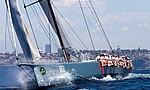
Beneteau 40.7 - an IMS600 contender
Amidst the gasps of surprise when it was learned that the Admiral's Cup was moving to Ireland, there was little discussion of the IMS600 class when the new format for the event was announced. Perhaps this was not surprising. Though described as a 'class' the current state of the IMS600 is in reality little more than a set of proposed rules. The man charged with getting the show on the road, Chairman of the ISAF Offshore Classes and Events Committee, Don Genitempo admits as much. "We are still in a fledging state," he says. "The first championship will be in October and we are sort of still feeling our way."
The intention is for all boats to have a General Purpose Handicap (GPH) of between 595 and 615 seconds per mile. Results will still be calculated using IMS scoring so it's not a level rating handicap system in the same way that the 'Ton' classes were under IOR. The exact method of scoring will be up to individual race organisers. Within the confines of IMS there are plenty of different ways of doing this.
With such a narrow band of handicaps, the extremely complex 'performance curve' scoring that caused so many problems in the 1999 Admiral's Cup will probably not be required. Conversely, a simple single number system similar to that used under IRC runs contrary to the ethos of IMS. Whatever system of scoring is used, it seems unlikely that individual navigators will be able to calculate 'rolling' results as they proceed round the course.
Like the Admiral's Cup itself, quite where the class will end up, seems rather unclear. The preamble to the rules initially states that, 'the IMS 600 is an offshore Cruiser/Racer rated under the International Measurement System' but then goes on to say, 'to foster competition at the highest levels of the sport'. If like me this leaves you confused, then clarification comes later in the rule when the rules' intention to generate an essentially Corinthian class is made clear with a limit on professional crew.
Due for ratification during the class' inaugural Championships in Spain this October, the rules have been defined to encompass a huge range of production cruiser-racers. At least five boats of a given design must have been completed, launched and certificated before they can qualify as an IMS600. Alternatively hulls with an age date (the age date changes when a hull is modified) older than six year may be eligible if they meet a number of other criteria. The prospect of some pretty old boats competing in Dublin next year is thus far from fanciful.
Hulls, decks and interiors must be retained in their original condition, though the owner is free to make modifications to the rig, keel and rudder. And here's the rub. Such are the complexities of the IMS rule, that venue-specific tuning is all but essential. Potential owners looking to win the Admiral's Cup will almost certainly be looking at some serious keel and rig modifications to optimise their boats for the inshore series and Round Ireland race.
And those looking to the inaugural class championships in October as a guide to the form for Dublin need to exercise caution. The boat that wins in the Mediterranean may not be the best tool for the job come July 2003.
So exactly what boats will be in Dublin for the Admiral's Cup? Current stalwarts of the Cruiser/Racer fleet such as the IMX40 and the Beneteau 40.7 top the list right now. But if serious interest does develop in the Admiral's Cup, you can be sure that something a little more specialised will come along.
Though it is far from clear that there will be serious professional interest in the new event, if there is, expect the Cruiser/Racer aspect of the rule to be pushed pretty hard. If the event runs at a lower level, it seems reasonable to expect some well tricked-out standard production boats with highly optimised keels and rudders. The chances of winning with a standard rig seem slim indeed.
As might be expected the IMS600 shares the strengths and the weaknesses of the IMS as a whole. In their effort to be inclusive, one can understand why it has been chosen for Admiral's Cup by the RORC. The wider implications are however harder to assess. Though clearly delighted that one of the ORC's classes has been chosen for the Admiral's Cup, Genitempo is concerned about the pressure that such high level competition may have. Accepting that such pressure will lead to a need for tightening and changes of the rule, he candidly admits, "you can't expect us to get everything right straight out of the box".
Most Read
Most Commented
Comments
Businesses
Pro businesses
-
Italy
-
-
Netherlands
-
France
Editor's choice
Member blogs
-
 Ned Collier Wakefield: MOD70 round BarbadosWell that was intense. 12 hard fought for seconds for the win. In idyllic conditions, Tony Lawsons MOD ...
 -
 Mini Transat leg 2 reportThe second leg of the Mini Transat started on 31st October, just over a month after ...
 -
Leg 1 reportI’ve been working towards the Mini Transat now for three years. In 2013 I was part ...
Business blogs
-
 The Island Sailing Club in Cowes, Isle of Wight, is delighted that Prince Michael of Kent ...
 -
Peta Stuart-Hunt chats with the 25 year-old British solo sailor Lizzy Foreman before she sets sail ...
-
The 2015 Student Yachting World Cup (SYWoC), an ISAF-recognised event hosted and run by students for ...
Editor's Choice
All time favourites...
-
 Three legs down into Ian Walker’s
 -
 Winning all but two races at
 -
 For the first time in its
Latest Comments
Add a comment - Members log in