
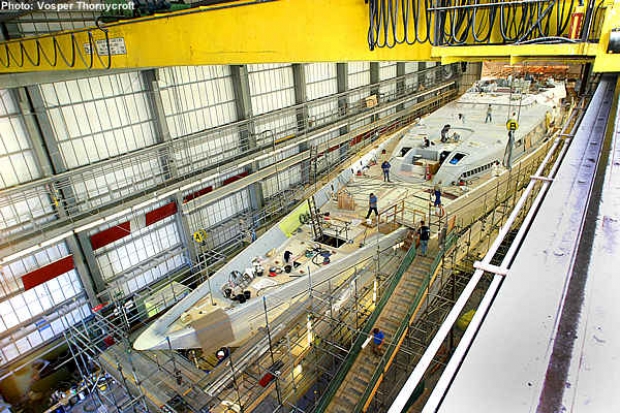
Nearing completion at the Vosper Thornycroft yard in Southampton
Mirabella V
Tuesday October 21st 2003, Author: Andy Nicholson, Location: United Kingdom
Mirabella V already has an entry in the latest Guinness Book of Records; her mast is the tallest carbon fibre structure in the world. One imagines that she may well end up with an entire chapter to herself.
When it comes to superlatives, the new Mirabella V has more than any other sailing yacht built in recent history. She is simply the biggest composite sloop ever built. A good place to start is with her vital statistics.
LOA: 247ft (75m)
Beam: 48.5ft (14.8m)
Draft: 33ft (10m), keel down
Mast Height: 290ft (88.5m)
Displacement: 800 tonnes, fully laden
Mainsail: 16,760sq ft (1,557 m2)
Genoa: 19,730sq ft (1,833 m2)
Staysail: 8,915sq ft (828 m2)
In the world of charter yachts, where Mirabella V is to live, one of the key parameters of design is ensuring that the yacht can fit under all the important bridges on the main shipping thoroughfares around the world, thus ensuring swift passage to all the key cruising grounds. However, due to the design direction taken by owner Joe Vittoria, owner of the Avis car rental company, the yacht will now sail under the slogan ‘Too big to fit under any bridge in the world’.
Originally conceived as a 200ft day sailor the commission was given to eminent designer Ron Holland. Initial designs included building a mast with a movable masthead, which could drop down, thus allowing the yacht under the all important Panama Canal Bridge and out into the Pacific. With the yacht’s overall length being stretched to an a final resting place of 247ft, and the owner’s strict instructions to keep the sloop rig, Mirabella V will now have to round the Capes to venture into new oceans.
While something of a statement by her owners, Mirabella V is also very much a business proposition in the private yacht charter market, a market that is growing at a rate of 10% year on year. The yacht has cost US$40m to build, which equates to standard running costs per season of US$4m (based on the 10% rule). With charters for 12 guests already being sold for US$250,000 a week, maybe the business side will add up in the same way as Ron Holland’s mathematics have.

The yacht has been built at Vosper Thornycroft in Southampton, better known for building minesweepers for the Navy than taking commissions from wealthy individuals. This choice was down to several factors, including experience with composites (on the minesweepers), a large enough facility and ability to deliver to the determined construction deadline. Holland cannot praise the yard strongly enough stating that “No one in the world could have delivered in this time frame.”
Mirabella V is due to be launched at the end of November, she will then go round to Portsmouth for her keel to be ‘attached’ and her rig stepped. Sea trials are expected to take place early next year before she embarks on her first charter season in the Mediterranean.
Holland is the first to admit that he does not know every piece of the jigsaw and on a project like this many different companies are part of the team. Many of the suppliers of equipment to the boat have had to go back to the drawing board, because of the scale involved.
The hull has been built using seven external laminates in a female mould, this has the benefit of reducing the amount of fairing required. There are four layers of E Glass and three layers of Kevlar over a PVC foam core, with four layers of E Glass on the internal side. Carbon fibre has been used in highly stressed areas. The superstructure was again made using a female mould but is mostly carbon. The reason for this is to provide sideways stiffening to the yacht.
The mast has been designed by High Modulus (who have also done the structural engineering on the hull) and has been a major feat of engineering and problem solving. Over 13,000 sqm of carbon laminate has been used in the construction at VT Halmatic’s yard in Portsmouth. The rig has been designed so that if any part of the rigging needs to be removed, for inspection or repair; it can be done with the mast still stepped. The V1 rod shroud alone weighs 1.1 tonnes. When the mast is stepped in Portsmouth later in the year they will use three cranes. Two will juggle with the mast; another will look after the headfoils and furlers. The Genoa furler alone weighs three tonnes. The carbon fibre boom is 28 metres long and weighs three tonnes. The sheave in the end of the mast for the reefing lines has more carbon fibre in its construction than a Formula One racing car.
Only the UPS (light wind reacher) sheet can touched by the human hand. When it comes to off-the shelf winches, the shelf stops at the 18-20 tonne load. For Mirabella V a specialist engineering firm in Germany was brought in to manufacture hydraulic captive winches for the maximum 40 tonne loads calculated for the rest of the running rigging.
However, herein lies another design conundrum. What rope are you going to use? None exists which will have a suitable diameter for the 40 tonne load on the sort of winch that was being designed. Back to the drawing board for the rope manufacturers. Knowing that they have to come up with something in the 32 to 34 mm range. What they came back with in the end was a rope which, when tested broke at 108 tonnes.
Although the mast height on Mirabella V may restrict her movements, draft-wise she has an almost ‘go anywhere’ set up. The 150 tonne keel has a lifting mechanism that will reduce her draft from a submarine twanging 10m to a more respectable 4m, enabling her to enter most of the important cruising ports around the world. Built out of steel, with a lead bulb, the keel will lift up and down on hydraulics. Fitting the keel will take place in dry dock, with the bulb positioned on the dock floor, the yacht then manoeuvred into position above and then the steel fin lowered from above, through the keel box and down to meet the bulb, where the two will be joined together. With the keel fully retracted the top of the foil will actually poke out just proud of the top of the superstructure. The keel will also be held fore and aft by hydraulics, with the aft end of the keel box designed as a crash zone. Running a boat like this aground doesn’t bear thinking about.
Design of the sail wardrobe also began with new blank sheet of paper. Doyles have been busy figuring out just how to build the sails and then fit them. The yacht has three headsails, a UPS, a genoa and a staysail, all on their own foils and furlers. The mainsail is one of the most ingenious bits of design, with the sail being made up of panels, which will then be ‘laced’ together at the battens. Imagine a curtain pole with two ‘tab top’ curtains, one joining from the top and one from bottom. The battens have a ‘shock absorber’ system, which helps to tension the join between the panels - they also compress during tacks to help bring the main through and set it on the other side.
Mirabella V is very much a sailing yacht, albeit on bewildering scale. Weighing in at 800 tonnes she will need a fair bit of sail area to get her going, but then will need to start taking this in as she gets up to full speed in any reasonable amount of true wind. Ron Holland’s office predicts upwind speeds of 12-14 knots. Like an Open 60, she will not be able to tack with the main fully up because of the backstay arrangements. The first reef is a single line on a captive reel winch - so a case of pressing the button, putting the reef in, tacking, then taking the reef out again. The second reef goes in at 25 knots true, with the two reef lines being taken down by the biggest commercial winches available.
While sailing along, Mirabella V will be ‘programmed’ not to scare her guests too much. Racing boats go upwind quite comfortably at about 27 degrees of heel - Mirabella is designed to sail at 15 degrees with all the sheet winches ready to start easing automatically if she goes over to 20 degrees. The owners have as one of their concept priorities that the yacht sails well and gives her guests a pretty unique experience. On the top bridge deck the two-part mainsheet comes down to winches on each side of the cockpit, this does mean that on a reach there will be a considerable amount of loaded mainsheet sweeping across the deck. The UPS headsail sheets to the aft quarter and will be trimmed ‘by hand’ on the biggest Harken winches available. Guests will be able to look up and trim a 16,000 sq foot sail.
The main helm positions have completely duplicate controls. Included in the huge range of fingertip controls are several screens for chart plotting, radar, boat systems. Displayed on one of these will be CCTV footage from inside the mast - focussed on the halyard locks for the sails. Just behind the helm stations is a built in BBQ, and in front a fixed table with seating for sixteen.
The lower aft deck has more seating and dining space, this time the two tables are hydraulically controlled. From here you can walk down the steps to the transom garage, which will have all the toys. The yachts’ two main tenders come out of the foredeck; the wells then become a pool and a jacuzzi.
The interior is very much in the superyacht style. On the main deck there is another dining room and relaxed seating, further forward is the ‘bridge’, and in front of that the owners suite. Below the main deck are the six guest cabins, with the crew accommodation and kitchens etc stretching up into the distance. Guests will be comforted to know that they will probably be only four metres away from a plasma screen at any one moment. One last statistic for you – there is 54 miles of cabling onboard.
Joe Vittoria has certainly created something unique with new Mirabella V. Seeing the yacht under sail will be one of those ‘must tick the box’ experiences for any sailor.
More pictures on the following pages

Most Read
Most Commented
Comments
Businesses

Pro businesses
-
France
-
Netherlands
-
Italy
-
Editor's choice
Member blogs
-
 Ned Collier Wakefield: MOD70 round BarbadosWell that was intense. 12 hard fought for seconds for the win. In idyllic conditions, Tony Lawsons MOD ...
 -
 Mini Transat leg 2 reportThe second leg of the Mini Transat started on 31st October, just over a month after ...
 -
Leg 1 reportI’ve been working towards the Mini Transat now for three years. In 2013 I was part ...
Business blogs
-
 The Island Sailing Club in Cowes, Isle of Wight, is delighted that Prince Michael of Kent ...
 -
Peta Stuart-Hunt chats with the 25 year-old British solo sailor Lizzy Foreman before she sets sail ...
-
The 2015 Student Yachting World Cup (SYWoC), an ISAF-recognised event hosted and run by students for ...
Editor's Choice
All time favourites...
-
 Three legs down into Ian Walker’s
 -
 Winning all but two races at
 -
 For the first time in its
Latest Comments
Add a comment - Members log in