
Left, right or centre?
Thursday March 14th 2002, Author: Peter Bentley, Location: Transoceanic
Positions at 10.00 14 March 2002

|
Yacht | Latitude | Longitude | DTF | DTL | DTL-C | CMG | SMG | PO |
| 1 | Assa Abloy | 08 54.44S | 034 41.44W | 3470 | 0 | 0 | 12 | 7 | 28 |
| 2 | Tyco | 08 56.88S | 034 41.48W | 3473 | 3 | 1 | 12 | 6.9 | 25 |
| 3 | illbruck | 08 57.44S | 034 41.16W | 3473 | 3 | 1 | 12 | 6.8 | 35 |
| 4 | News Corp | 09 22.48S | 035 01.16W | 3501 | 31 | 15 | 20 | 4.4 | 24 |
| 5 | Amer one | 09 40.76S | 034 49.40W | 3517 | 47 | -12 | 13 | 8.8 | 26 |
| 6 | djuice | 09 44.12S | 034 46.80W | 3520 | 50 | -13 | 19 | 9.3 | 20 |
| 7 | Amer Too | 09 48.24S | 034 49.00W | 3525 | 55 | -17 | 12 | 10 | 9 |
| 8 | SEB | 09 49.80S | 034 43.40W | 3526 | 56 | -18 | 13 | 10.2 | 13 |
Assa Abloy, Tyco and illbruck now spearhead the Volvo Ocean Race fleet as they continue to press towards the equator. With all three boats are in sight of one another the strategic battle is compliments by a shorter term tactical competition and no one is giving an inch. Describing it as, "The closest ocean racing around," illbruck's Stu Bannatyne says, "never before at this stage in a leg have we had to be so concerned about keeping our air clear.
"This morning we had Assa Abloy camp on us and block our every move from 20 degrees below course to 30 degrees above course. They were determined not to give us any quarter. A bit odd really as we both lost a lot on all the other boats as they covered our every move. Eventually we slipped past them anyway so it was all a waste of time for them. One wonders if someone on board has a personal vendetta against us?
For Kevin Shoebridge and his crew on Tyco it's as much a battle against the weather as the other boats. "The last 18 hours have been dominated by cloud action," he says.
"We have been through numerous dark clouds, which bring with them unpredictable wind speeds and directions. Some boats have been hit harder than us by these. Amer Sports One and djuice have dropped back out of the lead pack by being caught under these clouds. There is no escape when these big clouds get in your path. Our plan has been to avoid them completely where possible otherwise try and get on the leeward side. At least this way you may get extra wind speed although from a different direction.
Assa Abloy, Tyco and illbruck have all set themselves up in the middle of the fleet with the Amer Sports boats, djuice and SEB all slightly to weather in the east. News Corp is continuing her more westerly route closer inshore and has reaped gains in all the recent position reports.
As the fleet approach Recife,the next turning point on the course, the consistent message coming from every boat, is just how hard the sailing is. While the freezing cold of the Southern Ocean may have been swapped for the boiling heat of the Tropics, the steady winds down south have also given way to unstable conditions which are testing the crews to the limit.
"Even when the going is good these boats are very demanding," says News Corp's Gordon Maguire. "In a single four-hour watch, the wind can shift through 100 degrees and vary in strength from 6 to 20 knots as the cloud formations play havoc with the gradient wind." Every change in wind direction or strength requires a sail change. More often than not the entire 'stack' has to be moved from one side to the other, an exhausting job at the best of times and all the more so in the heat of the tropical day.
The unpredictability of the weather is taking its toll in other ways too. With the navigators anxiously scanning the radar and internet for up to the minute weather information to guide them through the storm cells and the crew drinking huge quantities of fluid to keep them from dehydrating, the demands on the diesel powered generator are high. With every tack and gybe requiring the water ballast pump to be started up, it's easy to see how the demand for fuel has proved higher than expected. "That means cutting down on all energy to get on track with daily diesel use," says Roger Nilson from onboard Amer Sports One.
Aside from their preoccupation with the ever present clouds, the navigators have some big decisions to make about their approach to Recife and their crossing of the equator. Rounding Recife, the big decision is how far off to pass. Close in, the wind is hugely influenced by the land but every mile closer to the beach is essentially a mile saved in distance. Further out the wind might be more consistent, but at the expense of extra distance.
Strategic decisions further down the track also have to be considered. A left turn at Recife offers the shortest course to Miami, but the Northeast Trades are stronger further north and east. All the navigators will be studying the weather charts and running their routing programmes at double speed in order to try and make an assessment of the fastest route.

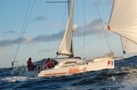
Neal McDonald steers Assa Abloy at Dusk
Most Read
Most Commented
Comments
Businesses
Pro businesses
Editor's choice
Member blogs
-
 Ned Collier Wakefield: MOD70 round BarbadosWell that was intense. 12 hard fought for seconds for the win. In idyllic conditions, Tony Lawsons MOD ...
 -
 Mini Transat leg 2 reportThe second leg of the Mini Transat started on 31st October, just over a month after ...
 -
Leg 1 reportI’ve been working towards the Mini Transat now for three years. In 2013 I was part ...
Business blogs
-
 The Island Sailing Club in Cowes, Isle of Wight, is delighted that Prince Michael of Kent ...
 -
Peta Stuart-Hunt chats with the 25 year-old British solo sailor Lizzy Foreman before she sets sail ...
-
The 2015 Student Yachting World Cup (SYWoC), an ISAF-recognised event hosted and run by students for ...
Editor's Choice
All time favourites...
-
 Three legs down into Ian Walker’s
 -
 Winning all but two races at
 -
 For the first time in its
Latest Comments
Add a comment - Members log in